
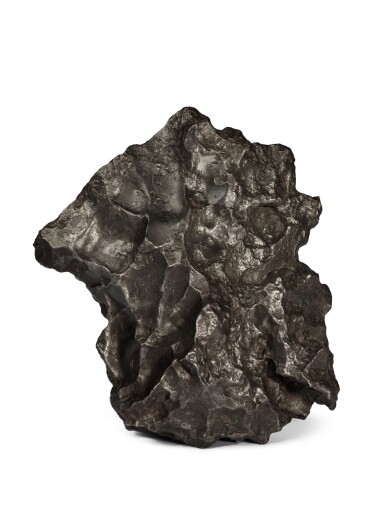
Sikhote-Alin Meteorite
From One of the Largest Witnessed Meteorite Falls
Auction Closed
July 14, 07:13 PM GMT
Estimate
15,000 - 25,000 USD
Lot Details
Description
Sikhote-Alin Meteorite — From One of the Largest Witnessed Meteorite Falls
Iron – IIAB
Maritime Territory, Siberia, Russia (46° 9' 36"N, 134° 39' 12"E)
Witnessed Fall on February 12, 1947
187 x 162 x 89 mm (7⅜ x 6⅜ x 3½ inches). 5.97 kilograms (13.16 lb).
A STUNNINGLY AESTHETIC PIECE OF ONE OF THE MOST IMPORTANT WITNESSED FALLS IN HISTORY
On February 12, 1947, a large meteor traveling approximately 9 miles per second soared across the Sikhote-Alin mountains in Russia's Far East, northeast of Vladivostok. Observed by many eyewitnesses, the "fireball moved from north to south and, at 10:38 a.m. local time, fragmented in the Earth's atmosphere. The debris covered an elliptical area of 1.6 square kilometers on the snow covered western spurs of the Sikhote Alin mountains."
The impact site was first discovered by a pair of pilots flying over the mountains; they had witnessed a meteor the day prior and had good reason to believe that the felled trees and craters they observed from above were the result. Reporting their find once they reached the town of Khabarovsk, the Geological Society of Khabarovsk organized a search party, eventually finding dozens of craters in an area of destroyed forest.
On April 27, a second expedition arrived from the Soviet Academy of Sciences, including the Soviet geologist E.L. Krinov. Krinov had cut his teeth working on the Tunguska Event impact site, and whereas the first group had only found shrapnel-like meteorites (see Lot 140), Krinov and his team found unfragmented pieces covered in thumbprint-like regmaglypts and bearing a fusion crust. Whereas the jagged and twisted shrapnel-like specimens resulted from a low-altitude explosion of the meteor, dimpled specimens such as this one broke free of the main mass in the upper atmosphere and acquired the aerodynamic regmaglypts (or "thumbprints") on their descent to Earth.
REFERENCES:
Meteoritical Bulletin Entry for Sikhote-Alin
Norton, O. Richard. Rocks from Space: Meteorites and Meteorite Hunters. Missoula, MT: Mountain Press, 1998, 100-109.