
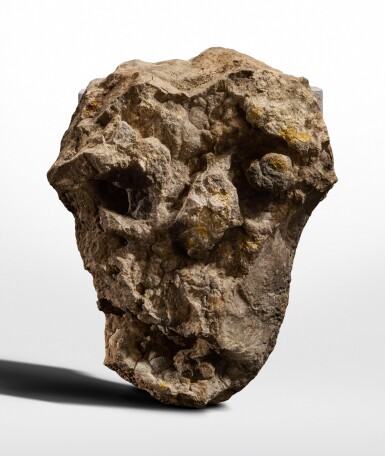
Paleolithic Limestone "Figure Stone"
Middle Paleolithic (approx. 150,000-50,000 years ago), Fontmaure, France
No reserve
Auction Closed
July 14, 07:13 PM GMT
Estimate
5,000 - 8,000 USD
Lot Details
Description
Paleolithic Limestone "Figure Stone"
Middle Paleolithic (approx. 150,000-50,000 years ago)
Collected from the Neanderthal site of Fontmaure, France
9⅛ x 7¼ x 4 inches (23.2 x 18.4 x 10.2 cm), 10 inches (25.4 cm) on a custom metal stand. 12 pounds (5.44 kg).
A naturally-formed limestone nodule of substantial mass, selected and worked to emphasise a strongly anthropomorphic appearance. A large cavity to one side suggests an eye, set within a broader configuration that evokes a face, with a projecting central ridge forming a nose-like feature and a recessed lower section suggesting a mouth. Areas of trimming around the edges appear to frame and reinforce these features, while the surface retains a heavily textured, weathered character.
Included in the lot is a copy of Tony Berlant and Thomas Wynn's First Sculpture: Handaxe to Figure Stone (Nasher Sculpture Center, 2018), where the present piece is illustrated.
Formerly in the collection of artist Tony Berlant (b. 1941).
With EU license 2025DMF0222 permitting export, issued by the French Ministry of Culture
First Sculpture: Handaxe to Figure Stone. 27 January - 29 April 2018. Nasher Sculpture Center, Dallas, Texas.
The Origins of Sculpture. 27 September 2023 - 7 January 2024. Benaki Museum, Athens, Greece.
Berlant, Tony, and Thomas Wynn. First Sculpture: Handaxe to Figure Stone. Nasher Sculpture Center, 2018, Cat. 60.
Galanidou, Nena, et al., editors. The Origins of Sculpture: Archaeological Finds from the Old World and Lesbos 2.5 Million to 50,000 Years Before Present. University of Crete/Benaki Museum, 2023, p. 264 (not illustrated).
A LARGE AND POWERFUL NEANDERTHAL FIGURE STONE WITH STRONGLY DEFINED FACIAL FORM FROM FONTMAURE
Recovered from the important Paleolithic site of Fontmaure in central France, this substantial limestone nodule belongs to a small and much discussed group of objects often described as “figure stones.” Unlike fully worked tools, such pieces appear to have been selected for their natural form and then minimally modified to emphasise suggestive imagery.
Figure stones have long occupied a controversial place in Middle Paleolithic archaeology. Once dismissed as detritus from Neanderthal sites, these often strikingly aesthetic and sculptural stones have received considerable reevaluation in recent years, as scholars have reconsidered the cognitive and representational abilities of Neanderthals, and thus reconsidered their ability to create and appreciate what we may consider "art" or "sculpture." Archaeologist Thomas Wynn, once a critic of figure stones as early attempts at aesthetic representation in Neanderthals, has since become one of the most forceful exponents of Neanderthal representational ability, as evidenced by his co-curation of the exhibition First Sculpture: Handaxe to Figure Stone at the Nasher Sculpture Center in Dallas in 2018, where this piece was prominently displayed.
The present example is notable for the strength and solidity of its form. A large cavity reads as an eye, offset within the composition, while a projecting central ridge and recessed lower area combine to create a clear impression of a face. The surrounding edges appear to have been worked to frame these features, reinforcing the overall configuration without obscuring the natural character of the stone.
As with other examples from Fontmaure, the interest lies in the relationship between recognition and intervention. The maker has responded to a naturally-occurring form, making selective adjustments that clarify rather than impose an image. The result is an object in which the boundary between natural creation and human action remains deliberately ambiguous.
Its inclusion in both the Nasher Sculpture Center’s landmark exhibition First Sculpture: Handaxe to Figure Stone and the Benaki Museum’s The Origins of Sculpture places it within a key group central to current discussions surrounding the origins of representation in early human history.
While interpretations necessarily remain open, the physical presence and clarity of form in this example set it apart. Pieces such as this suggest an early capacity to recognize and emphasize human-like forms within the natural world, offering a direct and compelling insight into the perceptual world of Neanderthals.