
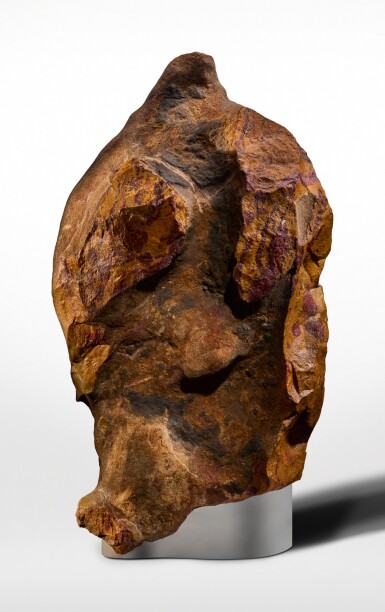
Paleolithic Jasper "Figure Stone"
Middle Paleolithic (approx. 150,000-50,000 years ago), Fontmaure, France
No reserve
Auction Closed
July 14, 07:13 PM GMT
Estimate
10,000 - 15,000 USD
Lot Details
Description
Paleolithic Jasper "Figure Stone"
Middle Paleolithic (approx. 150,000-50,000 years ago)
Collected from the Neanderthal site of Fontmaure, France
20⅞ x 12 x 9 inches (53 x 30.5 x 22.9 cm), 21⅛ inches (53.7 cm) on a custom base. 70 pounds (31.8 kg).
A large jasper nodule of irregular form emphasizing a strongly suggestive anthropomorphic figure. The composition is defined by projecting lateral forms that create a broad, rounded upper section, suggestive of breasts, above a more tapered lower body. Areas of deliberate shaping accentuate the form, while the surface retains rich variations in color and texture characteristic of Fontmaure jasper.
Included in the lot is a copy of Tony Berlant and Thomas Wynn's First Sculpture: Handaxe to Figure Stone (Nasher Sculpture Center, 2018), where the present piece is illustrated.
Formerly in the collection of artist Tony Berlant (b. 1941).
With EU license 2025DMF0222 permitting export, issued by the French Ministry of Culture
First Sculpture: Handaxe to Figure Stone. 27 January - 29 April 2018. Nasher Sculpture Center, Dallas, Texas.
The Origins of Sculpture. 27 September 2023 - 7 January 2024. Benaki Museum, Athens, Greece.
Berlant, Tony, and Thomas Wynn. First Sculpture: Handaxe to Figure Stone. Nasher Sculpture Center, 2018, Cat. 64.
Galanidou, Nena, et al., editors. The Origins of Sculpture: Archaeological Finds from the Old World and Lesbos 2.5 Million to 50,000 Years Before Present. University of Crete/Benaki Museum, 2023, Cat. 72.
A LARGE AND HIGHLY EVOCATIVE NEANDERTHAL FIGURE STONE, SUGGESTING A HUMAN – POSSIBLY FEMALE – FORM
Recovered from the important Paleolithic site of Fontmaure in central France, this imposing jasper nodule belongs to a small and much discussed group of objects often described as “figure stones.” Unlike fully worked tools, such pieces appear to have been selected for their natural form and then subtly modified to emphasize suggestive imagery.
Figure stones have long occupied a controversial place in Middle Paleolithic archaeology. Once dismissed as detritus from Neanderthal sites, these often strikingly aesthetic and sculptural stones have received considerable reevaluation in recent years, as scholars have reconsidered the cognitive and representational abilities of Neanderthals, and thus reconsidered their ability to create and appreciate what we may consider "art" or "sculpture." Archaeologist Thomas Wynn, once a critic of figure stones as early attempts at aesthetic representation in Neanderthals, has since become one of the most forceful exponents of Neanderthal representational ability, as evidenced by his co-curation of the exhibition First Sculpture: Handaxe to Figure Stone at the Nasher Sculpture Center in Dallas in 2018, where this piece was prominently displayed.
The present example stands out for its scale and presence, and for the strength of its overall composition. The broad upper section, with its pronounced lateral projections, gives the impression of shoulders or breasts, set above a narrower lower portion that suggests a torso. While the reading remains necessarily speculative, the visual association with the human figure, and in particular with a female form, is compelling. Comparisons have been drawn with later prehistoric traditions in which similarly emphasized forms have been associated with fertility or “mother goddess” imagery, though such interpretations remain open.
Fontmaure is well known for its distinctive jasper and for the large number of Paleolithic objects recovered from the site. Within this context, objects of this type are of particular interest, as they suggest that certain stones were selected not only for practical use, but for their visual and formal qualities.
Its inclusion in the Nasher Sculpture Center’s landmark 2018 exhibition First Sculpture: Handaxe to Figure Stone, where it was among the largest examples on display, and subsequently in the Benaki Museum’s The Origins of Sculpture, places it within a key group central to current discussions surrounding the origins of representation in early human history.
While interpretations vary, pieces such as this point toward an ability to recognize and emphasize forms within the natural world that resonate with the human figure. As such, they offer a rare and important insight into the perceptual and cognitive world of Neanderthals.