
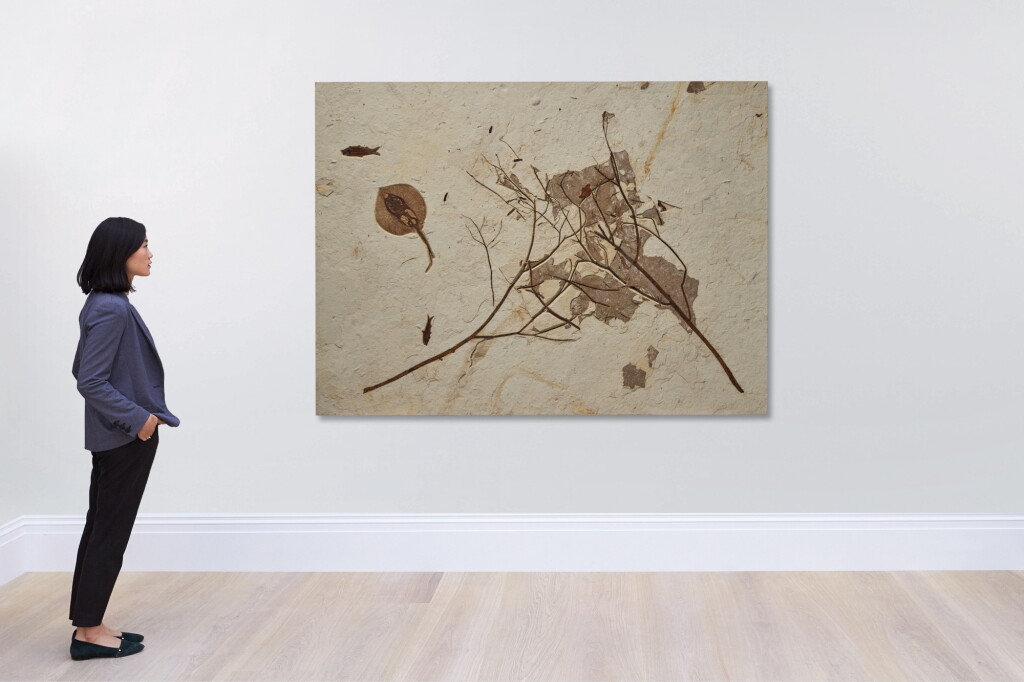
Fossil Branches With Stingray and Fish
Early Eocene (approx. 52-48 million years ago), Green River Formation, Lincoln County, Wyoming, USA
No reserve
Auction Closed
July 14, 07:13 PM GMT
Estimate
40,000 - 60,000 USD
Lot Details
Description
Fossil Branches With Stingray and Fish
Unidentified plants of unknown affinity, Heliobatis radians, Knightia eocaena
Early Eocene (approx. 52-48 million years ago)
Green River Formation, Lincoln County, Wyoming, USA
Presentation measures 65 x 48 x 2⅞ inches (165.1 x 121.9 x 7.3 cm), branch crossing upwards diagonally from left to right measures approx. 47½ inches (120.7 cm) in length, branch crossing upwards from right to left measures approx. 51 inches (129.5 cm) in length. Stingray (Heliobatis radians) measures 13½ inches (34.3 cm) in length. 210 pounds (95.3 kg).
The fish belong to extinct species of freshwater stingray (Heliobatis radians), and herring (Knightia eocaena), beautifully captured and preserved in a lake bottom scene with branches and leaves. This inspiring fossil is in very good condition and ready for wall display.
AN EXCEEDINGLY RARE PRESENTATION OF FOSSIL BRANCHES FROM THE FOSSIL LAKE OF THE GREEN RIVER FORMATION
Fossil branches of any appreciable size and level of preservation are extremely rare finds in the Green River Formation's Fossil Lake. The current display presents two large branches alongside a number of unidentified leaves, as well as one of the rarer fishes from Fossil Lake, Heliobatis radians, an extinct species of stingray.
Finding plant fossils in Fossil Lake is particularly challenging because they rarely have any thickness to detect during excavation. Thus, the only way branches such as these are discovered is when a layer of rock is fortuitously split in just the right place, or if it is exposed in the laboratory as another fossil is being prepared. As is the case here, many plant species from Fossil Lake remain unidentified due to the lack of diagnostic characteristics to place them in an existing family or order.
REFERENCES:
Grande, Lance. The Lost World of Fossil Lake. University of Chicago Press, 2013, p. 341.

