
Sold to Benefit the Veterans Transition Center of California and Its Mission to Help Formerly Incarcerated and Homeless Veterans
Chesley Bonestell
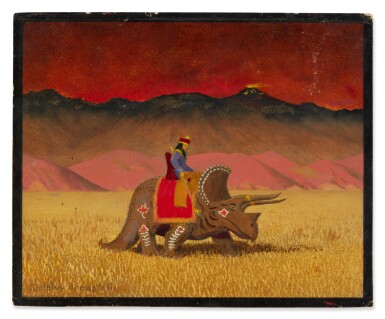
"The Emperor of Shangrila Rides a Triceratops Past a Volcanic Range" | A Rare Dinosaur Painting by the Father of Space Art, 1977
No reserve
Auction Closed
July 14, 07:13 PM GMT
Estimate
4,000 - 6,000 USD
Lot Details
Description
Chesley Bonestell — "The Emperor of Shangrila rides a Triceratops past a volcanic range," 1977.
Gouache on board, 9¼ x 7½ inches (23.5 x 19.1 cm), dated in pencil to verso, verso additionally titled in blue ink "The Origin of the Solar System" (indicating that Bonestell painted over an earlier piece, presumably a study for one of the illustrations in his 1961 bookThe Solar System. Unframed.
Miller, Ron & Frederick C. Durant III. The Art of Chesley Bonestell, 2001.
A RARE, UNPUBLISHED DINOSAUR SCENE FROM THE FATHER OF SPACE ART
The present work was one of a number of personal paintings Bonestell did in the last couple of decades of his life, which often featured fantasy characters riding dinosaurs; these works were never intended for publication.
Chesley Bonestell (1888-1986), a San Francisco native, executed his first space painting in 1905 after seeing Saturn through the telescope at the Lick Observatory. This first painting was destroyed in 1906, in the fire caused by the great San Francisco earthquake. His career began in architecture, and many iconic U.S. landmarks came to life from his designs, including the Art Deco façade and eagles of New York City's Chrysler building, the US Supreme Court building, the New York Central building, the Plymouth Rock Memorial, and the Golden Gate Bridge to name but a few. His work took on a whole new dimension when, at the age of fifty, he moved to Los Angeles, where he was to become the highest paid special effects artist in Hollywood (though his work went largely uncredited). The Hunchback of Notre Dame (1939), Citizen Kane (1941), and The Magnificent Ambersons (1942) all received their distinctive looks from Bonestell's brush and pen, and the buildings designed by Ayn Rand's architect superhero Howard Roark in the 1949 film The Fountainhead were by Bonestell.
It is no surprise that Bonestell’s interest in science fiction and space converged beyond strictly planetary scenes. In 1950, almost three decades before he painted the present lot, Bonestell illustrated an anonymous short story titled “Mr. Smith Goes to Venus” in Coronet Magazine. In the story, an American family travels to Venus and sees several wonders, including dinosaurs in the Venopolis zoo. Despite this precedent, there seem to be few examples of Bonestell’s paintings of dinosaurs on the market.
"Bonestell's paintings electrified a generation of teenage space enthusiasts: aspiring writers, astronomers, physicists, artists, and engineers... The late Carl Sagan said he didn't know what other worlds looked like until he saw Bonestell's paintings of the Solar System. Joseph Chamberlain, director of the Adler Planetarium, maintained that 'It might even be suggested that without Bonestell and his early space age artistry, the NASA era might have been delayed for many years, or it might not have happened at all'" (Miller & Durant).
Sir Arthur C. Clarke, who collaborated with Bonestell on Beyond Jupiter (1972), said that, "Chesley is the original Kilroy — he's been there ahead of them all. Neil Armstrong? Well, Tranquility Base was established over Bonestell's tracks and discarded squeezed-out paint tubes. The man not only moves across space, but also across time. He was present at our world's birth and has also set up his easel to paint its death..." (Miller & Durant).