
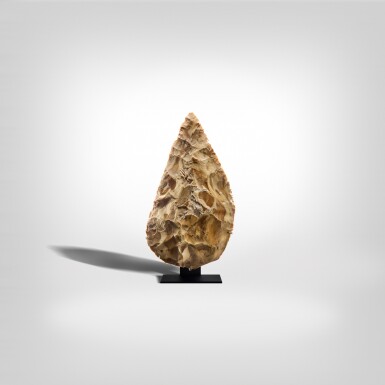
Acheulean Variegated Stone Handaxe
Lower Paleolithic (approx. 500,000-300,000 years ago), Saudi Arabia
No reserve
Auction Closed
July 14, 07:13 PM GMT
Estimate
7,000 - 10,000 USD
Lot Details
Description
Acheulean Variegated Stone Handaxe
Produced by Homo heidelbergensis
Lower Paleolithic (approx. 500,000-300,000 years ago)
Saudi Arabia
5⅞ x 3¼ x 1 inches (15.1 x 8.4 x 2.4 cm), 6⅝ inches (16.8 cm) on stand.
A finely worked handaxe of broadly cordiform type, expertly knapped from variegated stone, likely hornfels. The surface displays colored patches of cream and brown scattered evenly throughout. The axe is thin compared to many other Acheulean hand axes, evidence of delicate and skillful workmanship.
Included in the lot is a copy of Tony Berlant and Thomas Wynn's First Sculpture: Handaxe to Figure Stone (Nasher Sculpture Center, 2018), where the present piece is illustrated.
Formerly in the collection of artist Tony Berlant (b. 1941).
First Sculpture: Handaxe to Figure Stone. 27 January - 29 April 2018. Nasher Sculpture Center, Dallas, Texas.
The Origins of Sculpture. 27 September 2023 - 7 January 2024. Benaki Museum, Athens, Greece.
Berlant, Tony, and Thomas Wynn. First Sculpture: Handaxe to Figure Stone. Nasher Sculpture Center, 2018, Cat. 21.
Galanidou, Nena, et al., editors. The Origins of Sculpture: Archaeological Finds from the Old World and Lesbos 2.5 Million to 50,000 Years Before Present. University of Crete/Benaki Museum, 2023, Cat. 25.
A FINELY KNAPPED HANDAXE IN BEAUTIFULLY VARIEGATED STONE FROM SAUDI ARABIA
Among the earliest surviving artifacts made by our human ancestors, Paleolithic handaxes provide remarkable insight into the development of both technology and form. The present example is distinguished by the refinement of its workmanship, its delicate size and shape, and the care with which it has been shaped.
The flaking is especially skillful, producing a well-balanced handaxe with cleanly defined edges and a pleasing overall symmetry. Its relatively thin profile suggests a high degree of technical control, the result of careful and sustained working.
Part of the appeal of the piece lies in the stone itself. The variegated stone – likely a fine-grained, metamorphic rock known as hornfels – displays beautiful patches of cream and brown, which give the surface a striking visual texture. In a handaxe such as this, where material and workmanship are so closely aligned, the character of the stone forms an important part of the object’s appeal.
Examples of this quality from Saudi Arabia are of particular interest, as it places the piece within a broader geographic story of early human toolmaking, beyond the better known European and African locales.
Its inclusion in both the Nasher Sculpture Center’s landmark exhibition First Sculpture: Handaxe to Figure Stone and the Benaki Museum’s The Origins of Sculpture places it within a wider, contemporary discussion of the earliest forms of human toolmaking and tool use.