
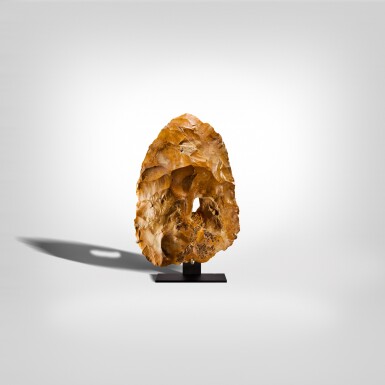
Acheulean Flint Handaxe With Hole
Lower Paleolithic (approx. 500,000-300,000 years ago), France
No reserve
Auction Closed
July 14, 07:13 PM GMT
Estimate
7,000 - 10,000 USD
Lot Details
Description
Acheulean Flint Handaxe with Hole
Produced by Homo heidelbergensis
Lower Paleolithic (approx. 500,000-300,000 years ago)
France
6 x 4⅛ x 1¾ inches (15.4 x 10.4 x 4.5 cm), 6½ inches (16.5 cm) on stand.
A finely worked flint handaxe displaying broadly ovate form, bifacially knapped and centered around a natural hole in the stone. The circular aperture has been deliberately preserved and integrated within the composition, creating a striking focal point. The surface is particularly well preserved, retaining areas of original deposits and displaying a warm yellow patina. The overall working is careful and balanced, with more recent collection marks and a tag on the base of the axe.
Included in the lot is a copy of Tony Berlant and Thomas Wynn's First Sculpture: Handaxe to Figure Stone (Nasher Sculpture Center, 2018), where the present piece is illustrated.
Formerly in the collection of artist Tony Berlant (b. 1941).
With EU license 2025DMF0222 permitting export, issued by the French Ministry of Culture
First Sculpture: Handaxe to Figure Stone. 27 January - 29 April 2018. Nasher Sculpture Center, Dallas, Texas.
The Origins of Sculpture. 27 September 2023 - 7 January 2024. Benaki Museum, Athens, Greece.
Berlant, Tony, and Thomas Wynn. First Sculpture: Handaxe to Figure Stone. Nasher Sculpture Center, 2018, Cat. 40.
Galanidou, Nena, et al., editors. The Origins of Sculpture: Archaeological Finds from the Old World and Lesbos 2.5 Million to 50,000 Years Before Present. University of Crete/Benaki Museum, 2023, Cat. 56.
A RARE PALEOLITHIC HANDAXE WITH A CENTRAL HOLE, FORMERLY IN THE COLLECTION OF ARTIST TONY BERLANT
Among the earliest surviving artifacts made by humans, Paleolithic handaxes provide a window into the development of material culture and the origins of technology. The finest examples, of which this is one, suggest not only technical expertise, but a sensitivity to form, balance, and the inherent qualities of the material.
This example is notable for the seemingly deliberate preservation of a natural hole at the center of the tool. As the hole would have introduced weakness and instability into the tool, it has been suggested by scholars such as Thomas Wynn that it must have been selected and retained for reasons other than function. Indeed, it appears to have been incorporated as a defining visual feature, around which the handaxe was then carefully knapped. The surface remains in an unusually good state with a warm, yellow-orange patina, indicating that this may have been considered a prestige piece more than an everyday tool.
Examples of handaxes exhibiting such clear engagement with natural features are rare. They occupy a distinctive place within the Acheulean tradition, where the maker has responded directly to the character of the stone, incorporating its natural properties into the final form rather than working against them.
Its inclusion in both the Nasher Sculpture Center’s landmark 2018 exhibition First Sculpture: Handaxe to Figure Stone and the Benaki Museum’s The Origins of Sculpture underscores its importance within this small and well documented group of objects. As part of the Tony Berlant Collection, assembled over decades and widely regarded as one of the most significant collections of its kind, the present work carries both scholarly and historical importance.
With the dispersal of the collection, objects of this type are rarely available. Fully published and exhibited, and belonging to a group that sits at the intersection of toolmaking and early aesthetic awareness, this handaxe stands as a particularly strong example of early human craftsmanship.