
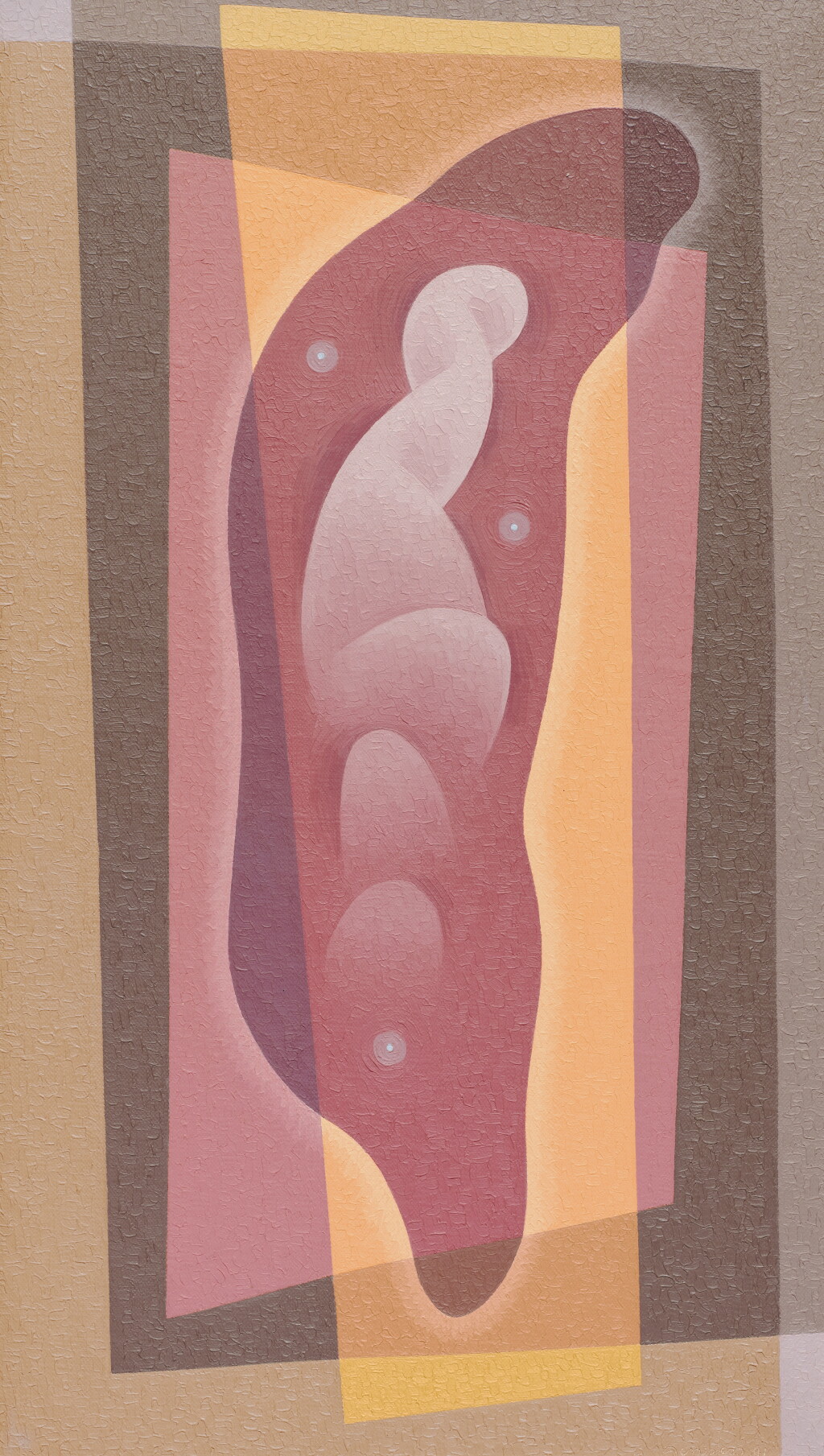
Property from the Estate of Harrison Eddins, Jr.
Raymond Jonson
Oil No. 9
Auction Closed
May 20, 08:59 PM GMT
Estimate
30,000 - 50,000 USD
Lot Details
Description
Property from the Estate of Harrison Eddins, Jr.
Raymond Jonson
1891 - 1982
Oil No. 9
incised Jonson and dated 41 (lower right); dated 7/25 1941 (on the stretcher); dated 1941- and titled (on the tacking edge)
oil on canvas
28 by 16 ⅛ in.
71.1 by 40.6 cm.
Executed on 25 July 1941.
Ed Garman, Taos, New Mexico and San Francisco
Martin Diamond Fine Arts, New York
Acquired from the above in 1984 by the late owner
A leading figure in the Transcendental Painting Group, Raymond Jonson was a pioneer in American abstract painting who devoted himself to exploring the spiritual in art. Jonson’s development as an artist was strongly influenced by the Chicago Armory Show in 1913, particularly the avant-garde works of Wassily Kandinsky. After attending the Chicago Academy of Fine Arts and the Art Institute of Chicago, Jonson gained an international reputation for his minimal and experimental stage design work as Art Director at Chicago Little Theatre from 1912-1917. Jonson moved to New Mexico in 1927, where he tirelessly advocated for modernism through teaching and organizing exhibitions. He painted increasingly abstract landscapes until he developed a signature geometric style, producing rhythmic, sculpturally modeled works, often featuring biomorphic, abstracted forms.
In 1938 he co-founded the Transcendental Painting Group of abstract artists with Emil Bisttram with the aim of defending, validating and promoting abstract art. Other members of the group included Agnes Pelton, Florence Miller Pierce, William Lumpkin and Dane Rudhyar. Jonson began to teach at the University of New Mexico full-time in 1950, living in the Jonson Gallery—a studio, residence, and exhibition space that he designed for his work and for other artists who shared his dedication to spiritual, nonobjective art. He continued to paint and exhibited widely throughout the United States until his death in 1982.
Throughout his career, Jonson devoted himself to the goal of achieving visual harmony through what he called “unifying principle,” in which a successful painting embodied his emotional, intellectual, and physical experiences, and exhibited a high degree of craftsmanship. He believed that the attainment of this ideal was possible only through abstraction. It is not solely Raymond Jonson’s work which makes him noteworthy, but his contributions to art as an innovator, teacher, curator and mentor.


