Giovanni Francesco Barbieri, called il Guercino
The Triumph of Galatea
Auction Closed
February 4, 06:26 PM GMT
Estimate
80,000 - 120,000 USD
Lot Details
Description
Giovanni Francesco Barbieri, called Guercino
(Cento 1591 - 1666 Bologna)
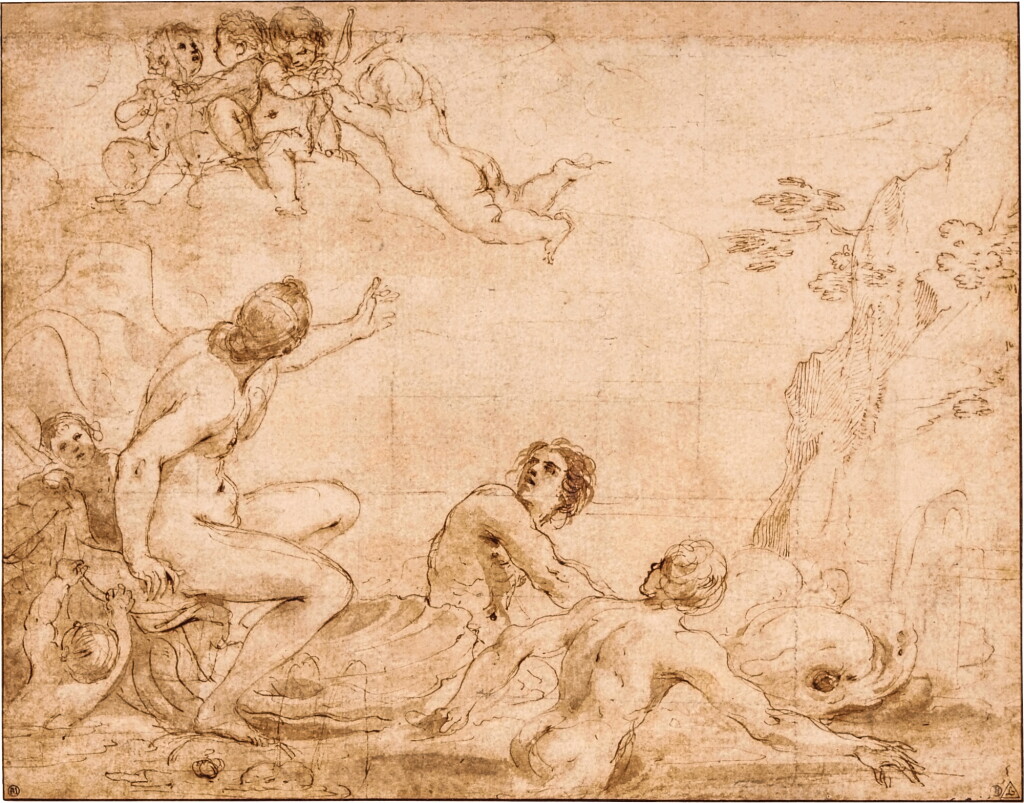
The Triumph of Galatea
Pen and brown ink and wash, squared in black chalk, with later framing lines in brown ink, made up with a horizontal strip of paper along the upper edge by Pierre-Jean Mariette and laid down on the original Mariette mount;
bears artist’s dates in brown ink, lower right: 1590-1666
206 by 261 mm; 8⅛ by 10¼ in.
Pierre Crozat (1665-1740), does not bear his numbering,
his sale, Paris, 10 April - 13 May 1741 (part of lot 544, "Jean- François BARBIERI, dit le Guerchin, Six, idem [Drawings] dont une premiere pensée pour le tableau de saint Guillaume, dans l'Eglise de saint Gregoire à Boulogne" ), bought by Hecquet for Mariette,
Pierre Jean Mariette (1694-1774), Paris (L.2097, twice), with part of his mount (L.1852),
his sale, Paris, Basan, Catalogue Raisonné des différens objets de curiosités dans les Sciences et Arts, qui composoient le Cabinet de feu Mr Mariette.., 5 December 1775, part of lot 149 (BARBIERI,(Jean-Franç.) dit le Guerchin. Bol. Trois autres petits Sujets, à la plume & au bistre, dont le Satyre Marsyas écorché, le Triomphe de Vénus, & c.). Bought by Fournelle;
Jean-Nicolas Fournelle (1730-1777),
his sale, Paris, 14 October 1776 ff., lot 159 ( "GUERCHIN. (Barbieri, dit le). Le triomphe d'Amphitrite"). Bought by Joullain,
François Joullain (1697-1778) or François Charles Joullain (c.1735-1790);
Jean-Baptiste-Florentin-Gabriel de Meryan, Marquis de Lagoy (1764-1829), Aix-en-Provence (L.1710), (his inventory number, no 225: "École de Bologne. Gio Francesco Barbieri detto il guercino . n. 1560. m. 1666. Le triomphe de Venus sur les eaux, elle est dans une conque trainée par des dauphins et précédée par deux tritons. De petits amours poussent son char d'autres se jouent dans les airs à la plume, légèrement lavé au bistre. Larg. 8p 2/4 haut. 7p. 1/2 Coll. Crozat, Mariette".),
Maurice Delestre (1848-1931), Paris,
his sale, Paris, Hôtel Drouot, 14 December 1936, lot 43. Bought by Catroux,
René Claude Catroux (1874-1964);
an unidentified collector’s mark (H, in a circle, lower right), not in Lugt;
with P. & D. Colnaghi and Co., Ltd., London, exhib. cat., 19 July 1986, no. 15;
Elmar W. Seibel, Boston;
with Katrin Bellinger Kunsthandel, Munich, 1994,
where acquired by Diane A. Nixon
New York, The Morgan Library & Museum; Washington, D.C., National Gallery of Art, Private Treasures: Four Centuries of European Master Drawings, 2007, no. 31 (entry by Anne Varick Lauder);
Northampton, Massachusetts, Smith College Museum of Art; Ithaca, New York, Herbert F. Johnson Museum of Art, Drawn to Excellence: Renaissance to Romantic Drawings from a Private Collection, 2012-2013, no. 35;
New York, The Morgan Library & Museum, Pierre-Jean Mariette and the Art of Collecting Drawings, 2016, no. 18
A. Lurie, ‘Old and Modern Drawings. A Drawing by Guercino’, The Art Quarterly, vol. 26, no. 2 (Summer 1963), p. 229, no. 14, fig. 13;
D.M. Stone, Guercino, Master Draftsman: Works from North American Collections, exhib. cat., Cambridge (Mass.) 1991, p. 226, no. 237, reproduced plate I;
P. Rosenberg, C. B. Bailey and S. Welsh Reed, La vente Mariette, Le catalogue illustré par Gabriel de Saint-Aubin, Milan 2011, p. 25;
P. Rosenberg, Les Dessins de la collection Mariette. Ecole italienne et espagnole, Paris 2019, Vol. II, p. 590, no. I 962, reproduced (the present drawing was drawn by Saint-Aubin, in his copy of the catalogue of the sale of Jean-Nicolas Fournelle; BnF, Rés., Yd-120-8o)
The present sheet, executed in Guercino’s highly characteristic early, Carraccesque style is one of the most important and handsome drawings by the artist to remain in private hands. Guercino has long been admired as one of the great draftsmen of Western European art, with his biographer, Carlo Cesare Malvasia praising the artist for his refined style and the celebrated French collector Pierre Jean Mariette, who owned this very drawing, describing his “plume tout-à-fait séduisante” (completely seductive pen).1
Executed in the artist’s preferred technique of fluidly applied pen and brown ink, coupled with the subtle and skillful application of brown wash, this bravura combination of media allowed Guercino not only to express the virtuosity of his penmanship, but also to achieve a range of pictorial nuances, and his desired suggestions of light and shade. Interestingly the drawing is also lightly squared in black chalk, suggesting that he planned to transfer the design, although the composition cannot be securely connected to any known or documented painting by the artist.
While the Nixon drawing can certainly be dated, on stylistic grounds, to early in the artist’s career there has historically been some debate over its more precise dating. Nicholas Turner has previously suggested that The Triumph of Galatea may have served as a study for a fresco in Bartolomeo Pannini’s family palace in Cento, which was decorated by Guercino and assistants between 1615 and 1617.2 This approach seems particularly compelling when one compares the present sheet with a drawing in the Cleveland Museum of Art, Venus and Cupid in a Chariot Drawn through the Clouds by a Dove.3 The Cleveland drawing has long been thought to relate to the Pannini commission and shares clear stylistic affinities with the Nixon drawing. The handling, for example, of the face and hair of Venus in the Cleveland sheet can be very closely compared to that of the Triton in the center of the Nixon drawing.
David Stone (see Literature) has, however, proposed an alternative dating for this important drawing to a few years later in Guercino’s career, circa 1621, by which time the young artist was working in Rome. Stone compares the Nixon drawing to the artist’s Aurora fresco of 1621 in the Casino Ludovisi in Rome. In her 2007 entry for this drawing (see Exhibited) Anne Varick Lauder notes that it seems more likely that Guercino developed the Galatea theme in Rome, pointing out that “the triumph of the sea-nymph Galatea…held popular appeal in the papal city…largely due to the famous portrayal by Raphael and his assistants of 1518-1519 in the Villa Farnesina, which Guercino certainly would have known, either in the original or through Marcantonio Raimondi’s faithful engraving.” Lauder also refers to the Casino Ludovisi project as one of great importance; given that it was commissioned at the behest of Pope Gregory XV and his nephew, Cardinal Ludovico Ludovisi, it is likely that the artist took great pains to prepare it with all possible thoroughness, maybe even to the extent of exploring similar mythological themes on paper.
Though the precise dating and purpose of this exquisite sheet may continue to defy neat categorization, what is clear is that the quality and vigor that it possesses as an artwork, something that was recognized early on by the likes of Pierre Crozat and Pierre-Jean Mariette and more recently by Diane Nixon, speaks clearly for itself.
For other sheets formerly in the collections of Pierre Crozat and Pierre Jean Mariette see lots 8, 29 and 40.
1. Mariette 1741 [1973], p. 57
2. Oral communication, noted in New York, Paris, and London 1994, no. 18
3. Stone, op. cit., p. 4, no. 2, reproduced p. 5
You May Also Like