
Salvator Rosa
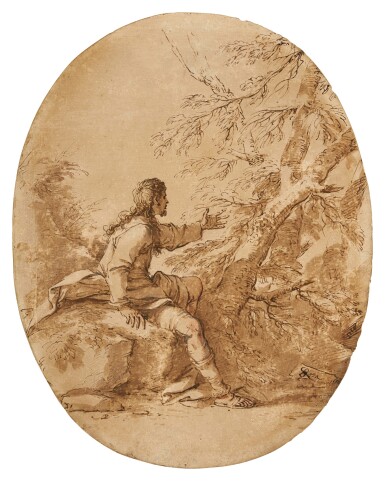
Seated Man Gesturing toward a Tree
Auction Closed
February 4, 06:26 PM GMT
Estimate
120,000 - 180,000 USD
Lot Details
Description
Salvator Rosa
(Naples 1615 - 1673 Rome)
Seated Man Gesturing toward a Tree
Pen and brown ink and brown wash with red chalk over traces of black chalk on lightly washed beige paper;
signed at lower right in pen and brown ink, S Rosa; bears numbering on reverse of the backing sheet, in pen and brown ink: 3
425 by 336 mm; 16¾ by 13¼ in. (oval)
Jonathan Richardson Sr. (1665-1745), London (L.2184);
Jonathan Richardson Jr. (1694-1771), London (L.2170);
Private collection,
sale, London, Christie's, 7 July 1981, lot 94;
Duke Roberto Ferretti di Castelferretto (1923-2005), Toronto,
sale, London, Christie's, 2 July 1996, lot 77;
with Thomas Williams Fine Art Ltd., London, by 1997,
where acquired by Diane A. Nixon
Naples, Museo di Capodimonte, Civiltà del Seicento a Napoli, 1984, p. 122, no. 3.71a, reproduced (entry by Julien Stock);
Toronto, Art Gallery of Ontario and elsewhere, Italian Drawings from the Collection of Duke Roberto Ferretti, 1985-86, pp. 90-91, no. 39, reproduced (entry by David McTavish);
New York, The Morgan Library & Museum; Washington, D.C., National Gallery of Art, Private Treasures: Four Centuries of European Master Drawings, 2007, no. 34 (entry by Rhoda Eitel-Porter);
Northampton, Massachusetts, Smith College Museum of Art; Ithaca, New York, Herbert F. Johnson Museum of Art, Drawn to Excellence: Renaissance to Romantic Drawings from a Private Collection, 2012-2013, no. 42
H.M. Hake, 'Pond's and Knapton's Imitations of Drawings', The Print Collector's Quarterly, IX, 1922, pp. 345-6
A quintessential subject for Salvator Rosa, this handsome and impressive drawing of a young man gesturing towards a tree conveys a mood of poetic solitude that strongly anticipates such elements in the work of much later painters of the Romantic era, for whom Rosa was a pioneering source of inspiration. Rosa was uncompromisingly eccentric for his time, always attracted by the idea of seeking refuge in a hermitage or in nature, although he was far from accurate in his portrayals of the nature that he observed: his aim seems rather to have been to represent an idealized image of a savage and lonely wilderness, where humans are immersed and sometimes overwhelmed.
Clearly the Nixon drawing is an imaginary creation. The rocks and the huge angular tree with broken branches, struggling to maintain its roots in the rocky ground to the right of the composition, are protagonists as much as the young man seen in profile, wearing contemporary clothing. There is a disregard for classical formality, and Rosa's image of the landscape is far removed from the countryside that his contemporaries were painting so much more faithfully at this time. It could not be more different from Claude's evocation of a classical Arcadia, even if the two artists share the same sense of isolation and remoteness from reality.
Both the choice of an oval format, which is not unusual in Rosa painted works, and the presence of the artist's signature on a flat stone to the right, reinforce the visual impression that this drawing was made as an independent work of art. As Rhoda Eitel-Porter noted (see Exhibited), the young man seen here can very possibly be identified as a poet, 'consistent with the common belief that the experience of solitude is a source not only of spiritual solace but also of poetic inspiration.'
Finished sheets like this one could have been executed as presents for friends or patrons, but it cannot be excluded that there were also commercial reasons for producing such drawings. It is worth remembering that Rosa response to a period when the art market in Rome was particularly difficult, between the mid-1550s and the early 1660s, was to take up etching, and although he emphasized in the frontispiece inscription to his famous series of prints known as the Figurine (1656) that he did them for pleasure, dedicating the series to his loyal friend the banker Carlo de' Rossi, the commercial potential of such a series would not have been far from his thoughts. The same may have been true regarding the making of an elaborate drawing such as this.
Michael Mahoney dates comparable, though less finished, drawings of figures in various attitudes of meditation to the first half of the 1650s, suggesting a similar date for this sheet.1
The Nixon drawing had a pendant, A Philosopher in meditation in a landscape, with which it remained together until 1996, when the two drawings were sold as individual lots in the auction of the collection of Duke Roberto Ferretti (see Provenance); the present location of the other sheet is unknown. In 1735, while in the celebrated collection of Jonathan Richardson Sr., the two drawings were engraved as facsimile prints, in reverse, by Arthur Pond.2
For other drawings by Salvator Rosa, see lots 47 and 50.
1.M. Mahoney, The Drawings of Salvator Rosa, New York & London 1977, I, pp. 383-385, reproduced vol. II, 36.1-36.6
2.The print by Pond is signed SRosa on a stone near the figure's feet (Weigel 1865, 43, no. 7958, erroneously identified as Saint John the Baptist in a Landscape). The other print is inscribed Salvator Rosa de/ A Pond fecit 1715 and E Musaeo Dni I Jonath: Richardson (Weigel 1865, 677, no. 7976). The prints by Pond show the images in their oval format, but within additional octagons. A brush drawing after Pond's print, depicting the youthful protagonist of the present drawing in reverse, further attests to the figure's enduring appeal (sale, London, Christie's,7 December 1995, lot 111, not reproduced; sale Portland, Maine, Barridoff Galleries 4 August 1999, lot 170, as attributed to Salvator Rosa)


