
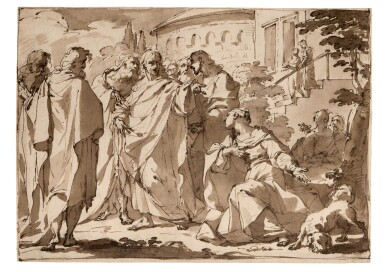
Ubaldo Gandolfi
Jesus and the Canaanite Woman
Estimate
20,000 - 30,000 USD
Lot Details
Description
Ubaldo Gandolfi
(San Matteo della Decima 1728 – 1781 Ravenna)
Jesus and the Canaanite Woman
Pen and brown ink and wash over black chalk, within brown ink framing lines;
bears two old attributions in pencil, verso: Louis Carrache and Lod. Carracci
bears numbering in pencil, verso: 151
212 by 295 mm; 8½ by 11½ in.
Probably the Earl of Warwick, based on an old mount now lost;
Alfred Normand (1910-1993), Paris (L.153c),
his sale, Monaco, Christie's, 20 June 1994, lot 37;
with Flavia Ormond Fine Arts Ltd., London, Italian Old Master Drawings: 1500-1850, 1996, no. 18,
where acquired by Diane A. Nixon
New York, The Morgan Library & Museum; Washington, D.C., National Gallery of Art, Private Treasures: Four Centuries of European Master Drawings, 2007, no. 55 (entry by Andrew Robison);
Northampton, Massachusetts, Smith College Museum of Art; Ithaca, New York, Herbert F. Johnson Museum of Art, Drawn to Excellence: Renaissance to Romantic Drawings from a Private Collection, 2012-2013, no. 60
The strong artistic identity of the two brothers Ubaldo and Gaetano (1734-1802), and the latter's son Mauro (1754-1834), were highly influential in the North Italian artistic evolution of the second part of the eighteenth century. They witnessed the transition from Baroque into Neoclassicism, a development evident especially in the work of Mauro.
Beautifully executed, the present compositional drawing, as Robison observed in his 2007 catalogue entry (see Exhibited), is clearly indebted to some aspects of Venetian art. He writes, 'Two features of this drawing evoke Venetian precedents such as the work of Sebastiano Ricci (1659-1734) and Giovanni Battista Tiepolo..: the elegant and somewhat languidly theatrical gestures, and especially the minimal use of line combined with broad wash to create brilliant light from untouched paper..' It is not known whether Ubaldo traveled to Venice around 1760, like his brother Gaetano, but he certainly somehow absorbed aspects of Venetian art at this time, as is abundantly clear from this beautiful drawing.
The Nixon drawing is a preparatory study for a painting of the same subject, one of a pair1 for which the artist received a prestigious commission from Abbot Pier Antonio Odorici, the treasurer of the Camera Apostolica.2 The painting, dated by Biagi Maino to circa 1764 and by Bagni to 1763-1765, is now in the Bolognese church of Santa Maria della Misericordia (fig. 1). A bozzetto for this same composition is in the Credito Romagnolo (fig. 2).3
Biagi Maino, in her 1990 entry for the related painting, noted the artist's debt to Tiepolo and Ricci, but also highlighted the strong Bolognese nature of Ubaldo's work. She wrote that both the composition and the chromatism of the canvas 'riconducono agli esempi veneti' ('lead back to Venetian examples').
The present composition, drawn within pen and ink framing lines, shows small differences with both painted versions. A finished study, possibly a presentation drawing, the Nixon sheet precedes the bozzetto, which shows a very similar background with the same classical buildings, which are slightly changed in the final painting. It is also possible that the present drawing was done as a work of art in its own right for a growing market of drawing collectors, who appreciated the ability to capture a narrative created with an extraordinary economy of means, and a delicacy and mastery of line enriched by several shades of abundant brown wash.
Like the Venetian masters of the eighteenth century, Ubaldo cleverly maximizes the impact of the white surface of the paper, his natural light source, perfectly combining it with his application of pen and wash to achieve sparkling results.
1.The pendant, The woman taken in adultery, was sold London, Christie's, 30 November 1973, lot 116
2.For more information on Odorici, see P. Bagni, I Gandolfi, Affreschi Dipinti Bozzetti Disegni, Padua 1992, p. 77, under no. 66
3.See D. Biagi Maino, Ubaldo Gandolfi, Turin 1990, p. 253, nos. 24 and 25, figs. 62-63; Bagni, op. cit., pp. 77-79, nos. 66-67, reproduced in colour
You May Also Like


