Giovanni Battista Tiepolo
The Annunciation
Auction Closed
February 4, 06:26 PM GMT
Estimate
250,000 - 350,000 USD
Lot Details
Description
Giovanni Battista Tiepolo
(Venice 1696 - 1770 Madrid)
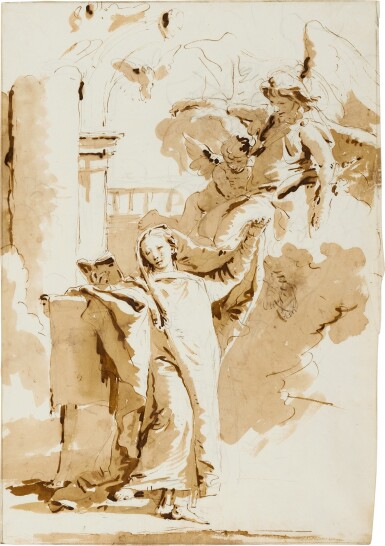
The Annunciation
Pen and brown ink and wash over black chalk, within later black chalk framing lines
435 by 304 mm; 17⅛ by 12 in.
From an album of Tiepolo drawings probably belonging to Count Grigory Vladimirovich Orloff (1777-1826), St. Petersburg and Paris,
thence by descent to Prince Alexis Nikolayevich Orloff (1867-1916), Paris,
his estate sale, Paris, Galerie Georges Petit, 30 April 1920, lot 71;
Michel Family, Paris;
with Bruno de Bayser, Paris, 1994;
with Didier Aaron, Paris, London, New York, 1994, Didier Aaron Catalogue, 1994/1995, no. 6,
where acquired by Diane A. Nixon
Cambridge, Massachusetts, Harvard University Art Museum; New York, The Morgan Library, Tiepolo and His Circle: Drawings in American Collections, 1996, no. 23 (catalogue by Bernard Aikema);
New York, The Morgan Library & Museum; Washington, D.C., National Gallery of Art, Private Treasures: Four Centuries of European Master Drawings, 2007, no. 52 (entry by Andrew Robison);
Northampton, Massachusetts, Smith College Museum of Art; Ithaca, New York, Herbert F. Johnson Museum of Art, Drawn to Excellence: Renaissance to Romantic Drawings from a Private Collection, 2012-2013, no. 52
D. von Hadeln, Handzeichnungen von G.B. Tiepolo, Munich 1927, vol. 1, no. 29, vol. 2, pl. 94;
G. Knox, 'The Orloff Album of Tiepolo Drawings', The Burlington Magazine, vol. CIII, no. 699, June 1961, pp. 273 and 275
This emotive drawing depicting the Annunciation, so magnificent both in composition and condition, was once part of the exiled Russian Prince Alexis Orloff’s collection, sold at auction at the Galerie Petit, Paris, on 29- 30 April 1920 (lot 71). We learn, from the introductory text in the Orloff sale catalogue, that the group of outstanding Tiepolo drawings included in the sale all originated from an album. Characterized by their large format, ambitious compositions and brilliantly sophisticated use of a light-filled, brown wash, the drawings by Giambattista from the Orloff album include many of the most spectacular and beautiful of all the artist's surviving drawings.
George Knox, in his 1961 Burlington Magazine article (see Literature), discusses the provenance of the drawings and proposes two possibilities as to their history. Firstly, he suggests that the album may have been purchased by Prince Alexis Orloff at the end of the 19th century, which leaves open the possibility that it was part of the large collection which London dealer Parsons and Sons bought at the sale of Edward Cheney’s drawings at Sotheby’s in 1885. Secondly, Knox provides an alternative explanation (one that he deems more likely), namely that the drawings were part of the Orloff family collection and descended from Gregory Vladimirovitch Orloff (1777-1826). Gregory was the son of Vladimir Orloff, who was appointed President of the St. Petersburg Academy of Sciences in 1766. He wrote books about Italian music and painting and spent most of his life outside Russia, in the last years of the 18th Century. Knox observes that an examination of the remainder of the works in the Orloff collection would appear to confirm that it dated from the late 18th or early 19th century.1
The present sheet is one of five from the Orloff collection illustrating the theme of the Annunciation. Knox describes these five studies as being the ‘most advanced’ of the drawings in the Orloff group and dates them to the 1730s.2 The Nixon drawing shows the Virgin Mary standing in the center of the composition while the Angel Gabriel appears above her, to the right, accompanied by a winged putto. In doing so, Tiepolo has created a harmonious and sophisticated composition in which, unlike the other Orloff Annunciations and as noted by Robison, he “conjoins the two principals” and “has the divine being descend behind the human, so that she does not actually see him but senses his approach.”3 This compositional approach allows Tiepolo to set the pair along one diagonal line that leads the eye from lower left to the upper right part of the sheet, in one unified movement. These diagonal curves are balanced by the verticals created in the form of the pulpit and column, as well as the Holy Spirit which appears slowly to descend above the Virgin.
Executed in the 1730s, the drawing gives us an insight into the artist’s formative years, and demonstrates his extraordinary aptitude, at a fairly young age, for producing intensely poetic and moving works of art. Though other Orloff drawings have appeared on the market in relatively recent times - most notably another interpretation of the Annunciation, previously in the collection of Howard and Saretta Barnet4 - the Nixon drawing must be recognized as one of the most ravishing works on paper by the artist to remain in private hands.
1.G. Knox, op. cit., p. 269
2.Ibid., p. 273
3.See Exhibited, New York and Washington 2007
4.Sale, New York, Sotheby’s, The Line of Beauty: Drawings from the collection of Howard and Saretta Barnet, 31 January 2018, lot 22
You May Also Like