
The Shapes of Cartier
Piaget | Cartier
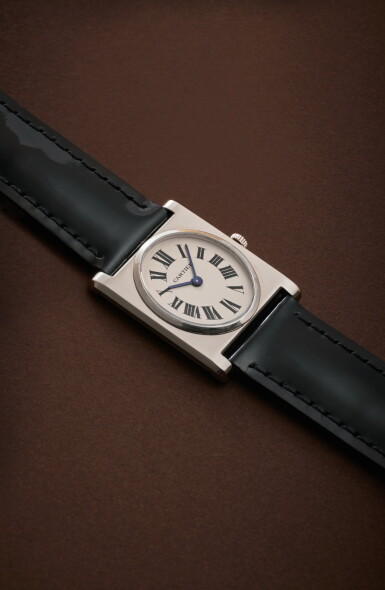
Reference 9136 | Retailed by Cartier New York: A white gold rectangular wristwatch with white gold deployant buckle, Circa 1968
No reserve
Auction Closed
June 15, 08:08 PM GMT
Estimate
5,000 - 8,000 USD
Lot Details
Description
Dial: white, black Roman numerals, blued steel pointed baton hands
Caliber: 9’’’ cal. 9P movement signed Piaget, grained decoration, lever escapement, 18 jewels, annular balance with poising screws, flat hairspring
Movement number: 614'005
Case: 18ct white gold rectangular case, flat upper case with oval chamfered bezel, down-turned lugs, notched winding crown, snap-on case back with vertical satin finish and polished chamfered rim
Case number: outside case back numbered 79'184 and etch numbered with New York Subsidiary Stock No. 015'878, twice stamped with French owl assay import mark and G†I punch mark, inside case back with Swiss Helvetia head assay mark, Poinçon de Maître key mark 15 for Uli Rotach, Geneva, inside back and underside of case top and bezel stamped 13, underside of lower left and upper right lugs with Helvetia head assay mark
Closure: 18k white gold Cartier deployant buckle numbered 14827, stamped twice with French eagle’s head assay mark and Edmond Jaeger punch mark
Size: 30 x 23 mm
Box: no
Papers: no
During the 1960s, in addition to collaborating with a small number of watch brands on the design of new wristwatches, Cartier also chose a select number of models already created by makers such as Piaget and Audemars Piguet that were complimentary to their own aesthetic, but which could be badged and retailed as Cartier watches. This Ref. 9136 Piaget wristwatch was a perfect contender - not only did it echo the Tank in its basic shape, but it infused the model with a modernist slant, using an oval bezel to provide a dramatic contrast to the stark flat rectangular upper body of the watch.
The watch is remarkably slim with a depth of just 3.8mm including the crystal. This is in large part achieved by the use of Piaget’s ultra slim calibre 9P movement which the company had released in 1957. Together with the automatic 12P released two years later, the 9P and 12P transformed Piaget’s production and allowed the company to develop an entirely new and diverse range of dress watches.