The Shapes of Cartier
Cartier | Bueche-Girod
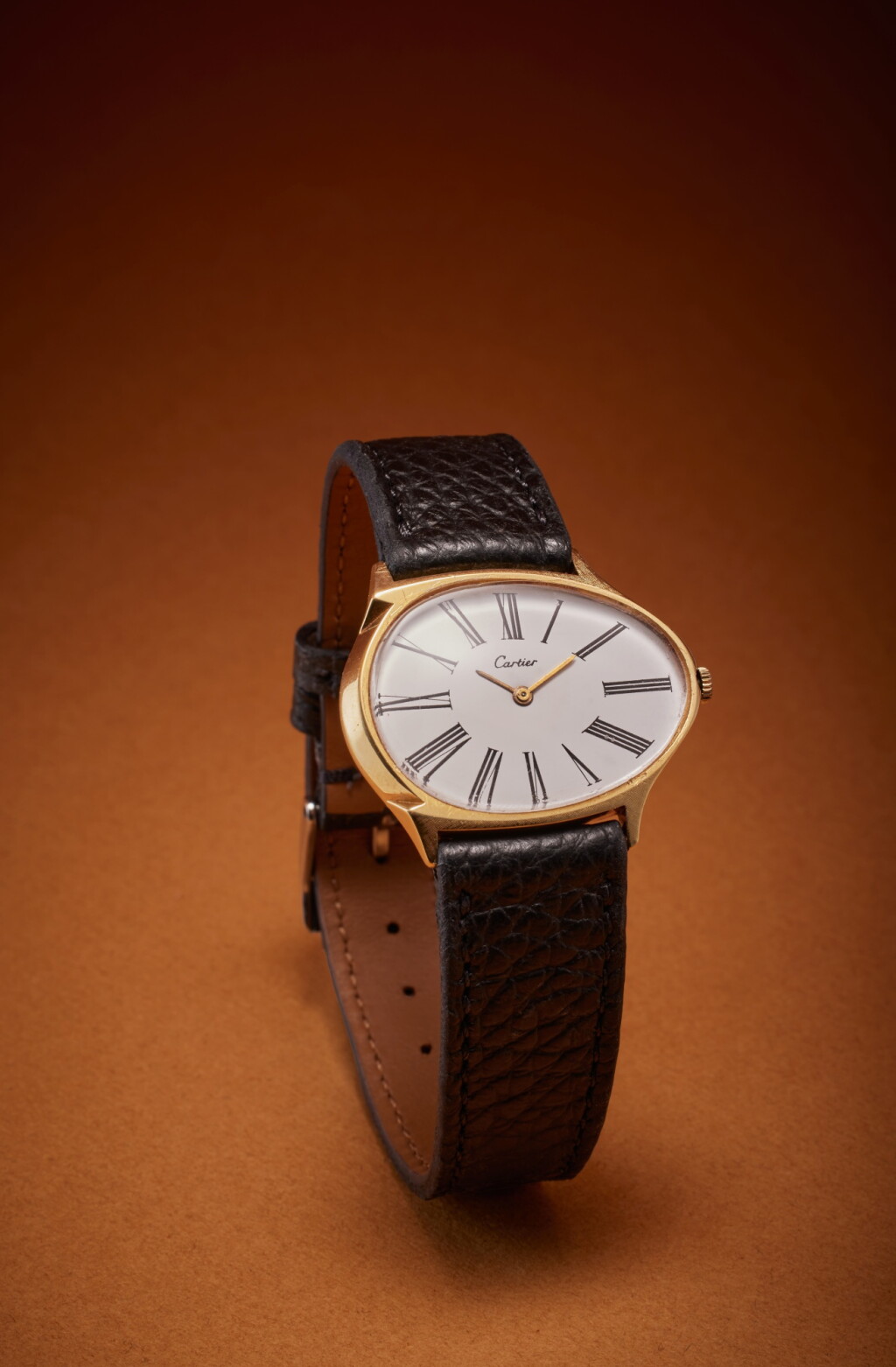
Poire | New York retailed: An unusual yellow gold asymmetric pear-shaped wristwatch with yellow gold deployant buckle, Circa 1965
Auction Closed
June 15, 08:08 PM GMT
Estimate
30,000 - 50,000 USD
Lot Details
Description
Dial: white dial, stretched radial Roman numerals, gilded pointed baton hands
Movement: 9’’’ Frédéric Piguet calibre 21 movement signed Bueche-Girod, grained finish, lever escapement, 17 jewels, annular balance with poising screws, adjusted in two positions, flat hairspring
Case: 18k yellow gold asymmetrical pear-shaped case, polished bezel with steep chamfer to left side, lugs with textured Florentine finish, short male lug nodules for retaining female spring bars, snap-on satin finished case back signed Cartier Paris, stamped Swiss and numbered 1 195'845, plain notched winding crown, inside case back with Swiss Helvetia head assay mark and Poinçon de Maître 122 for Guyot & Cie of La Chaux-de-Fonds
Closure: 18k yellow gold deployant buckle with D-shaped clasp, stamped Cartier New York 18k and with hand etched numbers 15'667
Accessories: Cartier presentation box
François Chaille, Franco Cologni, The Cartier Collection: Timepieces, Paris: Flammarion, 2006. See p. 443 for a similar example but with combination baton/Roman numeral dial.
During the 1960s, as the Paris, London and New York branches increasingly forged their own independent paths, Cartier worked with a small number of watch brands to collaborate on the design of new wristwatch models. One such collaboration was with Bueche Girod with whom Cartier produced the unusual pear-shaped watch shown here. The model incorporates the highly refined Frédéric Piguet calibre 21, an ultra-slim movement with a depth of just 1.75mm, which ensured that the overall watch’s design could adhere to Cartier’s long-held preference for slim dress watch styles.
Throughout the 1950s and 1960s there was a reaction among some designers against the classical watch shapes that had been established during the previous two decades. One of the results of this iconoclasm was the emergence of asymmetrically shaped wristwatches that began to appear towards the end of the 1950s, before being more widely available during the 1960s. These watches often defied convention with their unusual and surprising case designs.
This rare and unusual wristwatch takes the form of a pear arranged on its side. The asymmetric dial is stretched outwards to its right side and the irregular case has a textured so-called Florentine design to the tops of the lugs. There is a sharp chamfer to the left side of the bezel and this terminates in arrow-form niches as it reaches the lugs at the top and bottom of the case.