
Cartier, Paris
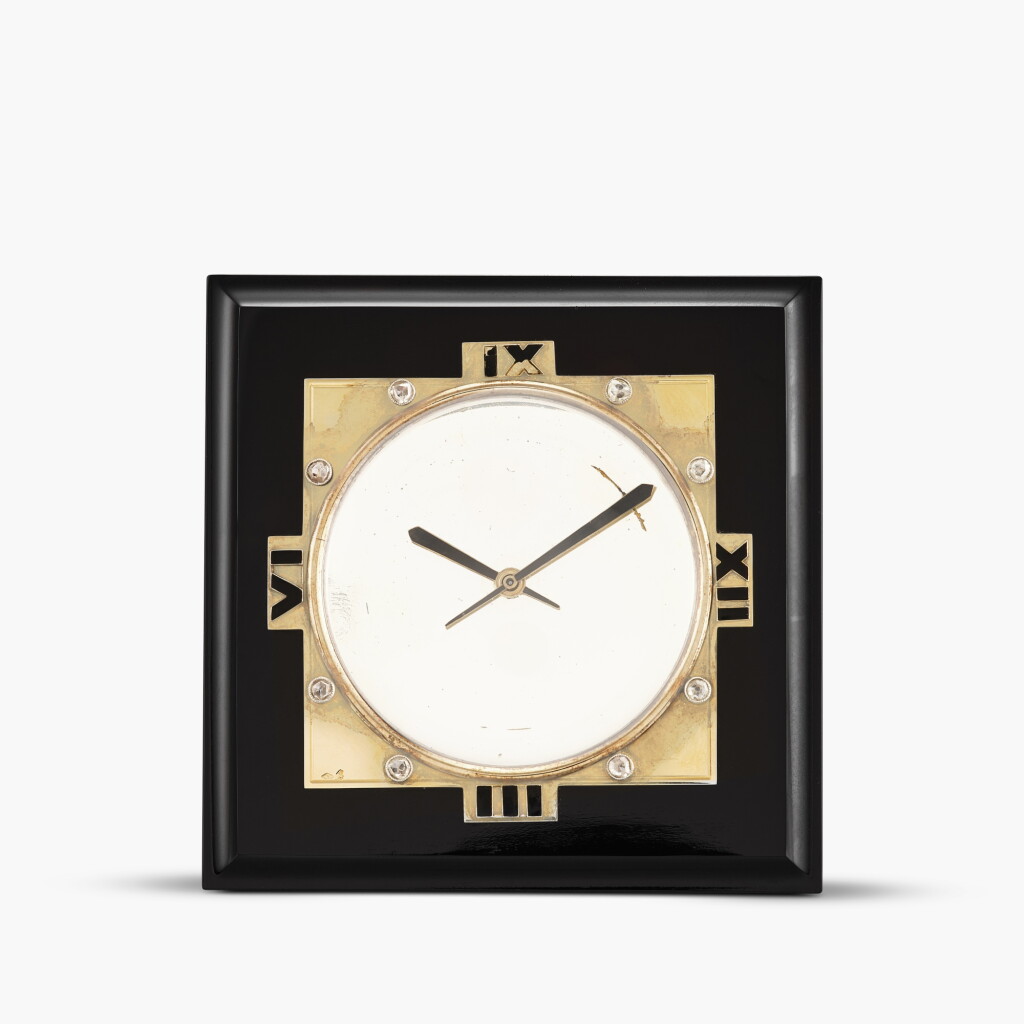
London retailed | A rare and unusual onyx, white gold, silver and enamel diamond-set desk clock with mirror dial, Circa 1930
No reserve
Auction Closed
April 24, 04:23 PM GMT
Estimate
40,000 - 60,000 HKD
Lot Details
Description
Cartier, Paris
London retailed
A rare and unusual onyx, white gold, silver and enamel diamond-set desk clock with mirror dial, Circa 1930
Dial: mirror dial, épée hands inlaid with black enamel
Calibre: 19’’’ frosted gilded 8-day duration calibre 19.41 movement signed Longines, lever escapement, 19 jewels, bi-metallic compensation balance with timing and poising screws, precision regulation
Movement number: numbered beneath dial 2'978'573
Case: square black onyx case with rounded edges, 18k gold Art Deco bezel with Roman numerals at the quarters inset with black enamel, millegrain collet-set rose-cut diamonds at the intervening hours, gold bezel with French eagle’s head assay mark and stamped SCA within a losenge-shaped cartouche for Cartier Société anonyme, silver strut stand with gilt edges, back with aperture for winding and hand setting
Case number: inside case back numbered 40, case back and strut stand with hand stamped numbering • 6013 •
Size: 75 mm length x 75 mm width
Accessories: Cartier presentation box and travelling pouch
The square, frame-form clock with strut stand was already an established Cartier design by the early 1910s. In its earliest iterations, this style was heavily influenced by the Fabergé aesthetic, with cases often richly ornamented in guilloché enamel. The clock shown here illustrates how Cartier’s approach evolved during the Art Deco period, shifting away from enamel-dominated decoration toward hardstone cases that emphasised geometric forms and bold colour contrasts. In this example, the angular gold bezel is strikingly juxtaposed with the black onyx frame – a dramatic composition that is unmistakably Art Deco in character. The mirrored surface of the dial subtly evokes the ethereal quality of Cartier’s mystery clocks, the first of which was sold in 1912, just one year after Maurice Coüet (1885–1963) began his collaboration with the Maison. These elegant creations, with their seemingly floating hands and refined silhouettes, became icons of modern sophistication and helped cement Cartier’s reputation for horological innovation. Complex and time-consuming to produce, a single mystery clock could take up to 12 months to complete. While not a mystery clock, this piece uses a mirrored dial to suggest the same sense of illusion. At first glance, it is not immediately apparent whether the mirror is a see-through glazed panel or a dial mounted in front of the movement – a subtle, playful reference to the magic of Cartier’s most technically dazzling timepieces.
卡地亞 巴黎
倫敦發行
罕有及獨特黑瑪瑙、白金、銀、琺瑯鑲鑽石座鐘,備鏡面錶盤,約1930年製
附帶盒子及旅行袋子