
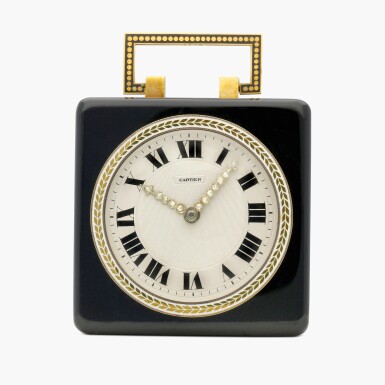
Cartier, Paris
An onyx, yellow gold and enamel 8-day desk clock, Circa 1919
No reserve
Auction Closed
April 24, 04:23 PM GMT
Estimate
48,000 - 70,000 HKD
Lot Details
Description
Cartier, Paris
An onyx, yellow gold and enamel 8-day desk clock, Circa 1919
Dial: silvered, engine-turned sunburst pattern radiating downward from 12 o’clock, plain chapter ring with black radial Roman numerals, filet sauté bordered minute track, gilded and diamond-set serpentine ring hands with arrow-form tips, plain rectangular panel signed Cartier, hour and minute hands numbered 1116 to their reverse
Calibre: 19½’’’ frosted gilded 8-day duration movement, lever escapement, bi-metallic compensation balance with timing and poising screws, blued steel Breguet hairspring
Movement number: numbered beneath dial 179'617, 22
Case: Square onyx case with rounded corners, two apertures to back with gilded mounts for winding and hand-setting, gilded decorative carrying handle with enamel inlay to front punctuated by repeated gilded dot motif, black enamel banded inlays to back of supports, gilt-brass and white enamel bezel with continuous stylised laurel leaf motif in relief
Case number: inside case back and underside of bezel hand stamped 1'116, 2'10 2
Size: 60 mm length x 26 mm width x 60 mm height
Accessories: Cartier presentation box, unsigned winding key and travelling pouch
Cartier’s transition from enamel-dominated designs to hardstone cases in the early 20th century marked a pivotal shift in the Maison’s approach to luxury timepieces and objets d’art. While the earliest Cartier desk and table clocks often featured richly coloured guilloché enamel – drawing inspiration from Fabergé and the delicate refinement of the Belle Époque – the emergence of Art Deco aesthetics ushered in a new era of bold materials, striking contrasts, and a more architectural design language. Hardstones such as agate, jade, nephrite, onyx, and rock crystal became increasingly central to the evolution of Cartier’s modern style. Nonetheless, the classical elegance of the Louis XVI style remained a strong undercurrent in many of Cartier’s creations during the late 1910s and early 1920s. This is expressed in the clock shown here, with its enamelled bezel and elaborate, diamond-set, interlocking arrow-tipped serpentine hands. When highly polished and used as a primary case material, onyx offered a smooth, lustrous surface that created a dramatic contrast against gold mounts and decorative elements. In this example, the case’s softened, canted corners introduce a subtle architectural interest, enhancing the balance between classical refinement and modern form.
卡地亞 巴黎
黑瑪瑙、黃金及琺瑯 8 日座鐘,約1919年製
附帶盒子、上弦鑰匙及旅行袋子