
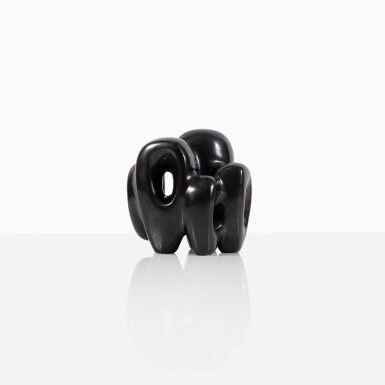
Georges Jouve
Sculpture
Auction Closed
May 28, 05:43 PM GMT
Estimate
30,000 - 40,000 EUR
Lot Details
Description
Georges Jouve
Sculpture
Circa 1950
Glazed ceramic
23 x 20 x 22 cm ; 9 x 8 x 8 ¾ in.
Mr. André Bloc collection, Meudon, France
Private collection, Meudon, France
Michel Faré, Georges Jouve, Paris, 1965, p. 29
Philippe Jousse et al., Georges Jouve, 2006, Paris, p. 285
Karine Lacquemant, Georges Jouve, Paris, 2025, p. 142, 167, 177, 197 and 275
It was in 1949 that André Bloc built his house-studio in Meudon, on the outskirts of Paris. Trained as an engineer and closely connected to the leading architects and thinkers of his time, he quickly developed an interdisciplinary vision of creation in which architecture and art existed in constant dialogue. Founder of the journals L’Architecture d’aujourd’hui and Aujourd’hui, he championed a modernity capable of uniting “the art of the engineer, the builder, the artist and the architect.”
This pursuit of a synthesis of the arts found its most radical expression in his celebrated “sculptures-habitacles.” Situated at the crossroads of architecture and sculpture, these free and organic forms transcended conventional boundaries, transforming architecture into a truly sculptural gesture.
It was within this atmosphere of artistic effervescence, at the dawn of the 1950s, that André Bloc met the ceramist Georges Jouve. Between the two men emerged an evident aesthetic affinity: a shared taste for purified forms, a fascination with the expressive power of material, and a common desire to imbue objects with an architectural presence. The black glazed ceramic “Sculpture” presented here, most likely gifted by Georges Jouve to André Bloc, appears as a subtle homage to the architect’s universe.
Through its vertical construction, stacked volumes and organic openings, the work immediately recalls André Bloc’s sculptural architectures: a totemic construction poised somewhere between an utopian maquette and a fragment of an imaginary dwelling. The depth of the black glaze further enhances its monolithic presence.
More than a simple token of friendship, this sculpture reveals the fertile dialogue between two creators driven by the same ambition: to dissolve the boundaries between sculpture, architecture and object.