
Property from a Princely Collection
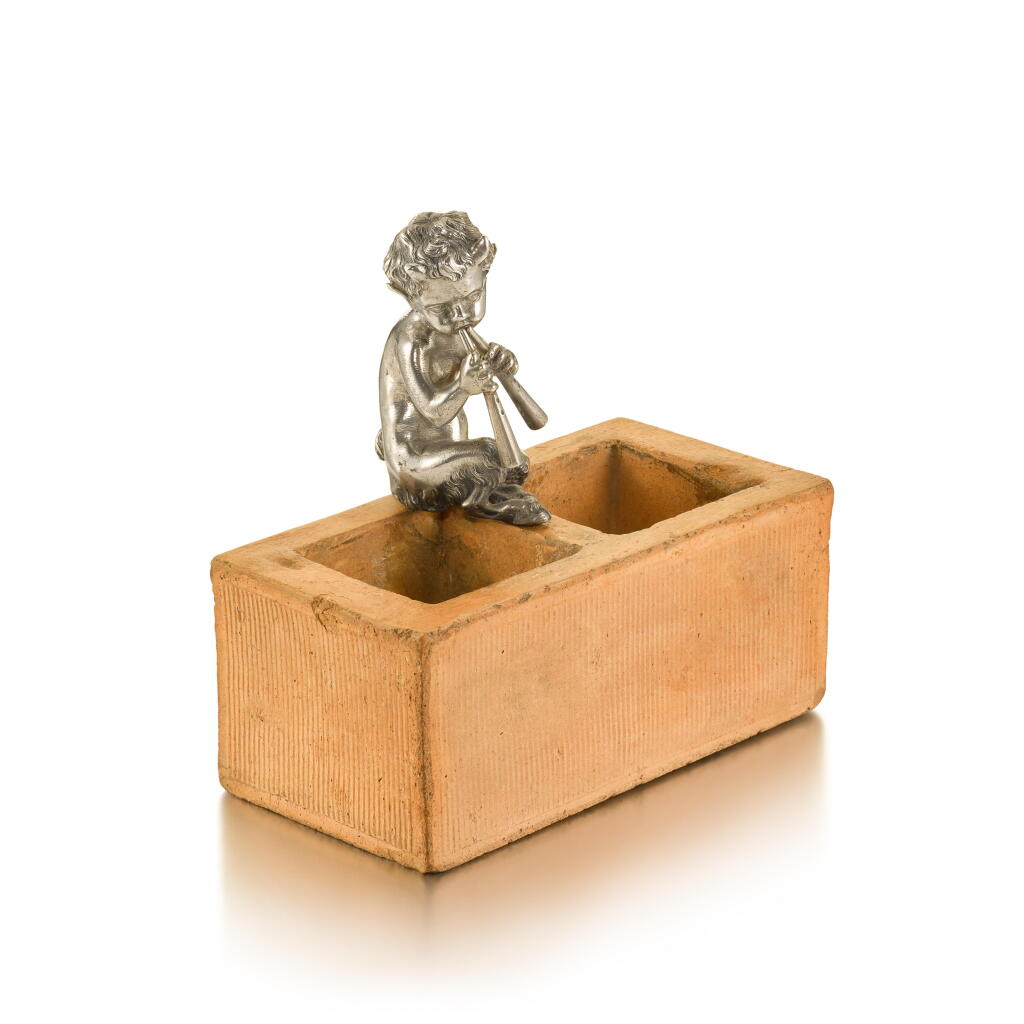
A Fabergé silver-mounted clay brick match holder, probably Moscow, circa 1895
Lot Closed
May 15, 11:38 AM GMT
Estimate
15,000 - 20,000 CHF
We may charge or debit your saved payment method subject to the terms set out in our Conditions of Business for Buyers.
Read more.Lot Details
Description
rectangular, the exterior of the clay brick with reeding for striking, the interior divided into two square match compartments, surmounted by a silver figure of a baby satyr playing the aulos, probably Marsyas, the base inscribed in Cyrillic, 'Factory / [of] A. Gusarev / in Moscow', apparently unmarked apart from scratched inventory number 833 to the base of the satyr, in a fitted wood case
length 9.7 cm; 3 3/4 in.
Property from a Private Collection, Netherlands;
Sotheby's, London, 30 November 2011, lot 570
Christie's London, The Winter Egg and Important Works by Fabergé from a Princely Collection, 1 December 2025, lot 24
Brick table match holders exemplify the Fabergé workshops’ ethos in championing design over material value. Fashioned from Russian clay supplied by the Gusarev brick factory, Moscow, these items harnessed local, raw materials to blend the functional with the aesthetic.
A nearly identical object also likely depicting Marsyas, struck with the workmaster’s initials of Julius Rappoport, and scratched with inventory number 614, was sold at Sotheby’s London, 27 November 2007, lot 556. Either the present or aforementioned piece could be the match holder which appears in Fabergé's 1899 Moscow catalogue, number 58, page 44, priced at 27 roubles. A published photograph of Emperor Nicholas II smoking at his desk also illustrates a possibly identical brick match holder displayed in front of a Fabergé frame on the desktop; see G. von Habsburg, Fabergé: Hofjuwelier der Zaren, 1986, p. 45.
Marsyas was the son of Olympus. As recounted by Ovid in his Metamorphoses, Marsyas stole the aulos from Minerva, its inventor, after she tossed it aside because it made her cheeks bulge when she played. Marsyas challenged Apollo to a musical contest, and after losing, was skinned alive on account of his hubris, the event depicted in Titian's The Flaying of Marsyas (c. 1570).
More generally, the British Royal Collection includes three examples of brick table lighters, all acquired by King Edward VII. One is mounted with a silver-gilt kneeling putto by Juilius Rappaport (RCIN 8338), another with jewelled gold snakes by Erik Kollin (RCIN 8337), and a third mounted in silver-gilt with cloisonné enamel and turquoises (RCIN 50723).