![Study for Untitled and Study for Sabro [Double-Sided Work]](https://sothebys-md.brightspotcdn.com/dims4/default/6caefbc/2147483647/strip/true/crop/2000x1531+0+0/resize/150x115!/quality/90/?url=http%3A%2F%2Fsothebys-brightspot.s3.amazonaws.com%2Fmedia-desk%2Fwebnative%2Fimages%2Fbc%2F9f%2F926936284ed88edef6024a2e16c5%2Fn12129-djmmh-t3-02-a.jpg)
![View full screen - View 1 of Lot 348. Study for Untitled and Study for Sabro [Double-Sided Work].](https://sothebys-md.brightspotcdn.com/dims4/default/e927522/2147483647/strip/true/crop/2000x1531+0+0/resize/385x295!/quality/90/?url=http%3A%2F%2Fsothebys-brightspot.s3.amazonaws.com%2Fmedia-desk%2Fwebnative%2Fimages%2Fbc%2F9f%2F926936284ed88edef6024a2e16c5%2Fn12129-djmmh-t3-02-a.jpg)
Robert Mnuchin: Collector at Heart
Franz Kline
Study for Untitled and Study for Sabro [Double-Sided Work]
Auction Closed
May 15, 11:34 PM GMT
Estimate
150,000 - 200,000 USD
Lot Details
Description
Robert Mnuchin: Collector at Heart
Franz Kline
1910 - 1962
Study for Untitled and Study for Sabro [Double-Sided Work]
signed and dedicated to Selden (on the Untitled side)
oil and ink on paper
8 ½ by 11 in.
21.6 by 27.9 cm.
Executed circa 1957.
Selden Rodman, New York (acquired directly from the artist)
Allan Stone, New York
Allan Stone Gallery, New York (acquired from the above in 2006)
Private Collection, Florida (acquired from the above in May 2013)
Sotheby's New York, 12 March 2021, lot 2 (consigned by the above)
Acquired at the above sale by the present owner
New York, Mnuchin Gallery, Highlights of Post-War and Contemporary Art, March - April 2021
New York, Mnuchin Gallery, Highlights of Post-War and Contemporary Art, June - August 2021
Robert Mattison, ed., Franz Kline Paintings, 1950-1962: Digital Catalogue Raisonné, ongoing, no. 107, FKO68QNP, illustrated in color (online)
Executed circa 1957 at the apogee of Franz Kline's meteoric rise within the New York Abstract Expressionist milieu, new title: Untitled (Study for Untitled and Study for Sabro) distills the raw dynamism and architectural grandeur of Kline's singular visual lexicon into an intimate and concentrated work on paper. Through boldly graphic passages of oil and ink rendered in his signature bichromatic palette on two sides of the sheet, Kline here achieves a compositional tension that vibrates with visceral ferocity while at once offering a rare window into the artist’s process of negotiating between the spontaneous and the deliberate, between improvised gesture and rigorous structure. Heralding from the collection of Robert Mnuchin, the work foregrounds the visionary collector’s incisive eye for boundless energy and freedom captured in masterful works of art.
A draftsman to his core, Kline often relied on works on paper as an essential component of his artistic process, using them to rehearse, revise, and refine the force of his broad brushstrokes or the delicate balance of layering black upon white. A double-sided work, Untitled (Study for Untitled and Study for Sabro), captures the frenetic energy that defines Kline’s distinctive visual vernacular. In an interview with art historian David Sylvester, Kline underscored the significance of self-reference in the composition of his works: “A lot of the paintings have developed through painting out other paintings and then, in some way, I can use some reference maybe from part of another drawing, that maybe I had done three years ago, or something like that.” (the artist quoted in: Exh. Cat., Washington, D.C., The Phillips Collection (and traveling), Franz Kline: The Color Abstractions, 1979, p. 135) The present work reflects this importance of draftsmanship in Kline’s celebrated oeuvre as it is a preparatory study for Untitled from 1957, an expansive canvas once also held in the collection of Robert Mnuchin and which holds Kline’s auction record of $40.4 million that stands to this day. Furthermore, the verso of this drawing is also a study for a major canvas from 1956, titled Sabro making this drawing doubly significant as a preparatory work for not just one, but two paintings ultimately realized by the artist. Thus, Untitled (Study for Untitled and Study for Sabro) gives us an intimate glimpse into the artist’s working process, a contemplative balancing of thick, spontaneous marks that fervently interrogate the intense energy and conceptual complexity lying in its composition.
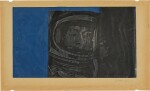
In Untitled (Study for Untitled and Study for Sabro), Kline’s broad and confident gestures of spontaneity harmonize with his deliberate and architectural planning in an unrestrainedly vivacious dance, creating an impression of velocity and a palpable sense of movement. The pitch-black structure represents the liberation of line from likeness that Kline began nearly a decade earlier in 1950, following his shift from the semi-representational to his mature style. Through thick, spontaneous marks, Kline creates grid-like forms, in which the charcoal-black masterfully balances against the thick strokes of titanium white. The simple monochrome color palette juxtaposes the intense complexities of the composition, Kline's fevered strokes simultaneously appearing utterly precise and improvisational. As Kline describes, "the immediacy can be accomplished in a picture that's been worked on for a long time just as well as if it's been rapidly." (Franz Kline quoted in: David Sylvester, "Franz Kline", 1960, in: Interviews with American Artists, New Haven 2001, p. 71) The composition that results is not a static image but rather a picture plane of depth, overlap, and a dynamic interplay of figure and ground, a true distillation of movement and experience onto a sheet of paper: “These are painting experiences. I don’t decide in advance that I’m going to paint a definite experience, but in the act of painting, it becomes a genuine experience for me. … I paint an organization that becomes a painting.” (the artist quoted in: Katherine Kuh, The Artist’s Voice: Talks with Seventeen Artists, New York 1962, p. 144)
By 1957, Kline had firmly established himself as one of the figureheads of Abstract Expressionism and among the foremost New York painters of his generation. Similar to Jackson Pollock’s drips, Barnett Newman’s zips, Robert Motherwell’s blots, and Mark Rothko’s ethereal stacks, Kline’s powerful brushstrokes and angular compositions have become a truly iconic style that represents the liberation of line from likeness informed by the relentless energy of New York City. The present work thus articulates both the artist's fascination with the revolutionary industrial and urban forms of the modern age and the New York School’s intellectually rigorous upheaval of the art historical canon, as the artist himself explained: “When I look out the window—I’ve always lived in the city—I don’t see trees in bloom or mountain laurel. What I do see—or rather, not what I see but the feelings aroused in me by that looking—is what I paint.” (the artist quoted in: Exh. Cat., Washington D.C., The Phillips Collection (and traveling), Franz Kline: The Color Abstractions, 1979, p. 16) Intimate in scale yet monumental in its presence, Untitled (Study for Untitled and Study for Sabro) stands as a testament to the unparalleled urgency and power of Franz Kline’s artistic vision.
You May Also Like