Robert Mnuchin: Collector at Heart
Untitled #4
Session begins in
May 15, 02:00 PM GMT
Estimate
500,000 - 700,000 USD
Bid
450,000 USD
Lot Details
Description
Robert Mnuchin: Collector at Heart
Willem de Kooning
1904 - 1997
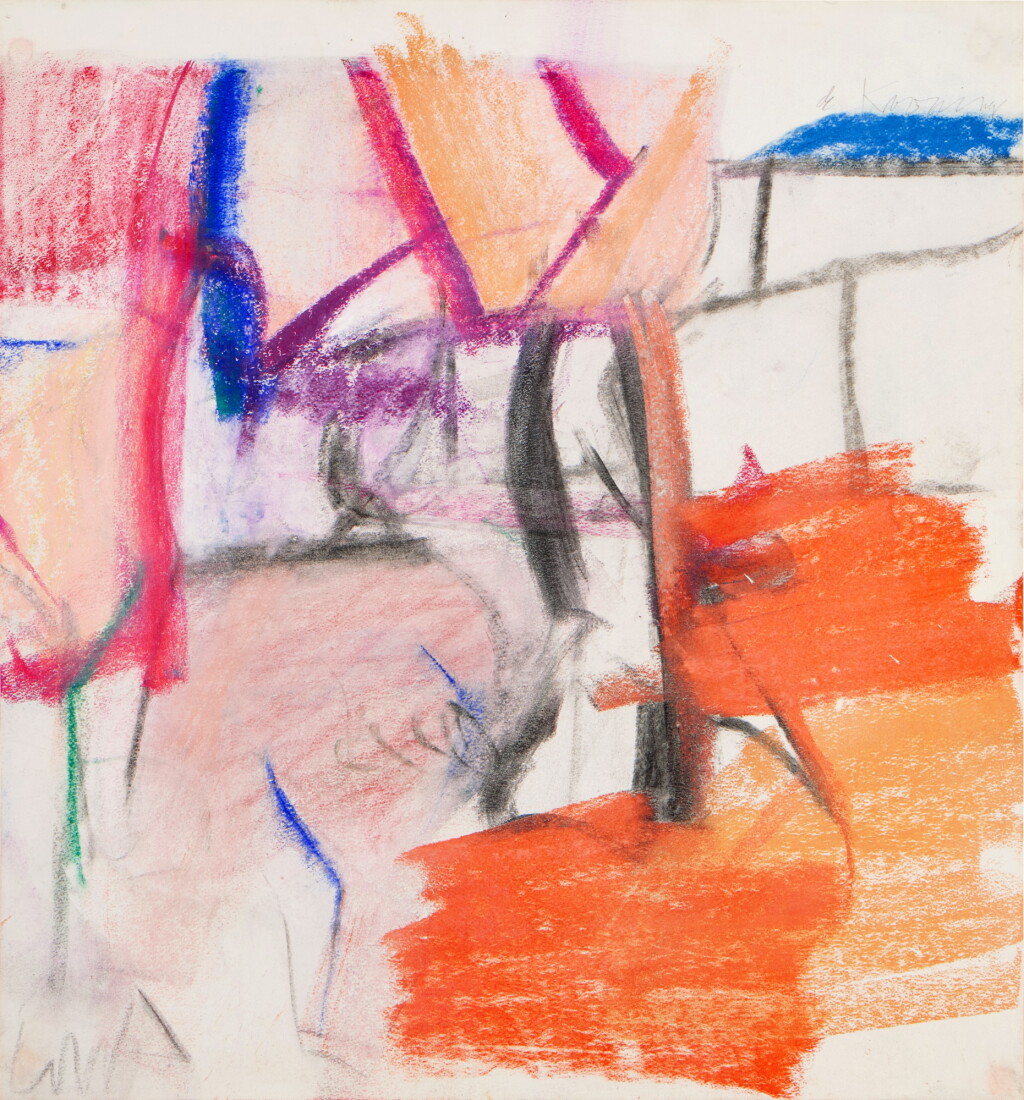
Untitled #4
signed (upper right)
pastel and charcoal on paper mounted on paper
23 ¼ by 21 ½ in.
59 by 54.6 cm.
Executed in 1956-58.
The artist
Fourcade, Droll, Inc., New York (acquired by 1974)
Pace Gallery, New York
Mnuchin Foundation, New York (acquired by 1983)
C&M Arts, New York
Private Collection, Washington, D.C.
Acquired from the above in December 2009 by the present owner
Minneapolis, Walker Art Center; Ottawa, The National Gallery of Canada; Washington, D.C., The Phillips Collection; Buffalo, Albright-Knox Art Gallery and Houston, The Museum of Fine Arts, Willem de Kooning: Drawings/Sculptures, March 1974 - April 1975, no. 88, fig. 46, n.p., illustrated in color
Chicago, Museum of Contemporary Art, Drawings by Five Abstract Expressionist Painters: Arshile Gorky, Willem de Kooning, Jackson Pollock, Franz Kline, Philip Guston, January - February 1976
Los Angeles, James Corcoran Gallery, Willem de Kooning: Paintings, Drawings, Sculptures, May - July 1981
Pittsburgh, Carnegie Institute, Museum of Art, Willem de Kooning, October 1979 - January 1980, no, 91, p. 120, illustrated
East Hampton, Guild Hall, Willem de Kooning: Works from 1951-1981, May - July 1981
New York, Whitney Museum of American Art; Berlin, Akademie der Künste and Paris, Musée d'Art Moderne, Centre Georges Pompidou, Willem de Kooning - Drawings, Paintings, Sculpture, December 1983 - September 1984, no. 78, p. 80, illustrated in color
Seattle Art Museum, Willem de Kooning in Seattle: Selected Works from 1943-1985 in Public and Private Collections, November 1995 - March 1996
Los Angeles, L&M Arts, Willem de Kooning: Figure & Light, November 2010 - January 2011, no. 16, pp. 46-47, illustrated in color
New York, Mnuchin Gallery, De Kooning: Five Decades, April - June 2019
New York, Shelter Island Historical Society, Once on this Island, June - September 2022
New York, Mnuchin Gallery, Spring Fever, May - June 2024
Thomas B. Hess, Willem de Kooning Drawings, Greenwich 1972, no. 82, pp. 198-99, illustrated
Jonathan Goodman, “Willem de Kooning at Mnuchin Gallery,” Tussle Magazine, 2018, illustrated in color (in installation, New York, Mnuchin Gallery, 2018)
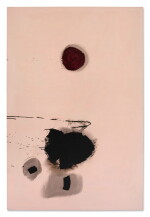
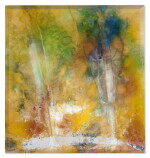
Willem de Kooning’s legendary and singular practice finds itself distilled into an intimate scale in Untitled #4. Executed in 1956-58, the present work marks a pivotal moment in Willem de Kooning’s career when the artist was pushing the boundaries between figuration and abstraction; while most pastel on paper works from this era belong to his Women series, Untitled #4 is an exceptionally rare work where de Kooning explored gesture, structure, and form in a more abstract composition. Indeed, de Kooning’s use of pastel here is strikingly anomalous, as the medium during this period was more typically reserved for his Women, making its application in an abstract composition such as Untitled #4 all the more distinctive. Testament to its quality and rarity, it has been included in numerous exhibitions over its history, most notably his 1974-75 retrospective de Kooning: Drawings/Sculptures organized by the Walker Art Center, Minneapolis and the 1983-84 retrospective Willem de Kooning: Drawings - Paintings - Sculpture organized by the Whitney Museum of American Art, New York. It is also featured in Thomas B. Hess’ seminal 1972 publication Willem de Kooning: Drawings, the first major survey of the artist’s works on paper all of which cements its position as a critical work from this period of early production from de Kooning's career.
Vibrant passages of cobalt, violet, vermillion, and ochre dash across the picture plane, de Kooning's sweeping strokes and energetic marks animating the surface with immediacy and spontaneity. Reflecting the pivotal mid-1950s transition when the artist began dissolving the female form into gestural language, Untitled #4 juxtaposes linear elegance with raw painterly gesture and sumptuous fields of color. This variegated surface calls to the richly textured compositions of collage found in de Kooning’s masterworks such as Asheville (1948) at The Phillips Collection, Washington, D.C., Attic (1949) at The Metropolitan Museum of Art, New York, along with the lyrical language of his later landscapes. However, perhaps its most important relationships are with de Kooning’s masterful large scale abstractions made during this same time period such as the landmark painting Interchange (1955), sharing its dynamic interplay of sweeping black lines and vibrant pink and orange passages as it oscillates between figuration and abstraction. Here, Untitled #4 captures in its pastel strokes the pulsating emotions and energy characteristic of de Kooning’s now legendary praxis on an jewel-like and intimate scale: “I’m not interested in ‘abstracting’ or taking things out or reducing painting. I paint this way because I can keep putting more and more things in it—drama, anger, pain, love, a figure, a horse, my ideals about space.” (the artist quoted in: “Six Abstractionists Defend Their Art,” The New York Times Magazine, 21 January 1951, n.p.)
The contextual chronology surrounding the present work’s creation spans momentous events in the New York art world and in de Kooning’s own life and work. The late 1940s was a culmination of creative ferment in post-war New York and de Kooning was at the heart of an artistic community that changed the course of Modern Art. Alongside the Action Painters like Franz Kline and Jackson Pollock, de Kooning’s works from this period catapulted the burgeoning school of Abstract Expressionism to the forefront. In 1957, when Untitled #4 was being created, de Kooning began to shuttle frequently between New York City and Long Island, deriving inspiration from the frenetic energy of the motorways. His paintings and works on paper of the late 1950s reflect the landscape as seen from a moving car, evoking the subjective vision of blurred horizons, fields, and intersecting roads. His technique mirrors the irrepressible and ceaseless energy of New York City as the new center of the art world, shifted from Paris in the years following World War II; the frenzied interplay between voluminous matter and tempestuous strokes fills his composition to the edges, expressing the teeming life, grit, and cacophony of the city all tightly compressed within the four edges of the intimately scaled sheet.
As evidenced by the bold presence and painterly quality of Untitled #4, there was little divide for de Kooning between drawing and painting during this period in his career. As he explored the depths of his innovative style, de Kooning was known to work and rework a sketch before, during, and after the application of pigment. As John Elderfield describes, “He often adapted shapes used in one work to fit into another, refitting a figural shape to make it work with the abstraction, and vice-versa. In fact, he would often trace them from one work to another, thereby producing a recurrence at the same size” (Exh. Cat., New York, The Museum of Modern Art, de Kooning: A Retrospective, New York 2011, p. 13). Therefore, drawings were not simply created as preparatory studies for paintings or as an arena for the artist to work through moment's of creative impasse, but rather they were the critical arena for pushing the boundaries of his own abstraction, of testing the limits of his gesture and ultimately works on paper have become a key critical aspect of his oeuvre. De Kooning's passionate mark-making here builds up a start of not only line and color but also of emotion and memory, as the artist himself explains: “The pictures [I have] done since the Women, they’re emotions, most of them. Most of them are landscapes and highways and sensations of that, outside of the city—with the feeling of going to the city or coming from it.” (the artist quoted in: David Sylvester, “Content is a glimpse…,” Location, No. 1, Spring 1963, p. 45). Overall, Untitled #4 encapsulates a critical juncture in de Kooning’s practice, distilling the artist’s radical negotiation between figuration and abstraction into a rare and intimate work on paper that powerfully conveys the energy, experimentation, and emotional intensity of mid-century Abstract Expressionism. At once graphic and painterly, Untitled #4 is itself a masterwork of de Kooning’s signature invention.
You May Also Like