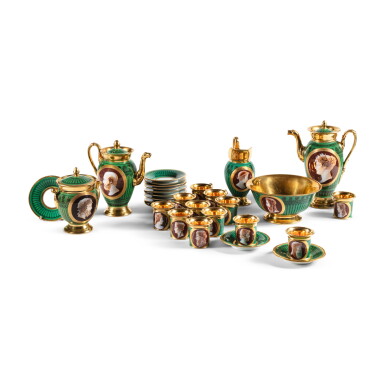
A Paris (Schoelcher factory) porcelain green-ground ‘cameo’ tea and coffee service, circa 1815
Estimate
10,000 - 15,000 EUR
We may charge or debit your saved payment method subject to the terms set out in our Conditions of Business for Buyers.
Read more.Lot Details
Description
painted in imitation of cameo with titled portrait busts of figures from Greco-Roman mythology against a brown ground, reserved by a green-ground enriched by dark green vertical bands surmounted by anthemion, enriched in gilding, gilt interiors to cups and bowl, gilt-rims, comprising: a coffeepot and cover; a teapot and cover; a sugar bowl and cover; a milk jug; a footed bowl; and twelve cups and saucers, Schoelcher script mark in black enamel to coffeepot, teapot and one saucer, crossed baton and T mark in underglaze-blue to sugar bowl, various incised marks
(32)
Height of coffeepot 10 5/8 in. ; Haut. cafetière 27 cm
In the early nineteenth century, the Paris porcelain manufactories were heavily influenced by the latest fashions emerging from Sèvres, where painters developed innovative enamel decorations inspired by hardstone cameos. The present service is contemporary with the celebrated Service Iconographique Grec (1811-1818), decorated with named cameo portraits reserved against bleu lapis enrichi d'or grounds. Produced in two closely related versions, the first was completed in 1811 and presented to Cardinal Fesch on 13 July of that year during the celebrations surrounding the baptism of the King of Rome, Napoléon II, son of Napoléon I and Marie-Louise. Known as the Service à Camées, its eighty-two pieces are discussed by Pierre Verlet in Les Grands Services de Sèvres, the catalogue of the 1951 exhibition at the Musée national de Céramique, Sèvres (p. 48, no. 23). The second version, produced between 1812 and 1817, derived much of its decoration from Ennio Quirino Visconti's Iconographie ancienne, ou recueil des portraits authentiques des empereurs, rois et hommes illustres de l'Antiquité. Comparable in spirit is a Sèvres déjeuner with a faux-malachite ground, painted by Antoine Béranger with cameo medallions after antique gems from the Bibliothèque du Roi, which was presented by Louis XVIII to Caroline, duchesse de Berry, in 1816.
A Schoelcher sugar bowl painted in this manner is illustrated in Régine de Plinval de Guillebon, Faïence et Porcelaine de Paris, Dijon, 1995, p. 413, pl. 405.
You May Also Like