
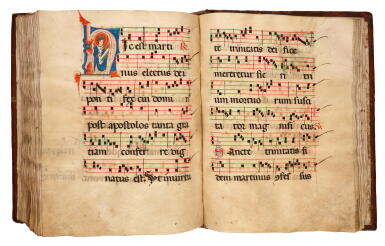
Illuminated Antiphonal (Sanctorale), on vellum, in Latin, (Italy, Emilia-Romagna?), 1270–1275
Lot Closed
July 9, 12:02 PM GMT
Estimate
50,000 - 70,000 GBP
We may charge or debit your saved payment method subject to the terms set out in our Conditions of Business for Buyers.
Read more.Lot Details
Description
An illuminated Antiphonal (Sanctorale)
on vellum, in Latin, (Italy, Emilia-Romagna?), 1270–1280, 427 × 330 mm; 289 leaves, complete, i-viii10, ix6, x-xiv10, xv2, xvi-xxiv10, xxv12, xxvi10-1 (last blank leaf missing), modern pencil foliation (incorrect from fol.121 onwards, counting 301 leaves), text block 300 × 210 mm, written in a single column in Gothic book hand, 6 lines of musical notation in red ink, with 17th-century additions commencing on fol.289r, numerous initials with filigree penwork alternately in red and blue, 34 floral initials and 17 historiated initials; binding of brown calf over wooden boards dating from the end of the 15th century with triple fillets, repaired, front and back pastedown taken from a 15th-century antiphonal; fol.1 darkened, some pages stained, some pages with tears to the lower margins, pages cockled due to continued use, miniatures in good condition.
AN IMPRESSIVE ANTIPHONAL WITH 51 DECORATED INITIALS, INCLUDING 17 INITIALS IN THE PRIMO STILE DA BOLOGNA
PROVENANCE
This manuscript was presumably made for Dominican use between 1270 and 1280, based on the importance given to St Dominic, who appears in the historiated initials on fols.87r, 89v, and perhaps fol.211r.
COMMENTARY
This impressive Italian Antiphonal, preserved in a historic binding, contains 51 large initials, including 17 historiated initials in the Primo Stile. With the growing influence of the University of Bologna, the demand for manuscripts in the region increased significantly, attracting artists to the flourishing city. Around 1250, a group of artists became distinguishable through their use of a similar style, now referred to as the Primo Stile da Bologna. This style of illumination represents a confluence of different artistic traditions, including Romanesque, Gothic, and Byzantine, and demonstrates a preference for portraying frontal figures on bold, colourful grounds. This style marks an early stage in the transition from Romanesque abstraction towards the more naturalistic tendencies of the Trecento, creating human figures with composed expressions and a heightened interest in incorporating narrative detail.
This extensively illuminated Antiphonal exemplifies late 13th-century manuscript production in Emilia-Romagna, offering a regional interpretation of the Primo Stile. St Dominic features twice, potentially three times, among the historiated initials, making it likely that the manuscript is a result of the industrious book production of a Dominican monastery in the Emilia-Romagna region. The Dominican Order, founded at the beginning of the century, rapidly established houses across Italy, all requiring liturgical books, thereby accelerating manuscript production.
The text of the Antiphonal covers the liturgical year from 1 August to Advent. Antiphonals are typically divided into two parts, the Sanctorale and the Temporale. A Sanctorale contains the feasts of saints arranged according to the calendar year, in contrast to the Temporale, which follows the movable cycle of feasts which is dependent on Easter. The present manuscript includes the celebrations, chants, readings, and prayers assigned to individual saints’ days, typically fixed to specific dates, for example 8 August for St Dominic. The Sanctorale reflects local devotion and regional identity through the selection and prominence of particular saints.
The manuscript remained in active use within its community as late as the 17th century, as evidenced by later additions commencing on fol.289r. While many sizeable liturgical manuscripts were pilfered by bookbinders — who reused parchment leaves to support bindings or create book covers — this manuscript survived intact. Its survival is not simply a matter of chance, but the result of its active use until the 17th century. This protected the manuscript from a dire fate and underlines the importance and precious nature of the manuscript for its congregation.
The artist employed a warm palette, featuring a wide range of pinks, reds, greys, and beige tones, which are offset by deep blue grounds decorated with fine white tracings. Floral and geometric patterns, as well as intertwining vines, fill the spaces within the initials.
The 51 initials bear a strong stylistic resemblance to the work of the Master of Imola, who created a series of choirbooks for the Cathedral of Imola shortly after its completion and consecration. The Master of Imola was an anonymous illuminator active in Emilia–Romagna (northern Italy) around c.1260–1275, and part of the earliest generation of artists responsible for the monumental decoration of liturgical manuscripts in the region. The compositions created by our illuminator for the present manuscript reveal a close familiarity with the work of leading Bolognese workshops, suggesting that the artist was active in one of the neighbouring regions of Emilia–Romagna or Lombardy.
The initials are:
1. fol.40r, Initial V: Christ blessing and a prophet
2. fol.87r, Initial G: St Dominic
3. fol.89v, Initial M: The miracle of St Dominic carrying the Lateran
4. fol.105v, Initial L: St Lawrence
5. fol.125r, Initial V: The Virgin with two angels
6. fol.142v, Initial I: St Augustine
7. fol.167v, Initial H: The Virgin and Child (accompanying the feast of the Nativity of the Virgin)
8. fol.181v, Initial D: The Crucifixion
9. fol.194r, Initial D: St Michael playing the cornet
10. fol.195v, Initial F: St Michael
11. fol.211r, Initial S: Christ, the Virgin, and St John with monastic saints
12. fol.231v, Initial C: The Mass for the Dead
13. fol.245v, Initial H: St Martin
14. fol.262r, Initial C: St Cecilia
15. fol.275v, Initial O: St Clement
16. fol.279r, Initial O: St Clement
17. fol.282r, Initial N: St Catherine of Alexandria
Forming an essential component to celebrating the Divine Office, the manuscript was cherished and actively used by its community for centuries following its creation. This reveals the appreciation for the craftsmanship and visual appeal that the manuscript holds.
LITERATURE
Battistini, Silvia. “Corali miniati di Faenza, Bagnacavallo e Cotignola.” In Corali miniati di Faenza, Bagnacavallo e Cotignola: Tesori dalla Diocesi, edited by Fabrizio Lollini, 169–170. Faenza: Diocesi di Faenza, 2000.
Bologna, Ferdinando. I miniatori a Bologna nel Duecento e Trecento. Turin: Einaudi, 1969.
Conti, Alessandro. La miniatura bolognese: Scuole e botteghe, 1270–1340. Bologna: Edizioni Alfa, 1981.
Conti, Alessandro. “Miniatura bolognese del Duecento: Problemi di stile e cronologia.” Arte antica e moderna 18 (1962): 123–145.
Faranda, Franco, ed. Cor unum et anima una: Corali miniati della Chiesa di Imola. Faenza: Edit Faenza, 1994.
Labriola, Ada. “Miniature a Brera 1100–1422.” In Miniature a Brera 1100–1422, edited by Miklós Boskovits, 104–107. Milan: Electa, 1997.
Lollini, Fabrizio. “Cor unum et anima una.” In Cor unum et anima una: Corali miniati della Chiesa di Imola, edited by Franco Faranda, 178–180. Faenza: Edit Faenza, 1994.
Medica, Massimo. “La miniatura a Bologna nel Duecento.” In Duecento: Forme e colori del Medioevo a Bologna, edited by Massimo Medica and Stefano Tumidei, 35–57. Venice: Marsilio, 2000.
Medica, Massimo, ed., with Stefano Tumidei. Duecento: Forme e colori del Medioevo a Bologna. Exhibition catalogue. Museo Civico Archeologico, Bologna, 15 April–16 July 2000. Venice: Marsilio, 2000.
Rouse, Richard H. “The Production of Law Books in Bologna and Modena.” In La production du livre universitaire au Moyen Âge: Exemplar et pecia, edited by Louis Jacques Bataillon, Bertrand G. Guyot, and Richard H. Rouse, 221–236. Paris: CNRS, 1988.
Zeileis, Friedrich G. Più ridon le carte. 3rd ed. Rauris: Zeileis, 2014.