
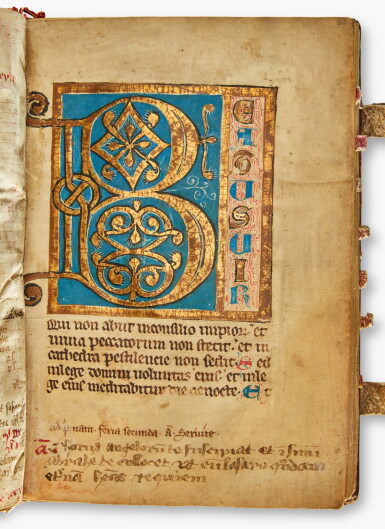
Illuminated Ferial Psalter on vellum, in Latin, German (perhaps Diocese of Trier), c.1250–70
Lot Closed
July 9, 12:01 PM GMT
Estimate
20,000 - 30,000 GBP
We may charge or debit your saved payment method subject to the terms set out in our Conditions of Business for Buyers.
Read more.Lot Details
Description
Illuminated Ferial Psalter
on vellum, in Latin, German (perhaps Diocese of Trier), c.1250–70, after 1233 (Translation of St Dominic in calendar), 139 × 200 mm; modern pencil foliation in upper right corner, 138 leaves, textually incomplete, last quire containing the Litany lacking leaves, i6 (paste down bound in leading to stub in first quire. The inserted leaf is from a different manuscript due to script orientation and layout), ii8 (collation uncertain, possible quire of 6 with 2 leaves added at end), iii8+1, iv8, v11 (quire of 10, 3rd leaf inserted), vi–viii8, ix6, x8 (second leaf inserted), xi8, xii10 (collation uncertain), xiii8, xiv10, xv6, xvi–xvii8 (back paste down bound into quire, leaving a stub before the first leaf); written in a Littera praegothica with multiple (later) additions and annotations in different hands; calendar (complete) with red KL-initials at the head of each page and small initials for important feast days in red or blue, numbers of days given in red, names of saints, martyrs, popes, and virgin saints written in either dark brown or a lighter brown ink; calendar adjusted and corrected to account for different preferences (e.g. fol.2), original text in places erased and amended, musical notation added in the margins on several occasions; one almost full-page ‘Beatus Vir’ initial filled with geometric designs, 9 large gold initials, 159 three-line high red and blue puzzle initials extending into the margins, red and blue one-line initials throughout, an ink drawing of a cockerel in the margins on fol.111v; manuscript in a 15th-century monastic binding with leather thongs laced into wooden boards, blind-stamped covers with agnus dei and a pelican piercing its breast as well as floral decorative stamps, on the back a winged lion(?) and charming floral stamps, decorated leather straps for closure (lower strap sympathetically replaced), one metal pin for closure extant on the upper board, upper board detached (cataloguing updated 25/06/26, to reflect that the board is currently detached); vellum slightly darkened (first and last leaves particularly affected), text occasionally smudged and faded, staining in the margins and darkening towards the gutter.
PROVENANCE
1. Based on the calendar, the manuscript was likely written for a diocese in western Germany, potentially Trier, as it includes the feast of the Translation of St Castor (from the Lower Moselle region to the city of Koblenz).
2. New York, Parke-Bernet Galleries, sale 29 November 1948, lot 319.
3. By descent to the current owner.
A GERMAN PSALTER WITH TEN GOLD INITIALS, NUMEROUS ANNOTATIONS, AND NEUMES, PRESERVED IN A 15TH-CENTURY BINDING WITH CLASPS
COMMENTARY
The Psalter was one of the most important devotional books of the Middle Ages before the advent of the Book of Hours. In addition to containing the 150 Psalms, these manuscripts often featured additional texts and prayers, such as the Pater Noster, the Athanasian Creed, and regionally relevant liturgies or suffrages.
The manuscript at hand contains the following texts:
1. Calendar, fols.1r–6v
2. Psalms, fols.7r–126v
3. Canticle of Isaiah, fols.126v–136r
4. Pater Noster, fol.136r
5. Symbolum Apostolicum, fols.136r–136v
6. Athanasian Creed, fols.136v–138r
7. Beginning of the Litany, fol.138v
Due to their poetic structure, the Psalms possess an inherent lyrical quality, which makes them perfectly suited to be sung as part of communal worship. The chanting of the Psalms during the weekly cycle of worship lay at the heart of monastic life and the Divine Office. The Psalter quickly became the standard medieval service book, used by monastic foundations and private individuals in their devotional practices.
In addition to the Psalms, the manuscript includes the Canticle of Isaiah, beginning with Confitebor tibi, Domine (I will give thanks to thee, O Lord, Isaiah 12:1–6). This is a short hymn offering thanks and forming part of Lauds in the Divine Office, which was recited during the hours of dawn. The hymn held a prominent position and emphasised themes of renewal and light at the start of the day.
Based on the calendar, and its inclusion of St Castor on 13 February, it is likely that the manuscript was created for a diocese in western Germany along the Moselle, possibly the Diocese of Trier and the city of Koblenz.
The manuscript contains ten gold initials of gold leaf executed on blue grounds. The ‘Beatus Vir’ initial introducing the Psalms is the most elaborate and grandest and is filled with intertwining geometric designs typical of the late Romanesque period. The gold initials are accompanied by uncial letters in red and blue used for the opening lines of the Psalms. The manuscript further encompasses 159 red and blue initials, whose extenders often run almost the full length of the page. Feathery line-fillers can be found throughout the manuscript.
A later owner added a small number of large red puzzle initials to further embellish the manuscript. On fol.111v there is a small drawing of a cockerel, an animal associated with Christ’s Passion that was frequently included in representations of the Arma Christi, the instruments of Christ’s passion. Based on its precious initials and mobile, handheld format, the Psalter was very likely intended for a higher-ranking member of the clergy or nobility.
The manuscript contains numerous marginal annotations in different later hands. This is also visible in the calendar which seemingly underwent multiple campaigns of adjustment, as readers added saints and martyrs more relevant to them as well as explanatory notes. These annotations assisted the reader in navigating the Psalter, while the extant red leather tabs served as aids to locating specific sections. Instances of palimpsest occur, for example on fols.57r, 69v, and 70r, where later users altered the text to reflect changing liturgical needs.
Among the marginal additions, the musical notation is of particular interest with neumes having been added to a large number of folios (e.g. fols.54v, 58r, 60r, 62r, 63v, 66r, 68r, 69r, 73r, 73v, 75r, 76r, 77r, 78r, 81r, 84v, 86v, 87r, 87v, 89v, 91v, 93r, 94v, 96v, 98v), suggesting that a later user adapted the manuscript for their specific practical liturgical use by adding the incipits of the Psalms in musical notation.
This Psalter was a cherished possession, likely handed down over multiple generations, as evidenced by the flurry of annotations by later owners. Its many marginal additions offer valuable insight into its owners and the use of Psalters in 13th-century Germany.
LITERATURE
Wieck, Roger S., ed. Sing a New Song: The Psalms in Medieval Art and Life. New York: Morgan Library & Museum, 2021.
Schoenberg Database of Manuscripts. Entry 4639. https://sdbm.library.upenn.edu/entries/4639.