
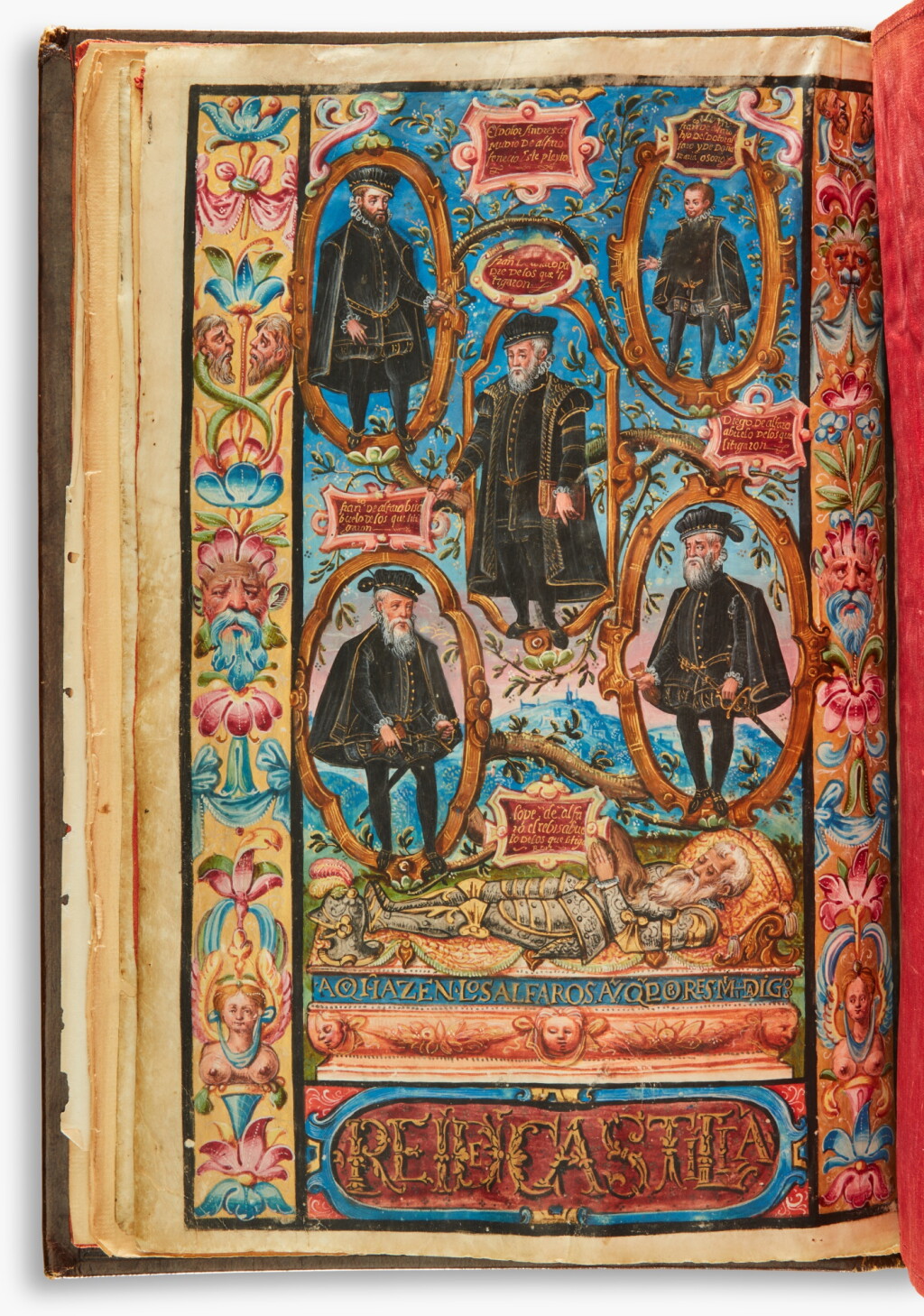
Illuminated Carta Executoria de hidalguía for Doctor Andrés Zamudio de Alfaro, on vellum, in Latin and Spanish, issued in Granada, February 1572
Lot Closed
July 9, 12:04 PM GMT
Estimate
6,000 - 8,000 GBP
We may charge or debit your saved payment method subject to the terms set out in our Conditions of Business for Buyers.
Read more.Lot Details
Description
An illuminated Carta Executoria de hidalguía a pedimento del doctor Andrés Zamudio de Alfaro, vecino de Sevilla
on vellum, in Latin and Spanish, issued in Granada, February 1572
325 × 230 mm; 97 leaves, written in Spanish Gothic bookhand of 34 lines, complete, with 4 full-page illuminated miniatures surrounded by borders of floral and vegetal elements, fleshy acanthus leaves, and Renaissance motifs, subjects of the full-page illuminations: Virgin and Child, St Francis of Assisi, coat of arms of the Alfaro family, and six full-length portraits in a genealogical tree; 1 large illuminated capital with portrait of King Philip II of Spain, and 38 smaller illuminated capitals throughout; in 19th-century modern binding of full brown morocco, covers gilt-tooled with fleurons, lions, Near Eastern, classical, zodiacal, and other ornaments, the whole forming an elaborate pattern similar to the one on the original binding, a cover of which is mounted as a front doublure; rear doublure and linings of crimson silk; good overall condition, particularly for this type of document, which was heavily used throughout its lifetime.
PROVENANCE
- Carta Executoria de hidalguía, dated Granada, February 1572, issued on behalf of Andrés Zamudio de Alfaro of Seville.
- Grolier Society label.
- 11 March 1919, lot 522, John W. Sterling, his sale.
- Bookplate Roderick Terry, his sale, American Art Association Anderson Galleries, Inc., 14 February 1935, lot 412.
- Bookplate from Robert Walsingham Martin, his sale, Parke-Bernet, New York, 12 November 1963, lot 409.
- By descent to current owner.
A HIGHLY DECORATED CARTA EXECUTORIA ISSUED FOR ANDRES ZAMUDIO DE ALFARO, PHYSICIAN TO THE KING OF SPAIN
COMMENTARY
Issued on behalf of Andrés Zamudio de Alfaro (d.1599), a native of Seville, this Carta Executoria was created for one of the most prominent physicians of late sixteenth-century Spain. Andrés, a graduate of the University of Salamanca, was born into a medical dynasty: he was the grandson of Andrés Núñez de Garoza, physician to the Inquisition in Seville, a role which he took on as well following his studies.
Andrés played a significant role in responding to plague and smallpox outbreaks. In 1568, following the outbreak of plague in Seville, the municipal authorities commissioned him, together with the physician Francisco Franco, to compose treatises on the diseases. While no printed edition of Andrés’ work survives, a manuscript copy, entitled Regimiento curativo y preservativo de la pestilencia, preserves one of his treatises.
In 1572, he and his brother Diego de Alfaro, a prosecutor at the Royal Audiencia of Seville, brought their claim to noble lineage to the Chancery of Granada. Carta Executoria played a crucial role in sixteenth-century Spain as a legal instrument that affirmed a family’s claim to hidalguía (noble status), thereby securing both social prestige, tangible economic and legal advantages. Possession of such a document ensured exemption from certain taxes, most notably the pechos a highly discriminatory direct tax, and protected assets from taxation that applied to the lower classes. The Carta Executoria also provided a certain degree of legally recognised immunity, protecting nobles from certain forms of prosecution, imprisonment, or corporal punishment through their distinct juridical status. As a result, the Carta Executoria functioned not only as a simple record of lineage, but as a powerful tool to safeguard wealth, distinguish social standing, and to secure additional legal protection within the Spanish monarchy.
Andrés’ reputation as a physician culminated in his appointment into royal service. In 1580, when Philip II fell gravely ill at Badajoz, Andrés was summoned from Seville and successfully treated the monarch. In recognition of his services, he was appointed physician to the royal chamber on 5 November 1580 and was subsequently elevated to the position of primer médico and chief physician of Castile. In this capacity, he also attended Philip II during his final illness in 1598.
The Carta Executoria issued for Andrés Zamudio de Alfaro is elaborately and lavishly illuminated to underline its legal function and to serve as testimony of its owner’s lineage and status. The manuscript contains four full-page illuminations, an unusual amount for a Carta Executoria. As legal and representative documents, they usually focus on the heraldic devices of the recipient. The full-page illuminations depict the Virgin and Child, St Francis of Assisi, the family coat of arms, a genealogical tree with family portraits, alongside a large historiated initial featuring King Philip II of Spain. Numerous illuminated initials and decorative borders extend throughout the volume, and the Alfaro coat of arms is prominently displayed. The manuscript forgoes the usual martial depiction of St James at the Battle of Clavijo and instead includes a full-page illumination showing St Francis of Assisi, underlining the presence and influence of the Franciscan Order in the city of Seville.
Crimson silk guards protect the miniatures, whose colours remain particularly vibrant and are well preserved. The miniatures are surrounded by dense borders of fleshy acanthus leaves, Greco-Roman motifs, angels, lion faces, fantastical creatures, human heads, and birds, which form a lively frame.
The palette is striking, combining yellow gold with shades of rose, light green, pink, red, and blue, recalling the city of Seville with its spectacular sunsets and Islamic heritage. The artist’s style is exemplified in the miniature of St Francis of Assisi; set within a hilly landscape beneath a sky rendered in hues of blue and pink, a dramatic scene unfolds. The saint’s stigmata are clearly visible, with thin threads of blood extending from his wounds towards the figure of Christ appearing in the clouds above, creating a direct spiritual and physical connection between saint and Saviour. The combination of vibrant colour, intricate border decoration, and narrative detail mark the style of the manuscript, underlining its status both as a formal legal document and a luxurious work of art.
LITERATURE
Davis, Charles, and María Luz López Terrada. “Protomedicato y farmacia en Castilla a finales del siglo XVI: Edición crítica del Catálogo de las cosas que los boticarios han de tener en sus boticas, de Andrés Zamudio de Alfaro, Protomédico general (1592–1599).” Asclepio 62, no. 2 (2010): 579–626.