Lin Fengmian (1900-1991) | Opera Personae
Auction Closed
June 11, 03:42 PM GMT
Estimate
120,000 - 200,000 EUR
Lot Details
Description
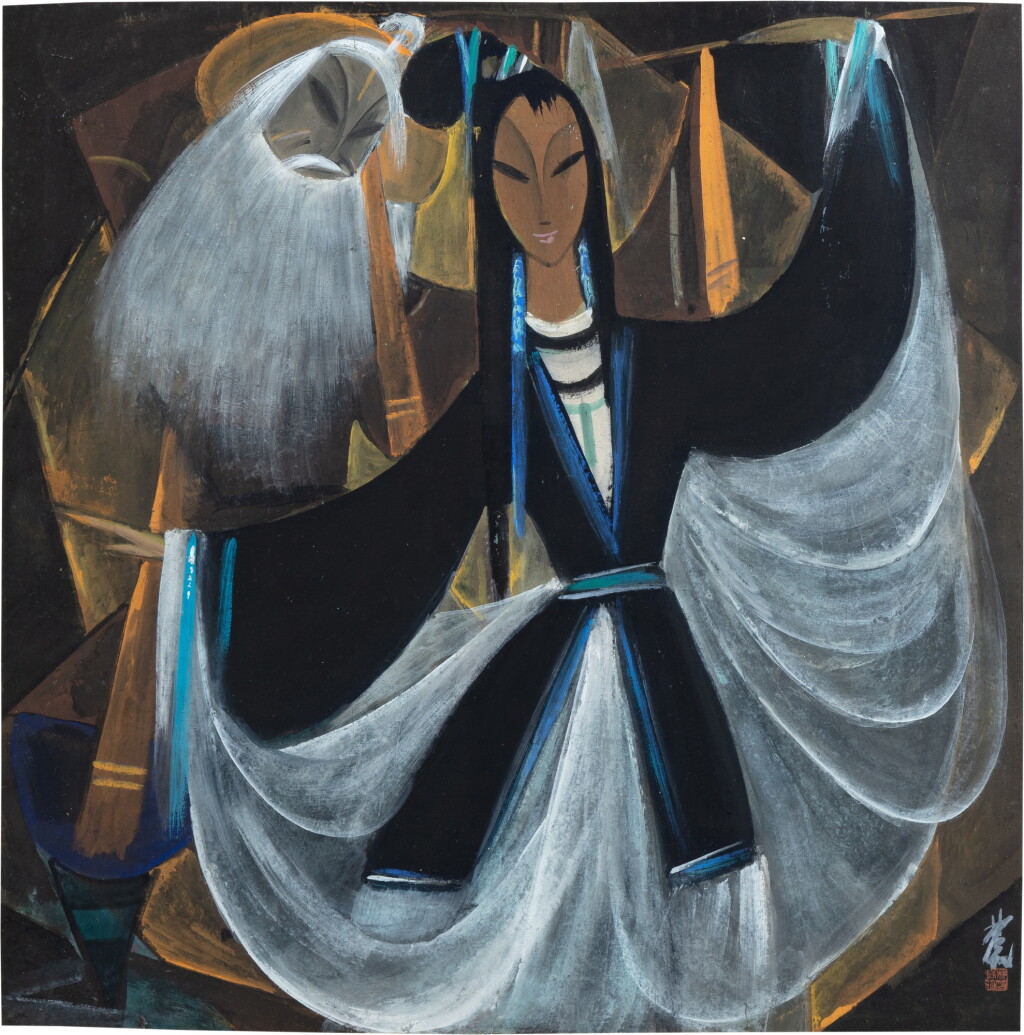
signed, with one seal of the artist (lower right)
ink and colours on paper, framed
66.5 x 66.5 cm, 26⅛ by 26⅛ in.
Acquired from an English Private Estate in Bergerac, France.
As one of the founding figures of modern Chinese art, Lin Fengmian developed from an early stage a singular artistic vision grounded in a dialogue between Eastern and Western cultures. In 1919, supported by a government scholarship, he pursued his artistic training in Europe, studying successively in Dijon, Paris, and Berlin. This immersion in the currents of Western modernism profoundly shaped his pictorial approach and permanently guided his search for an aesthetic synthesis between Chinese tradition and Western modernity.
Upon his return to China, Lin Fengmian gradually developed an innovative visual language that combined the spirituality and poetic sensibility of Chinese painting with the compositional principles, colour harmonies, and structural concepts of modern European art. This pioneering approach earned him early recognition, particularly among European and American collectors based in Shanghai.
Among the central themes of his oeuvre, figures from Chinese opera occupy an especially emblematic and deeply personal place. In the late 1950s and early 1960s, under the influence of his close friend Guan Liang, Lin Fengmian became a frequent visitor to traditional theatres, where he closely observed the stylised postures, codified gestures, elaborate costumes, and expressive stage presence of the performers. He transformed these observations into a distilled and highly expressive pictorial vocabulary.
Drawing in particular upon Cubism, he employed the superimposition of forms and a dynamic organisation of space to suggest continuity of time and movement. This approach enabled him to renew the representation of Chinese opera through modern formal means, while reinterpreting Western artistic principles through a sensibility deeply rooted in Chinese visual culture.
Through a deliberate simplification of form, Lin Fengmian reduced faces and bodies to their essential elements, privileging inner expression and spiritual resonance. This economy of means lends his works a timeless modernity and allows traditional subjects to fully inhabit the language of twentieth-century art.
Both a pioneer and an educator, Lin Fengmian played a foundational role in the history of modern art in China. His influence extends far beyond his own oeuvre, as evidenced by the careers of his students, including Zao Wou-Ki, Chu Teh-Chun, and Wu Guanzhong, whose achievements embody the enduring significance of his artistic and intellectual legacy.
You May Also Like