
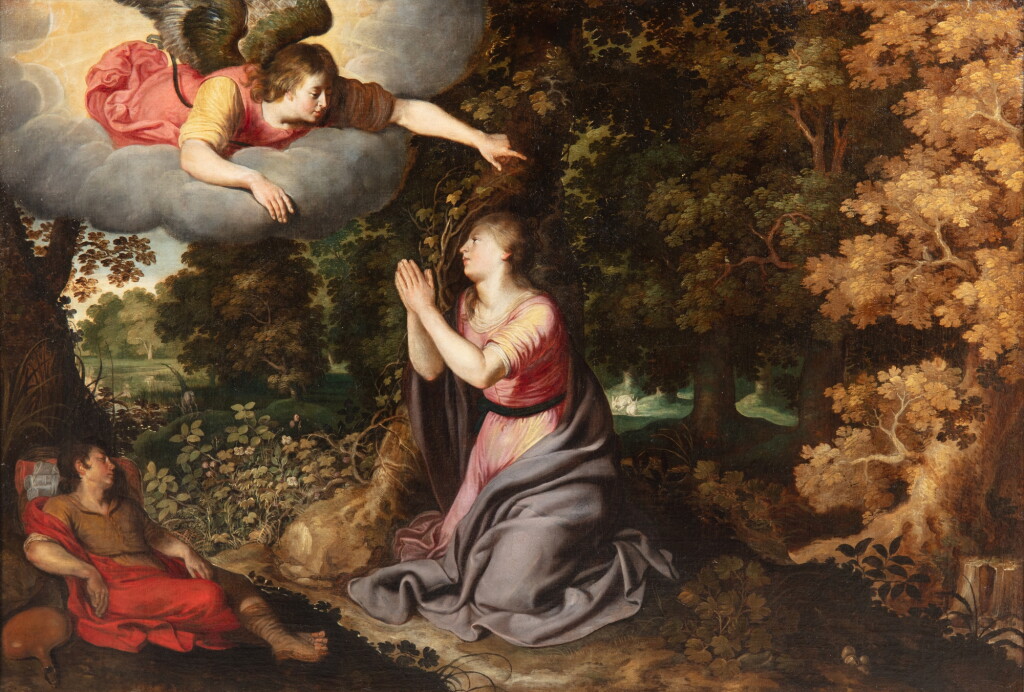
Attributed to Artus Wolffort
The Angel appears to Hagar
Lot Closed
June 13, 01:11 PM GMT
Estimate
20,000 - 30,000 EUR
We may charge or debit your saved payment method subject to the terms set out in our Conditions of Business for Buyers.
Read more.Lot Details
Description
Attributed to Artus Wolffort
Antwerp 1581 - 1641
The Angel appears to Hagar
Oil on canvas
115,5 x 167,8 cm ; 45½ by 66 in.
Collection Bernard Descheemaeker - Works of Art, Antwerp.
J. S. Held, 'Noch Einmal Artus Wollfort', in Wallraf-Richartz-Jahrbuch, 1981, vol. 42, pp. 143-156, pl. 8 (as Artus Wollfort).
A member of the Guild of St Luke in Dordrecht, then active in Antwerp from 1615 onwards, Artus Wolffort (1581–1641) was assistant to Otto van Veen and Rubens, whose influence profoundly marked his style. He probably then headed up his own workshop with assistants such as Pieter van Lint and Pieter van Mol. Although he painted a few mythological and genre scenes, Wolffort made his name mainly in religious painting, with scenes from the life of Christ, the Virgin, the Apostles and the Fathers of the Church. Following in the seventeenth century Antwerp tradition, he adopted the Baroque style with dynamic compositions distinguished by rich colours and expressive figures.
The present painting, The Angel Appearing to Hagar, was attributed to Wollffort in 1981 by Hans Vlieghe. It illustrates a rare theme in Flemish painting of the seventeenth century, taken from Genesis (21: 8–19). After being chased into the wilderness by Abraham, Hagar and her son Ishmael, exhausted, become lost. An angel appears to them and shows the mother a source of water, while the young boy sleeps with an empty gourd at his side. Hagar is shown kneeling, her palms joined together in gratitude.
The artist pays particular attention to the rendering of drapery and light, especially on the clothing worn by Hagar and the angel. He has replaced the biblical wilderness with a lush forest, a choice also made in a slightly later work, Hagar and Ishmael in the Desert by Gaspar de Crayer (Sotheby’s London, 30 July 1969, lot 47). Although the two compositions are similar – the angel in the top left corner, pointing at the water source, with the sleeping Ishmael below, both clothed in red draperies and facing Hagar – there is a perceptible difference in Hagar’s reaction. In Crayer’s painting she shrinks back from the apparition of the angel, while in the present painting she kneels before him.
A parallel has also been observed between this painting and another work: The Sacrifice of Abraham, whose size and composition are comparable. The two scenes echo each other, with the same narrative structure: an angel appearing to bring succour to a parent whose child is in danger.