Jan van den Hoecke
Sibyl
Lot Closed
June 13, 01:12 PM GMT
Estimate
12,000 - 18,000 EUR
We may charge or debit your saved payment method subject to the terms set out in our Conditions of Business for Buyers.
Read more.Lot Details
Description
Jan van den Hoecke
Antwerp 1611 - 1651
Sibyl
Oil on canvas
103,8 x 76,5 cm ; 40⅞ by 30⅛ in.
Anonymous sale, Christie's, London, 12 December 2003, lot 8 (as Attributed to Gaspar van den Hoecke);
Anonymous sale, Christie's, London, 23 April 2004, lot 25 (as Attributed to Gaspar van den Hoecke);
Private collection, Italy, 2004-2019;
Collection Bernard Descheemaeker - Works of Art, Antwerp.
H. Vlieghe, "Nicht Jan Boeckhorst, sondern Jan van den Hoecke, in: Beiträge zum internationalen Colloquium "Jan Boeckhorst - Maler der Rubenszeit" im Westfälischen Landesmuseum Münster, in Westfalen, LXVIII, 1990, pp. 167, nota 5, nº 11, p. 170, fig. 11;
M. Galen, Johann Boeckhorst. Gemälde und Zeichnungen, Hamburg 2012, pp. 361-362, ill. p. 364;
J. Sanzsalazar, 'Jan van den Hoecke (1611-1651), el pintor de Sibilas: exito, inspiracion y dispersion de una iconografia muy personal', in Philostrato, Revista de Historia y Arte, January 2019, pp. 11-32.
Son of Caspar van den Hoecke, whose apprentice he was, Jan van den Hoecke (1611-1651) was one of Rubens's main assistants. After a stay in Rome from 1635 to 1644, where he became close to the collector Cassiano dal Pozzo, he became the court painter to Emperor Ferdinand III in Vienna, before returning to Flanders in 1647, where he enriched the collections of Archduke Leopold Wilhelm.
Jan van den Hoecke favoured historical, religious and allegorical subjects in his oeuvre, developing a style that evolved into classicism, combining Flemish Baroque, the influence of Van Dyck and Rubens, and Italian idealization. With a rich, luminous palette and a particular focus on the rendering of flesh tints and drapery, he created a series of Sibyls, which were for a long time attributed to other painters in the School of Rubens.
The portrayal of these prophetic figures from antiquity, often associated with the prefiguration of Christ in Christian tradition, was a popular theme in Antwerp in the seventeenth century. As if echoing the prophets of the Old Testament, they allowed artists to merge humanist erudition, the taste for the antique, and religious symbols in their iconography. They decorated churches, libraries and private studies.
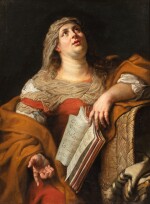
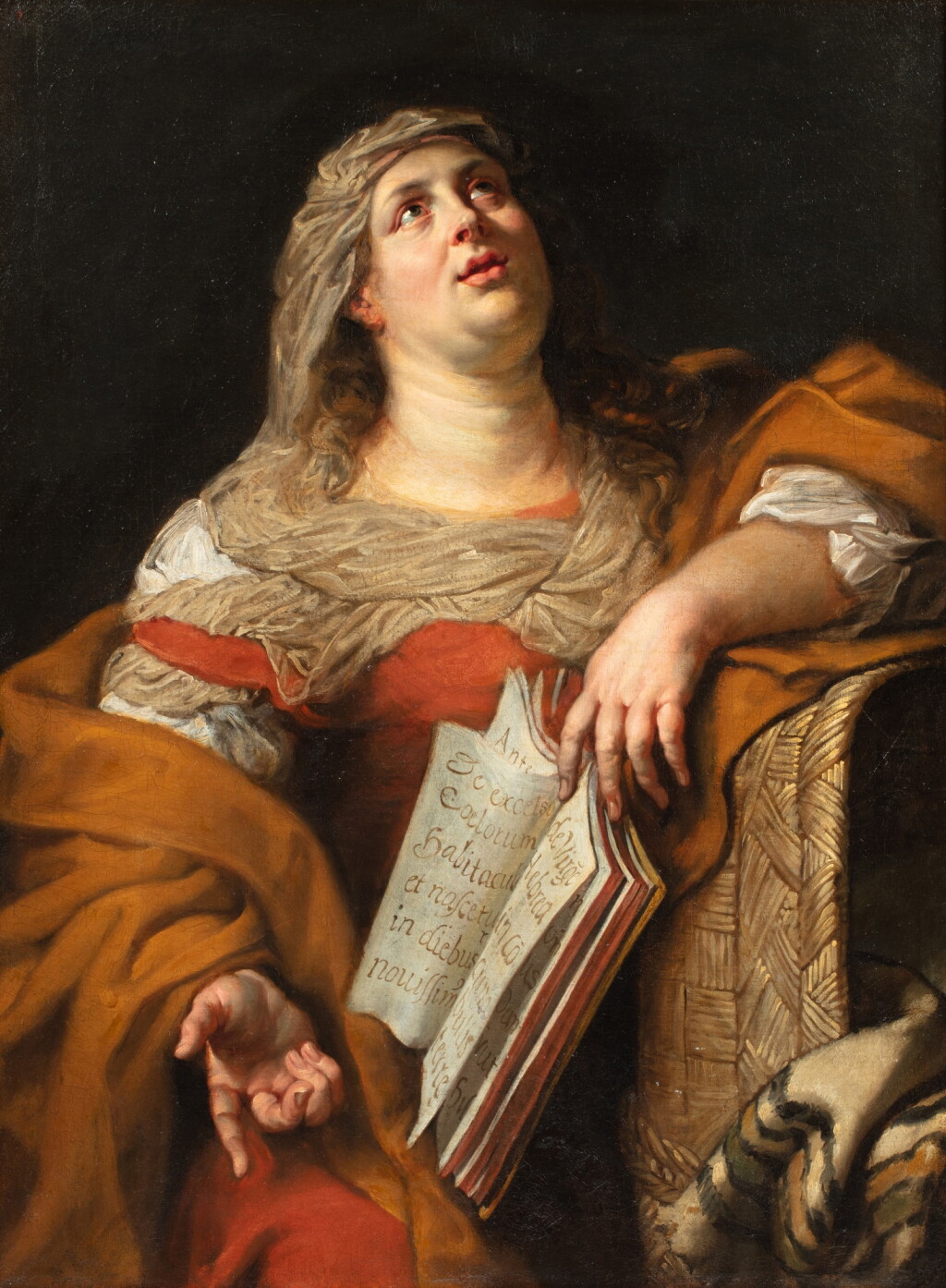
As in his Sibyl Agrippina (circa 1630, Düsseldorf, Museum Kunstpalast, M 125), who holds a whip and a crown of thorns – symbols of the Passion of Christ – the present Sibyl is shown bust-length, seated and draped in rich fabrics, carrying attributes and a prophetic inscription. Her head and gaze are turned upwards, seemingly drawing her wisdom from the heavens. With her right hand she makes a gesture as if speaking, while in her left she holds an open book inscribed as follows:
‘De excelsis coelorum habitaculo Et nascetur in diebus novissimis de virg[in]e hebraea in cunabulis terr[a]e’ (from the highest dwelling place of heaven, in the last days he will be born from a Hebrew Virgin, in the cradle of the Earth).
This passage, taken from Discordantiae sanctorum doctorum Hieronymi et Augustini: Sibyllarum et Prophetarum de Christo vaticinia, written by Filippo Barbieri in the fifteenth century, is associated by the author with the Hellespontine Sibyl, enabling the subject of our painting to be identified. Bridging pagan wisdom and Christian revelation, she rests her arm on a willow basket which may represent the cradle evoked in the passage but equally the basket in which Moses – an Old Testament figure often interpreted as a prefiguration of Christ in Christian exegesis – was placed in the Nile.
There are three further known versions of this Sibyl. The first, which seems to be of lesser quality, comes from the Visconde de Roda’s collection. Seized during the Spanish Civil War, it is only known from a photograph and bears the inscription ‘HELESPOTICA’. The second, described as a nameless Sybil belongs to the Campbell series in Scotland. The third is in the Musée Tessé in Le Mans (inv. 10.647).