
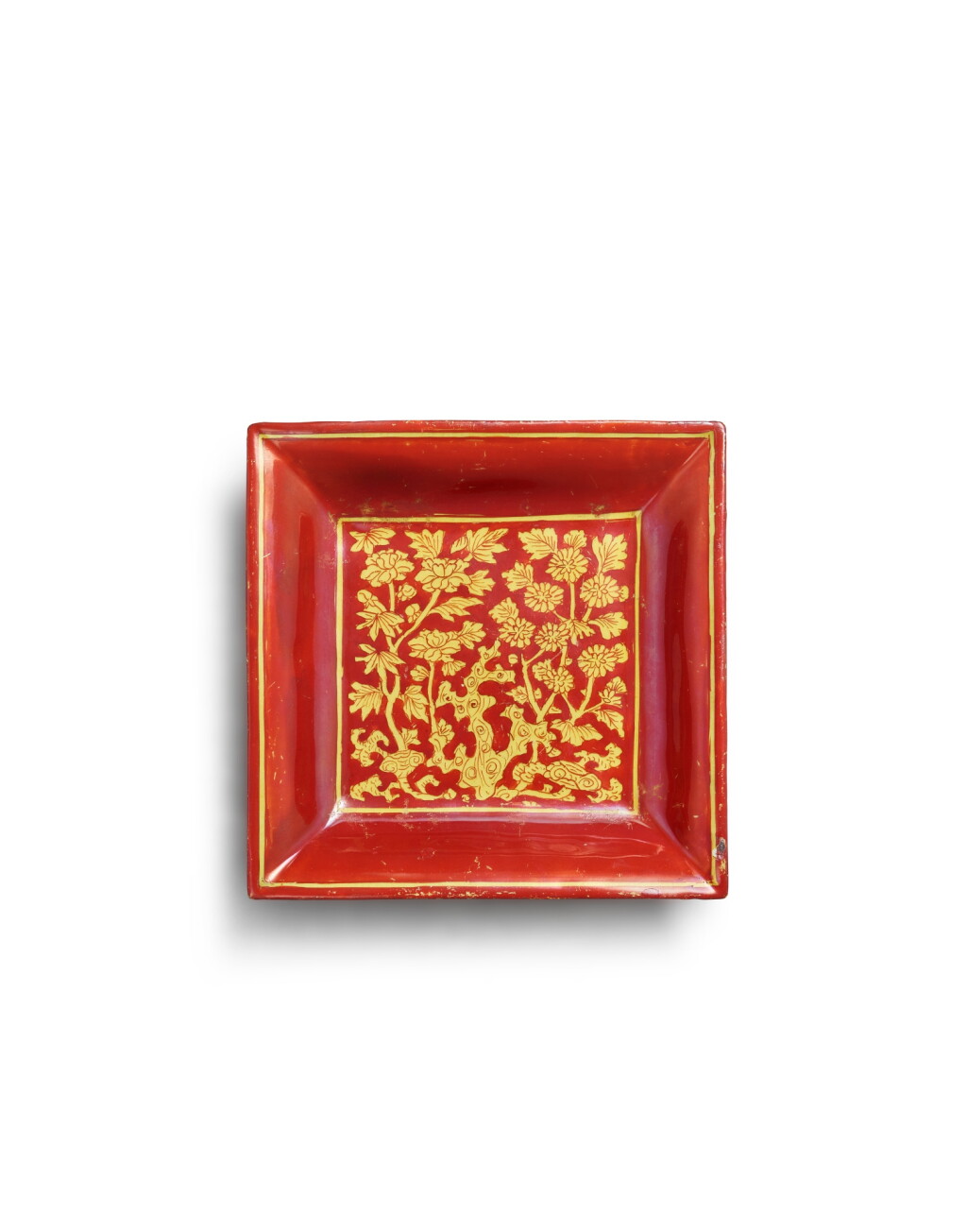
A very rare yellow-ground and iron-red decorated square dish, Mark and period of Jiajing | 明嘉靖 黃地紅彩菊花牡丹紋方盤 《大明嘉靖年製》款
Auction Closed
September 9, 11:30 AM GMT
Estimate
800,000 - 1,600,000 HKD
Lot Details
Description
sturdily potted with flaring sides supported on a slightly tapered foot, the interior painted in iron-red enamel with finely pencilled outlines against a yellow ground with sprays of chrysanthemum, peony and lingzhi emerging from jagged rockwork, the exterior similarly decorated, the base inscribed in underglaze blue with a six-character reign mark, Japanese wood box
19 cm
Collection of the Sekido family, Aichi.
Collection of Sozaemon Nishimura XIII.
Collection of Susumu Watanabe.
A Japanese private collection.
Mayuyama & Co., Ltd, Tokyo.
Chugoku Meito Hyaku-sen / A Loan Exhibition of One Hundred Selected Masterpieces from Collections in Japan, England, France and America, Takashimaya, Tokyo, 1960, cat. no. 88.
Chugoku Mitou Ten [Chinese Ceramics. A loan exhibition of selected masterpieces], Hiroshima Fukuya, Hiroshima, 1961, cat. no. 7.
Chugoku Meito Hyaku-sen / A Loan Exhibition of One Hundred Selected Masterpieces, Takashimaya, Osaka, 1961, cat. no. 78.
Chugoku Min Shin Bijutsu Ten Mokuroku / Chinese Arts of the Ming and Ch'ing Periods, Tokyo National Museum, Tokyo, 1963, cat. no. 336.
Chugoku Toji Meihin Ten Ise Korekushon no Shiho / Masterpieces of Chinese Ceramic Art Exhibition, Ishikawa Prefectural Museum of Art, Ishikawa, 2012, cover and cat. no. 67.
Shika Meisai: Ise Korekushon no Meito / Imperial Colors: Peerless Chinese Porcelains from the Ise Collection, Gotoh Museum, Tokyo, 2015, cat. no. 21.
Porcelaine. Chefs-d'œuvre de la Collection Ise, Musée Guimet, Paris, 2017, cat. no. 46.
Ise Korekushon Sekai wo Miryoshita Chugokutoji / The Enchanting Chinese Ceramics from the Ise Collection, Museum of Oriental Ceramics, Osaka, 2017, cat. no. 60.
Toujikyokai Kaiin Gentei Dainikai Tokubetsu Kanshokai Ise Collection Chugoku Toji To, Hokuso, Nanso, Gen, Min, Shin [Special exhibition for the members of The Japan Ceramic Society, Part 2, Chinese porcelains from Ise Collection; Tang, Northern Song, Southern Song, Yuan, Ming and Qing], Japan Ceramic Society, Tokyo, 2019, unillustrated.
Naohiko Masaki, et al., Genshokuban Toji Taikan [Complete survey of ceramics in color edition], vol. 8: Chinese polychrome, Tokyo, 1938, pl. 38.
Fujio Koyama ed., Chinese Ceramics: One hundred selected masterpieces from Collections in Japan, England, France and America, Tokyo, 1960, p. 99.
Ryoichi Fujioka, Toki Zenshu [The complete works of ceramics], vol. 27: Min no Akae [Polychrome in Ming dynasty], 1962, pl. 28.
Ryoichi Fujioka, Min no Akae, Toji Taikei [Compendium of Ceramics], vol. 43, Heibonsha, Tokyo, 1972, pl. 60.
Chugoku Toji. Ise Korekushon / Chinese Ceramics. The Ise Collection, Tokyo, 2012, pp. 86-87.
Tosetsu / A Monthly Journal Published by the Japan Ceramic Society, vol. 803, March 2020, pl. 7.
The yellow-ground iron red-decorated porcelain of the Jiajing period (1522-1566) in the Ming Dynasty represents the pinnacle of imperial colored ceramics, renowned for its intricate craftsmanship and extreme rarity. These works embody the distinctive aesthetic sensibilities and technological innovations characteristic of the Jiajing era. It was most likely the onerous production method that precluded a more widespread use: three necessary firings – one for the clear-glazed porcelain, one for the yellow overglaze enamel and a third for the design-bearing iron-red enamel – and the fact that the red, which had to be painted around the design to be reserved, proved difficult to apply in an even manner, must have accounted for high failure rates.
The Jiajing Emperor was a devout Daoist, and his commissioned wares frequently featured motifs symbolising longevity. This dish exemplifies this tradition with its yellow-glazed ground reserved to form gnarled tree trunks, from which sprout peonies and chrysanthemums painted in iron-red pigment, flanked by lingzhi. The peony, revered as the "king of flowers," represents both wealth and imperial authority. Chrysanthemums symbolise extended longevity, and the combination with peonies expresses the auspicious wish for "everlasting wealth and springtime" (fugui changchun) – a visual articulation of the Jiajing Emperor's Daoist pursuit of immortality that reflects the Daoist cosmological vision of perpetual regeneration.
The use of yellow glaze was exclusively reserved for the imperial household, as explicitly mandated in the Da Ming Hui Dian (Collected Statutes of the Ming Dynasty), which strictly prohibited its employment by commoners. The striking visual contrast of yellow-ground red-decorated wares served to reinforce imperial authority, with production tightly controlled by the imperial kilns at Jingdezhen. Private kilns (minyao) were incapable of replicating such pieces, making this dish exceptional.
Dishes of this type are extremely rare, with only a handful of known examples preserved in public and private collections. One is preserved in the Victoria and Albert Museum, London, bequeathed by Henry Blackwall Harris, accession no. C.110-1929; another resides in the Harvard Art Museums, bequeathed by Samuel C. Davis, accession no. 1940.223; a third is in the collection of Umezawa Hikotaro, illustrated in Mindai no Sometsuke to Akae [Ming dynasty blue and white and red-enamelled porcelain], Tokyo, 1953, pl. 45.
來源
関戸家收藏,愛知縣
十三代西村總左衛門收藏
渡部迪收藏
日本私人收藏
繭山龍泉堂,東京
展覽
《中国名陶百選》,髙島屋,東京,1960年,編號88
《中国名陶展》,福屋,廣島,1961年,編號7
《中国名陶百選展》,髙島屋,大阪,1961年,編號78
《中国明清展目録》,東京國立博物館,東京,1963年,編號336
《中国陶磁名品展―イセコレクションの至宝》,石川県立美術館,石川,2012年,封面及編號67
《瓷華明彩―イセコレクションの名陶》,五島美術館,東京,2015年,編號21
《Porcelaine. Chefs-d'œuvre de la Collection Ise》,吉美博物館,巴黎,2017年,編號46
《イセコレクション―世界を魅了した中国陶磁》,大阪市立東洋陶瓷美術館,大阪,2017年,編號60
《陶磁協会会員限定 第二回特別観賞会 イセコレクション 中国陶磁 唐、北宋、南宋、元、明、清》,日本陶磁協会,東京,2019年,沒載圖
出版
正木直彦等,《原色版陶磁大観》,卷8:中國赤繪,東京,1938年,圖38
小山富士夫編,《中國名陶百選》,東京,1960 年,頁99
藤岡了一,《陶器全集》,卷27:明の赤絵,東京,1962年,編號28
藤岡了一,《陶磁大系》,卷43:明の赤絵,東京,1972年,編號60
《中国陶磁―イセコレクション》,東京,2012年,頁86至87
《陶説》,803期,2020年3月,圖版7
明朝嘉靖時期的黃地紅彩瓷器是宮廷御用彩瓷的傑出代表,其工藝複雜、存世稀少,體現了嘉靖朝獨特的審美取向與技術革新。黃地紅彩俗稱黃上紅,釉彩套迭工藝繁複,窰燒三次方能成器。先以高溫燒瓷胎;第二次以高溫燒成黃釉器;最後以紅彩塗飾紋飾之外的地子,襯托出黃色花紋,以低溫烘烤,稍一不慎,前功盡廢,不能成器。
嘉靖帝篤信道教,器物多採用象徵「長生」的紋飾為主題。此盤以黃釉為地,紅彩塗繪,留出黃地劃樹樁,生出牡丹和菊花,兩側伴靈芝。牡丹為花王,象徵富貴,更代表皇權;菊花寓延壽之意,菊花常與牡丹構成富貴長春的美好意願。契合嘉靖皇帝追求長生的道教信仰,反映道教生生不息的宇宙觀。
黃釉為皇室專用,《大明會典》明確說明嚴禁民間使用。黃地紅彩通過視覺效果強化皇權象徵,其生產由御窰器廠嚴格把控,民窰無法仿製。此盤相同例子寥若晨星,甚為珍罕。目前已知存世僅有三例,倫敦維多利亞與艾爾伯特博物館貯一例,由 Henry Blackwall Harris 捐贈,館藏編號 C.110-1929;另一例藏於哈佛藝術博物館,由 Samuel C. Davis 捐贈,館藏編號1940.223;第三例為梅澤彥太郎舊藏,收錄於《明代の染付と赤絵》,東京,1953年,圖版45。
You May Also Like


