
Exceptional Discoveries: The Olmsted Complications Collection
Charles Frodsham, London
An exceptionally rare, very large and impressive yellow gold open-faced keyless eight-day pocket chronometer with duo-in-uno hairspring and up-and-down indication, No. 09587, 1915
Auction Closed
December 8, 10:03 PM GMT
Estimate
20,000 - 40,000 USD
Lot Details
Description
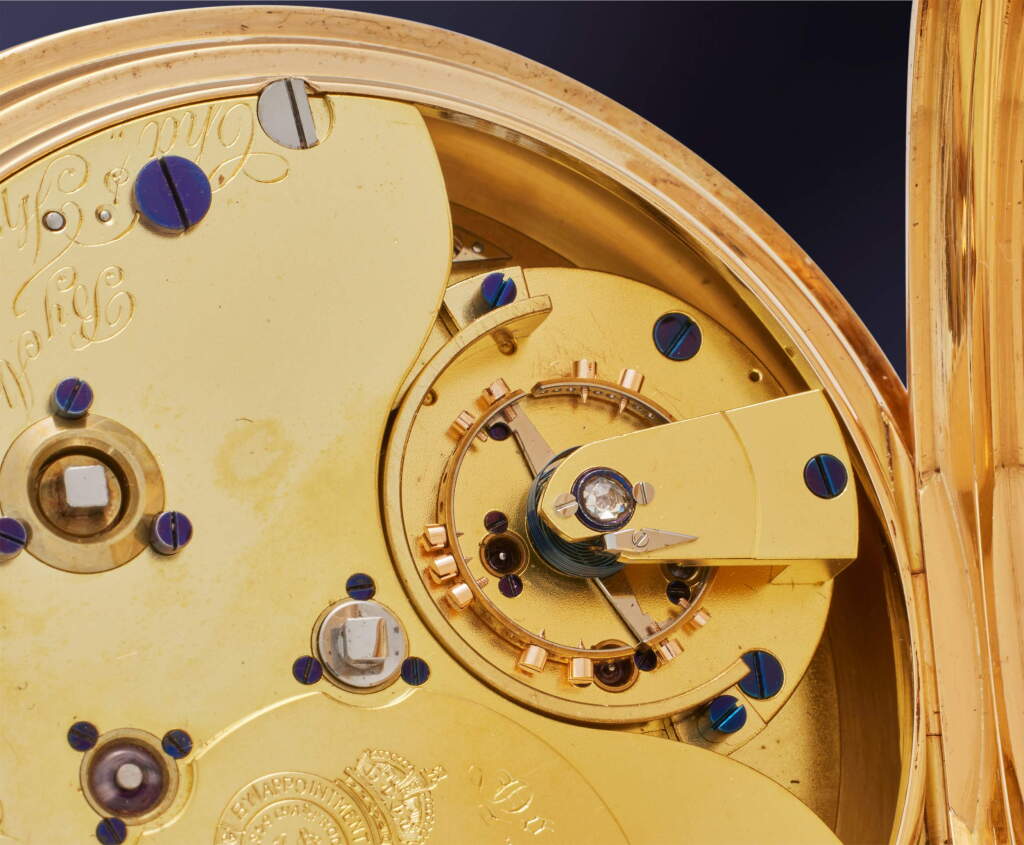
Movement: frosted gilded three-quarter plate movement, chain fusee, spring detent escapement, free-sprung bi-metallic compensation balance, duo-in-uno hairspring, diamond endstone, the backplate signed By Appointment to the King, Chas Frodsham, 27 South Molton St, London, AD Fmsz, No. 09587
Dial: silvered dial, Roman numerals, subsidiary dials for constant seconds and up-and-down indication for 8-day duration, signed Charles Frodsham, London, No. 09587, AD Fmsz
Case: 18k yellow gold engine-turned case centered by a blank rondel, stepped bezel, olivette for hand setting with protective shoulders, swiveling thief-proof bow, case with London hallmarks for 1915-16, HMF sponsor’s mark for Harrison Mill Frodsham, numbered 09587, cuvette stamped HMF and 87
Signed: dial and movement signed Charles Frodsham, case and cuvette stamped HMF
Depth: 24 mm
Diameter: 72 mm
Sotheby’s London, February 23,1984, Lot 132, sold for £20,900
Published in 1981, before the appearance of this watch at Sotheby’s in 1984, Vaudrey Mercer’s monograph The Frodshams does not contain a listing for this extremely rare long duration chronometer watch. Within the author’s section on Complicated Watches, Mercer lists only one eight-day Frodsham watch, no. 06398, a piece dating from 1886 with a ratchet-tooth lever escapement and twin going barrels. No. 06398 now survives as a movement/dial only and can be found in the collections of the British Museum. Some thirty years later in date, the present watch, no. 09587, is superior both by virtue of the complexity of its fusee movement with chronometer escapement and its exceptional originality and completeness. Also notable is the fact that the present watch has an up-and-down indicator on the dial, marked for each of the eight days of its duration; by contrast, the dial of no. 06398 has no state-of-wind indicator.
The primary challenge in producing a long-duration movement lies in maintaining an even distribution of power throughout the watch’s running period. When fully wound, a mainspring is at its peak strength, which then gradually decreases as it uncoils. Without a carefully calibrated gear train and escapement to regulate the release of energy, a weakening mainspring can cause irregular timekeeping. In a watch wound daily, with a typical 35-hour power reserve, this variance is relatively easy to compensate for; but in an eight-day movement, maintaining power consistency becomes significantly more complex. In the present watch, the solution lies in a movement of substantial size, incorporating a correspondingly large mainspring and a fusee that compensates for variations in mainspring strength as it unwinds. Release of the movement’s energy is precisely controlled by a highly refined spring detent escapement, ensuring constancy of rate.
One of the rarest and most impressive watches ever made by Charles Frodsham, the present example is now appearing on the market for the first time in over forty years.