
Exceptional Discoveries: The Olmsted Complications Collection
Charles Frodsham, London
A yellow gold open-faced keyless lever six-minute tourbillon watch with Kew A ‘Especially Good’ rating, No. 08978, 1905
Auction Closed
December 8, 10:03 PM GMT
Estimate
7,000 - 10,000 USD
Lot Details
Description
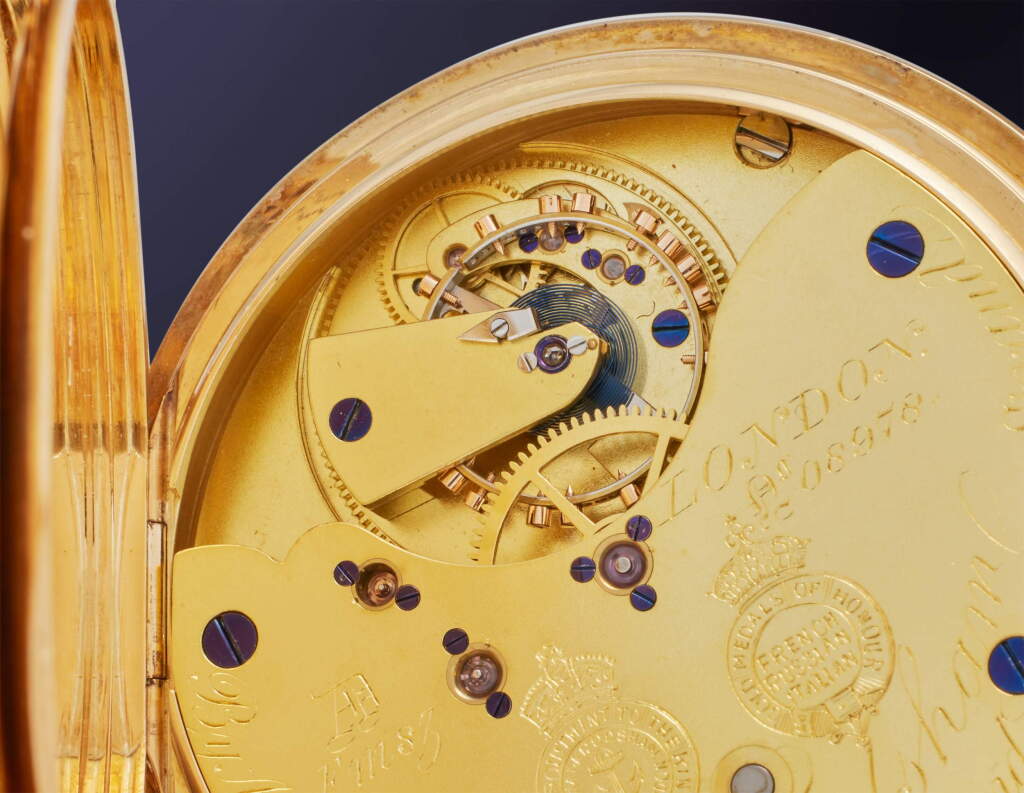
Movement: frosted gilded two-third plate Nicole, Nielsen & Co. movement, going barrel, Robert Benson North patent six-minute tourbillon carriage mounted with a ratchet-tooth lever escapement, free-sprung bi-metallic compensation balance, blued steel balance spring with overcoil, diamond endstone, backplate signed Chas Frodsham, By Appointment to the King, 115 New Bond St, late of 84 Strand London, AD Fmsz, No. 08978
Dial: silvered dial, Roman numerals, subsidiary dial for constant seconds, blued steel spade Breguet hands, signed Chas Frodsham, 08978, AD Fmsz
Case: 18k yellow gold, olivette for hand setting with protective shoulders, case back engraved with the Aber family crest of a rampant demi-talbot above the motto Fidelis, London hallmarks for 1905-06, sponsor’s mark HMF for Harrison Mill Frodsham, numbered 08978, cuvette stamped 78
Signed: dial and movement signed Charles Frodsham, case stamped HMF for Harrison Mill Frodsham
Diameter: 53 mm
Reinhard Meis, Das Tourbillon, Munich: Laterna Magica, 1986, p. 345.
Vaudrey Mercer, The Frodshams: The Story of a Family of Chronometer Makers, Antiquarian Horological Society, 1981, pp. 216, 262.
Frodsham no. 08978 was entered into trials three times between 1903 and 1905, achieving its highest score at the November 1905 trials, where it attained 82.4 marks and a Class A “Especially Good” certification. The outer case back bears the crest of the Aber family (a rampant demi-talbot) together with the motto Fidelis, meaning “faithful.”
This Frodsham incorporates a six-minute tourbillon movement supplied by Nicole, Nielsen & Co., constructed according to the designs of Robert Benson North’s 1903 patent (no. 6737). On 23 March 1903, North, then owner of Nicole, Nielsen & Co., applied for a patent for his “Improvements in Revolving Escapements for Watches and Other Portable Timekeepers.” In his design, the revolving toothed carriage is supported from beneath on a steel stud fixed to the pillar plate, dispensing with the upper bridge or support traditionally found above the tourbillon. This not only allowed for a slimmer movement profile but also, aesthetically, provided a clearer view of the escapement. As North noted in his patent application, “as compared with watches of ordinary construction, that is to say made with stationary platform or fixed escapement, the thickness of my watch is not at all increased.” North also claimed that the method of driving the carriage reduced friction and thereby minimised wear over time. In this form, the carriage’s construction is described as a ‘flying tourbillon’ and is frequently confused with the karrusel. The invention of the flying tourbillon is often credited to Arthur Helwig in 1920, however, North’s design is considerably earlier and the first tourbillon design to have been made without an upper supporting pivot. [i]
In the present watch, the carriage rotates once every six minutes - a period of revolution also found in certain examples by the tourbillon’s inventor, Abraham-Louis Breguet. Breguet invented the tourbillon around 1795, and his patent application for the device dates to 1801. His first two tourbillon watches had carriages with one-minute revolutions, followed by a series of four-minute tourbillons made between 1808 and 1815 (some sold as late as 1822). Around 1816, Breguet introduced a six-minute tourbillon carriage in a new, markedly slimmer style of tourbillon watch, although the carriage remained supported and fixed from both sides (for an example, see Sotheby’s Geneva, 3–16 June 2020, lot 27).
[i] Confirmation provided by David Penney in Pierantonio Maragna, Nicole, Nielsen Watchmakers, 2025, p. 93.