
Exceptional Discoveries: The Olmsted Complications Collection
Charles Frodsham, London
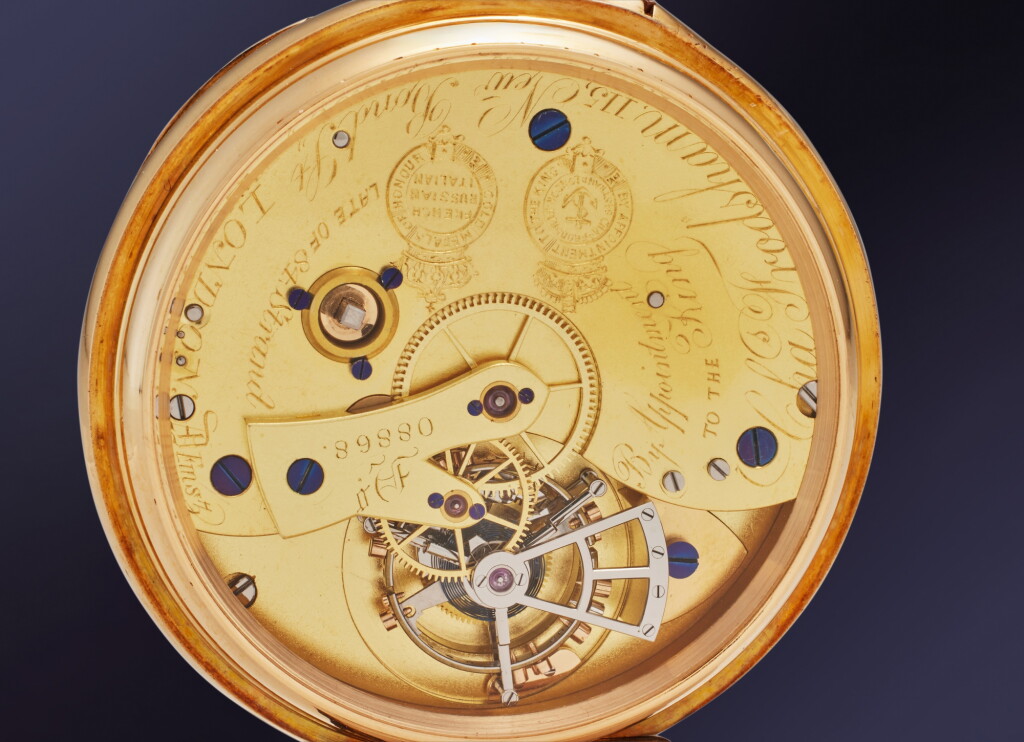
A yellow gold open-faced keyless one-minute tourbillon watch with up-and-down indication and Kew A ‘Especially Good’ rating, No. 08868, 1901-02
Auction Closed
December 8, 10:03 PM GMT
Estimate
30,000 - 50,000 USD
Lot Details
Description
Movement: frosted gilded three-quarter plate Nicole, Nielsen & Co. movement, chain fusee, lever escapement with double roller, bi-metallic compensation balance, blued steel balance spring with overcoil, Nicole Nielsen type-2 one-minute tourbillon carriage with polished steel bridges and open work balance cock, signed and numbered By Appointment to the King, Chas Frodsham, 115, New Bond Street, London, late of 84 Strand, AD Fmsz, No. 08868
Dial: silvered dial, Roman numerals, subsidiary dials for constant seconds and up-and-down indication, signed Chas Frodsham 08868 AD Fmsz
Case: 18k yellow gold, olivette for hand setting with protective shoulders, swiveling thief-proof bow, glazed cuvette, case back interior with London hallmarks for 1901-02, sponsor’s mark HMF for Harrison Mill Fordsham, and numbered 08868
Signed: dial, and movement signed Charles Frodsham, case back interior stamped HMF
Diameter: 52.5 mm
Reinhard Meis, Das Tourbillon, Munich: Laterna Magica, 1986, p. 345.
Vaudrey Mercer, The Frodshams: The Story of a Family of Chronometer Makers, Antiquarian Horological Society, 1981, pp. 262 & 276.
Frodsham no. 08868 was submitted to the Kew Observatory trials on three occasions - in July 1902, December 1902, and September 1908. Its Kew Certificates were respectively numbered 11126 (Class A), 11262, and 13344 (Class A “Especially Good”). The watch achieved its highest score, 85.8 marks, in the December 1902 trial, where it was Frodsham’s best-performing entry with a mean daily rate variation of only 0.4 seconds.
The 1902 trials were exceptionally competitive, with 530 watches entered - a significant increase from the 363 tested in 1901. That year, Frodsham received Kew ratings for three tourbillon watches (nos. 08867, 08868 and 08928). Of these, nos. 08868 and 08928 each received a Class A “Especially Good” certificate, with the present watch achieving the highest marks of the three. Overall, watch no. 08868 was ranked 26th out of the 530 entries. The 1902 trials were a closely fought contest, with just seven points separating first place from twenty-sixth.
As recorded in the Kew Observatory records reproduced by Vaudrey Mercer in The Frodshams, a total of 38 Frodsham tourbillon watches received Kew Certificates between 1889 and 1928, making the present watch one of the earliest to be successfully entered.