
Exceptional Discoveries: The Olmsted Complications Collection
Dent, London
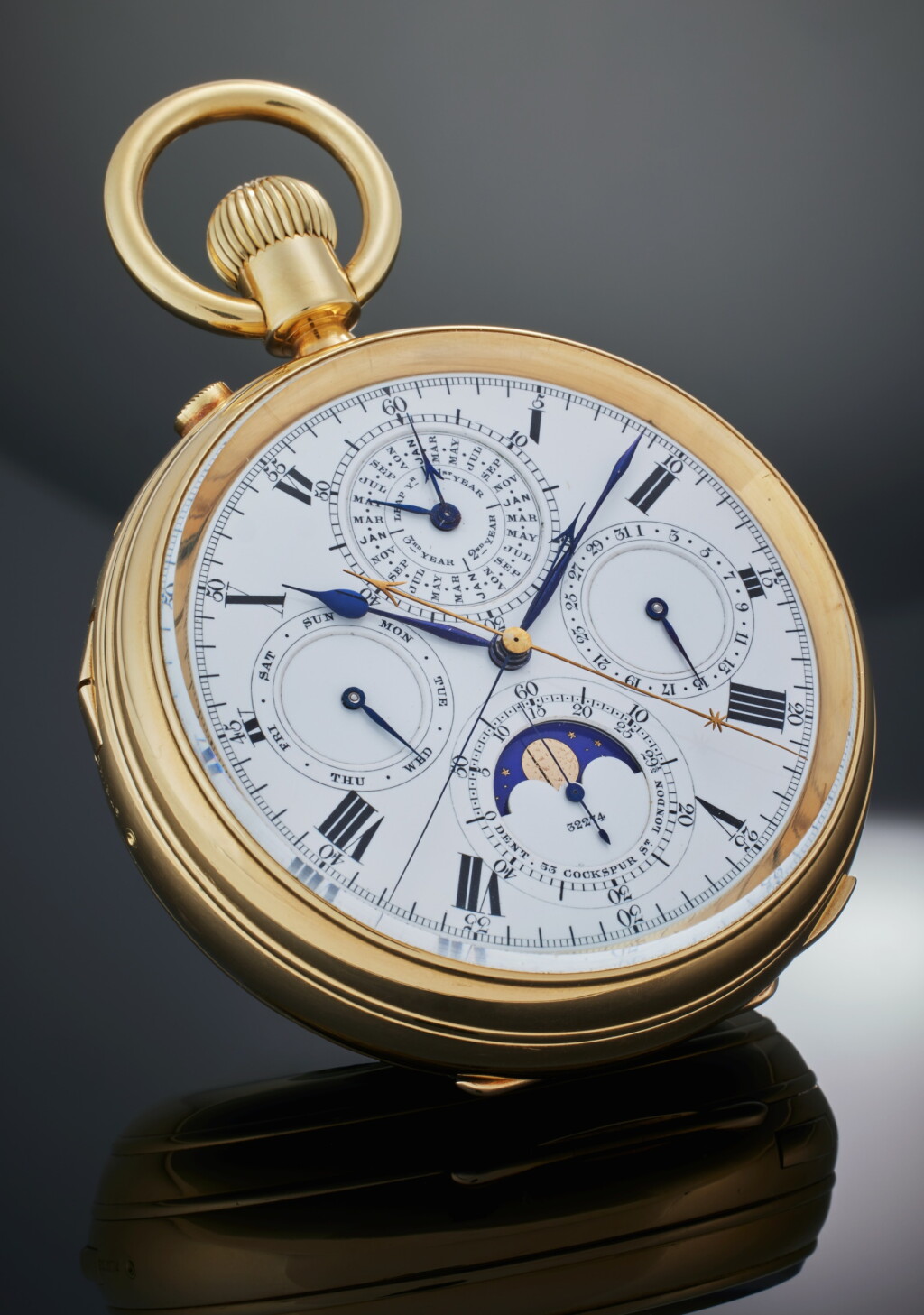
An important oversize yellow gold open-faced two train keyless one-minute tourbillon, grande and peitite sonnerie clock watch with minute repetition, split seconds chronograph and perpetual calendar with moon phases No. 32274, hallmarked 1901-2
Auction Closed
December 8, 10:03 PM GMT
Estimate
150,000 - 250,000 USD
Lot Details
Description
Movement: frosted gilded three-quarter plate two-train movement, ratchet-tooth lever escapement mounted on a one-minute tourbillon carriage, Nielsen type 1 cage with polished stepped arms and bridge, bi-metallic compensation balance with timing and poising screws, tria-in-uno balance spring, chronograph and split-mechanism partially visible to the backplate, signed Dent, Watchmaker to Her Late Majesty, 33 Cockspur St, London, no. 32274
Dial: white enamel dial attributed to Willis, Roman numerals, four subsidiary dials indicating day, date and months calibrated for four-year leap cycle combined with 60-minute register, subsidiary seconds combined with aperture for moon phases, the moon age calibrated to its edge, outer scale for minutes/chronograph seconds calibrated to fifths and with Arabic 5-minute markers, signed Dent 33 Cockspur St , London 32274
Case: 18k yellow gold case, large pusher beside crown for engaging winding, slides in the band for selecting strike/silent, hours & quarters/quarters only, and trip repetition, recessed pushers for calendar correction, hinged gold cuvette, London hallmarks for 1901-2, sponsor’s mark RN for Robert Benson North trading as Nicole, Nielsen & Co., case back numbered 32274, cuvette numbered 74
Signed: dial and movement signed Dent, case and cuvette stamped RN for Robert Benson North trading as Nicole, Nielsen & Co.
Diameter: 66.5 mm
Depth: 25.5 mm
Harold P. Berger.
Purchased from the above in 1970 via E. Greenberg, New York and Edgar Mannheimer, Zurich.
Mercer, Vaudrey, Edward John Dent and His Successors, Antiquarian Horological Society, 1977, p. 682 & 707.
Among the most exceptional, costly, and mechanically complex timepieces of its era, this remarkable watch stands as one of the most significant achievements of English horology at the turn of the twentieth century.
Nicole, Nielsen & Co., who supplied the movement to Dent in 1901,[i] were the only English manufacturer to produce tourbillon watches incorporating additional complications such as chronograph, minute repetition and perpetual calendar.[ii] Within the extensive individually numbered references of watches recorded in Vaudrey Mercer’s monograph on Dent, the present example is the only piece by the firm noted by the author to combine a tourbillon with the function of a clock watch. Furthermore, it is distinguished by the additional complications of minute repetition, perpetual calendar with moon phases, and split seconds chronograph.
The well-known Nicole, Nielsen & Co. wholesale catalogue of slightly later date (circa 1910) does not illustrate this exact configuration; the closest example, featuring similar complications but crucially without a tourbillon, was priced at £240 - the highest figure among the listed watches. For context, a first-quality, 18-carat gold open-faced lever watch in the same catalogue was priced at £25. However, a watch incorporating a tourbillon, such as the present example, had it been included, would have been illustrated within the section marked “price on application”, reserved for the firm’s most complex and costly pieces, with a markedly higher price.
As a measure of the impeccable finishing lavished on the movement, this watch includes the rarely seen tria-in-uno balance spring, a form of hairspring that was notoriously difficult to make, requiring exceptional skill on the part of the springer to avoid distortion when forming and hardening both ends of the spiral. The invention, by John Hammersley, is discussed by David Boettcher in The Horological Journal (July 2018). The tria-in-uno was devised in 1860 to overcome the problem of “acceleration” in new chronometers, where balance springs hardened and bent after tempering would initially gain rate before stabilising. Hammersley’s solution was a spring that required no bending after hardening, thereby avoiding internal stress. His design combined three elements in one: a central helical (cylindrical) section with flat spiral coils at both the top and bottom, which could be pinned directly to the collet and stud. This ingenious construction gave the tria-in-uno all the advantages of a cylindrical spring - excellent isochronism, stable timekeeping, and freedom from acceleration - while remaining relatively slim, making it particularly well suited to compact, high-grade watches such as this. From this concept emerged the duo-in-uno, a simplified form retaining the helical section but with only one flat spiral coil instead of two. Introduced in 1862, it was exhibited by John McLennan and A.P. Walsh, both of whom claimed its invention. Hammersley, however, maintained that it was simply derived from his own tria-in-uno, remarking that it could be made “by cutting one end off.”
Nicole, Nielsen & Co.
Nicole, Nielsen & Co. traces its origins to Adolphe Nicole’s partnership with Henry Capt in Geneva around 1837, when the firm was first known as Nicole & Capt. By 1840, they had established a London branch at 80B Dean Street, Soho and in 1843 were already supplying watches to Dent. In October the following year Adolphe Nicole applied for a patent which included his groundbreaking keyless winding and hand setting system. The patent (no. 10348) was granted on 12 April 1845 and helped lay the foundation for the firm’s reputation for technical refinement and mechanical complexity. Further patents followed, enhancing their position among the foremost watchmakers in Britain.
In 1858, the company relocated to 14 Soho Square, where it would remain for the rest of its existence. Sophus Emil Nielsen - a talented Danish watchmaker who married Nicole’s daughter in 1872 joined the company. He brought new ideas and secured Patent No. 13,336 in 1884 for his “Up-and-Down” power-reserve indicator mechanism. The company became known as Nicole, Nielsen & Co., continuing its tradition of innovation and high-grade craftsmanship.
During the late 19th century, Nicole, Nielsen & Co. earned an enviable reputation for producing precision and complication movements, including chronographs, perpetual calendars, and tourbillons, which were supplied to distinguished firms such as Dent, Charles Frodsham and S. Smith & Son. The firm became a limited company in 1888 and continued to expand under Robert Benson North, who assumed leadership from 1898. Under North’s direction, the company diversified and included ventures into tourbillon carriage clocks and, later, automotive instruments such as speedometers, adapting to the technological changes of the early 20th century.
By the 1920s, following the disruption of World War I, the company had shifted its focus primarily to speedometer production and, in 1917, was renamed North & Sons Ltd. The firm’s watchmaking operations gradually declined, and by 1934 the factory at 14 Soho Square closed, marking the end of Nicole, Nielsen & Co. as one of Britain’s most accomplished horological manufacturers.
Dent
Edward John Dent was born in 1790 and apprenticed at the age of fourteen to his grandfather, a tallow chandler. During this period he lodged with his cousin Richard Rippon, a watchmaker, whose influence inspired his interest in horology. With his grandfather’s consent, he transferred the remainder of his apprenticeship in 1807 to Edward Gaudin, a London watchmaker. Dent quickly established himself as an outstanding craftsman and, between 1815 and 1829, worked as a chronometer maker for several leading British firms, including Vulliamy, Barraud, and McCabe.
By 1830, Dent’s reputation was such that John Roger Arnold invited him into partnership at 84 Strand, London - a collaboration that lasted ten years. In 1831, Dent was admitted to the Worshipful Company of Clockmakers and became a Freeman of the City of London. In 1840, he established his own business at 82 Strand, and by 1843 had opened further premises at 33 Cockspur Street, the address appearing on the dial of the present watch.
Edward Dent died in 1853, leaving his business to his two stepsons, Frederick and Richard Rippon, on condition that they adopt his surname. Frederick managed the firm’s premises at the Royal Exchange and the Strand, while Richard took charge of the Cockspur Street branch. Neither long outlived their stepfather - Richard died three years later and Frederick after seven - whereupon their respective businesses passed to their widows and sisters. Richard’s branch continued under his widow Marianna Frederica Dent as M. F. Dent, while Frederick’s was inherited by his mother and sisters, Elizabeth and Amelia.
Among Edward John Dent’s many achievements, he is best remembered as the clockmaker awarded the contract to build the Great Westminster Clock, popularly known today as “Big Ben”, housed in the Elizabeth Tower at the Palace of Westminster.
[i] Mercer, Vaudrey, Edward John Dent and His Successors, Antiquarian Horological Society, 1977, p. 707.
[ii] Pierantonio Maragna, Nicole, Nielsen Watchmakers, Self Published, 2025, p. 148.