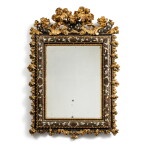
A Pair of George III Grey-Painted Mirrors attributed to John Linnell, Circa 1770
No reserve
Auction Closed
October 15, 06:30 PM GMT
Estimate
120,000 - 180,000 USD
Lot Details
Description
with bevelled central rectangular plate and divided border plates in a moulded arched frame carved with acanthus, C-scrolls, shellwork and trailing husks; previously but not originally gilded; probably retaining elements of original painted surface
height 79 1/4 in.; width 42 in.
201.5 cm; 106.5 cm
Sotheby's New York, Property of a Palm Beach Collector, 29 March 2011, lot 147
John Linnell (1729–1796) may have followed in his father’s footsteps as a furniture maker, but was evidently also gifted with fluid, attractive draughtsmanship skills that have left us some of the most beautiful furniture designs of the eighteenth century. No doubt nurtured by his training at St Martin's Lane Academy, Linnell’s large corpus of drawings and watercolours now in the collection the Victoria & Albert Museum are a key tool in the attribution of furniture pieces to Linnell and our understanding of his role in the luxury furniture trade. The closest drawing to the present mirror is probably one of the two held under the accession number E.177-1929, sharing the overall profile and the combination of foliate carving with the festoon motifs and ribbed outline. The present lot is more of an amalgam of several related Linnell designs, though, with the crest more similar to E.205-1929, and much of the overall spirit also close to E.208-1929, E.192-1929 and E.180-1929. Beyond the drawings, there are also extant examples of mirrors by Linnell that are similar to the present pair, including large pier mirrors at Dyrham Park, Gloucestershire (NT 453038) and Stourhead, Wiltshire (NT 731605); a festooned example at Hopetoun House, Midlothian and another example at the Legion of Honor Museum, San Francisco.1 There have also been numerous examples at auction that have been attributed to Linnell on stylistic grounds.2
The ornament of this design is best described as part of Linnell’s ‘Transitional’ period between the Rococo pieces from earlier in his career and the Neoclassical furniture that he later produced with Robert Adam. In French scholarship, this period in furniture history is sometimes given the name rocaille symétrisé,3 which more precisely identifies the new regularity and less effusively naturalistic form of ornament when compared to the high-water mark of the abundant and spontaneous Rococo. Linnell often operated well within this style, and these mirrors are a clear demonstration of the tendency: the clambering animals, rugged rockwork and chinoiserie figures of the 1740s and 1750s have been swept aside in favour of rhythmic draped husks, controlled scrolls of foliage and an overall more orderly, elegant feel.
There is also a clear kinship between the present mirror and the works of the Edinburgh-based maker John Thomson of Edinburgh. Thomson, whose name is recorded as James in some places, completed documented commissions at Hopetoun House, Arniston House, Penicuik House and Drumlanrig Castle. The present mirror is similar in style and carving to the two mirror he made for Penicuik House that sold at Lyon & Turnbull in 2024,4 one of which is now in the National Museum of Scotland (V.2024.32). These mirrors, alongside another that was pictured in Country Life in 1975,5 are clear evidence that Thomson was a confident worker in this Transitional style, and with a distinctive touch that is close to these mirrors. Thomson’s skill as a carver is also demonstrated in his impeccable copies of an elaborate Chippendale stand at Blair Castle.6
1 H. Hayward and P. Kirkham, William and John Linnell: Eighteenth-Century London Furniture Makers, London 1980, p.109 (Hopetoun) and p.106 (San Francisco).
2 examples at auction include; Christie’s London, 6 July 1995, lot 114, Sotheby’s London, 10 July 1998, lot 46 (from Ashburnham Place); Christie’s London, 16 April 2002, lot 50; Sotheby’s New York, 8 June 2010, lot 477; Christie’s London, 9 December 2010, lot 122; Sotheby’s New York, 18 June 2024, lot 1070; Christie’s New York, 22 October 2024, lot 135.
3 See, for example, B. G. B. Pallot, Furniture Collections in the Louvre, Dijon 1993, vol II, p.102.
4 Lyon & Turnbull, Select Property from Penicuik House, Midlothian, 17 March 2024, lot 17 and 46. See also ‘Thomson, John (1760-1818)’ BIFMO, available at: <https://bifmo.furniturehistorysociety.org/entry/thomson-john-1760-1818> [accessed 27th June 2025]
5 F. Bamford, ‘Plenishings at Penicuik House’, Country Life, 7 August 1975, p.333, fig.5.
6 S. Jackson, Scottish Furniture 1500–1914, Edinburgh 2024, p.116, fig. 4.12.
You May Also Like