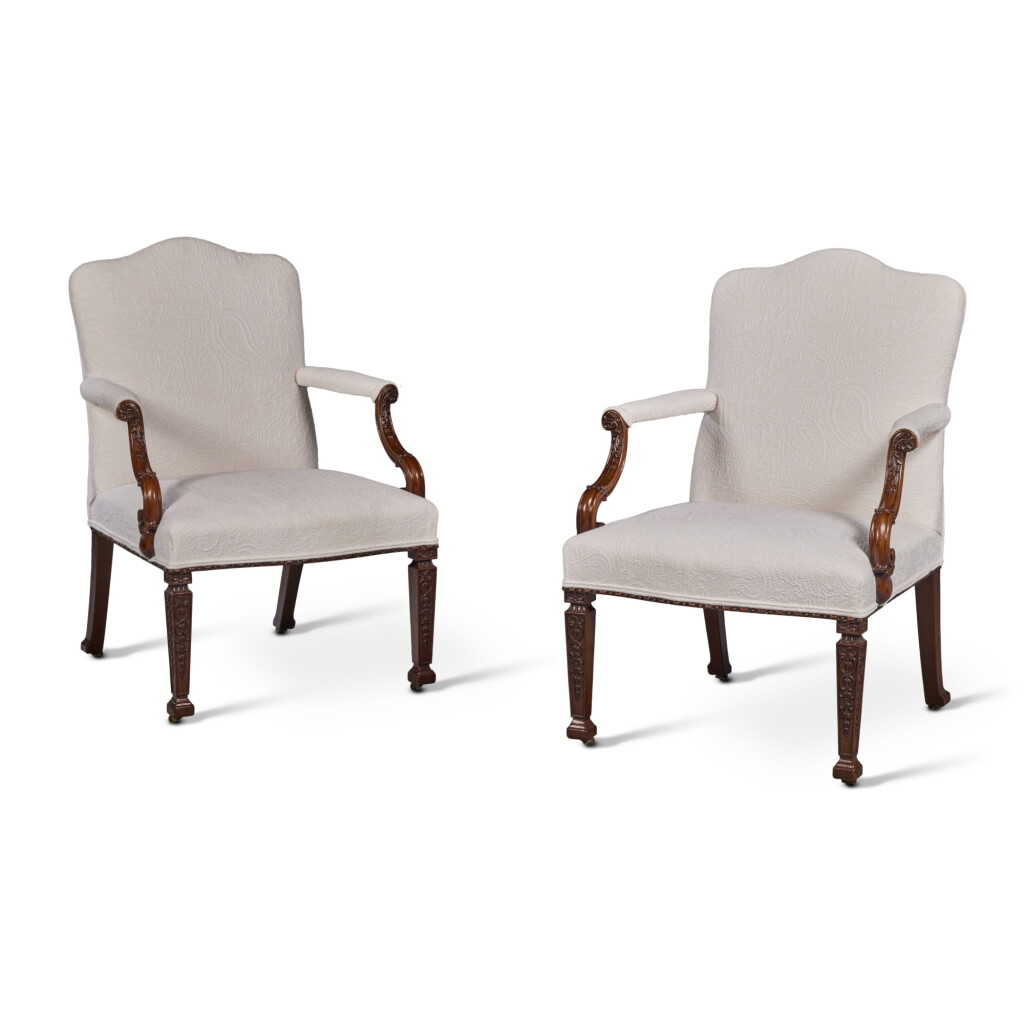
A Pair of George II Mahogany Library Armchairs, Circa 1750
No reserve
Auction Closed
October 15, 06:30 PM GMT
Estimate
12,000 - 18,000 USD
Lot Details
Description
the shaped padded backs with foliate carved scrolling armrests and tapering square front legs carved with trailing bellflowers on two sides; on later leather castors
height 40 in.; width 27 1/2 in.; depth 28 in.
115 cm; 70 cm; 71 cm
Possibly acquired by John Crewe (1709–1752), Crewe Hall, Cheshire, thence by descent;
Christie's, London, 19 November 1992, lot 73;
The Hascoe Family Collection, Greenwich, Connecticut;
Christie's New York, 21 October 2014, lot 32.
'Crewe Hall, Cheshire', Country Life, 3 May 1913, p.638.
These armchairs seem to speak two design languages, creating a hybrid of the ‘Palladian’ or ‘Kentian’ style of the second quarter of the eighteenth century and the Rococo aesthetic that would be characteristic of the mid-century. The legs are unmistakably Kentian in profile, quoting from a suite of seat furniture that he created for Rousham House in the late 1730s. This suite, which is visible in Country Life photographs of Rousham from both 1910 and 19461 and is referenced in the 2013 study William Kent; Designing Georgian Britain, features the same tapering square legs enclosing carved detail and surmounted by block-form knees. The architectural border that runs around the seat rail is also a typical example of Kentian decoration.
The upper half of the design, though, samples from other schools of design in the period. The rosette issuing a foliate sprig is characteristic of library armchairs of the Giles Grendey type and it not closely associated with Kent; it was at its most popular in the 1740s. The base of the armrest, though, is a variation of the ‘C-scroll’ motif that would become omnipresent with the curvaceous, sensuous Rococo style that was most popular in the 1750s. The spherical boss at the base of the armrest is unusual and recalls the prominence of a similar sphere in the arm terminals of many chairs by John Linnell (e.g. drawing E.82-1929 in the V&A collection).
These chairs were once at Crewe Hall in Cheshire. This grand manor was built over more than twenty years for Sir Ranulph Crewe (1558–1646), a prominent judge who served as Lord Chief Justice of the King’s Bench under James I and Charles I. If these chairs were acquired for Crewe Hall at the time of their manufacture, they would probably have been ordered by John Crewe (1709–1752) in the final years of his life, since his son the 1st Baron Crewe (1742–1829) would have been very young in the 1750s; both had successful careers as prominent Tory politicians. Crewe Hall had to be extensively rebuilt after a fire in the 1860s. The house was still with the Crewe family descendants when one of these chairs was photographed in Crewe Hall's library in a 1913 issue of Country Life,3 but the family left in 1922 and the house was sold in 1936. During the Second World War, it housed the War Department, and the newly-crowned Queen Elizabeth visited in 1955.4
1 ‘Rousham, Oxfordshire, the Seat of Mr. C. Cottrell Dormer’, Country Life, 26 February 1910, p.315; C. Hussey, ‘Rousham Oxfordshire – II, The Property of Mr. T. Cattrell-Dormer’, Country Life, 24 May 1946, p.947.
2 S. Weber, ‘The Well of Inspiration: Sources for Kent’s Furniture Designs’, in William Kent; Designing Georgian Britain, ed. S. Weber, London 2013, p.458; J. Bryant, ‘From “Gusto” to “Kentissime”: Kent’s Designs for Country Houses, Villas and Lodges’, p.222.
3 'Crewe Hall, Cheshire', Country Life, 3 May 1913, p.638.
4 ‘The History of Crewe Hall’, crewehallcheshire.co.uk. Available at <https://www.crewehallcheshire.co.uk/about-us/history-of-crewe-hall/> [accessed 12 August 2025]
You May Also Like