
Important Gold Boxes from a Private European Family Collection
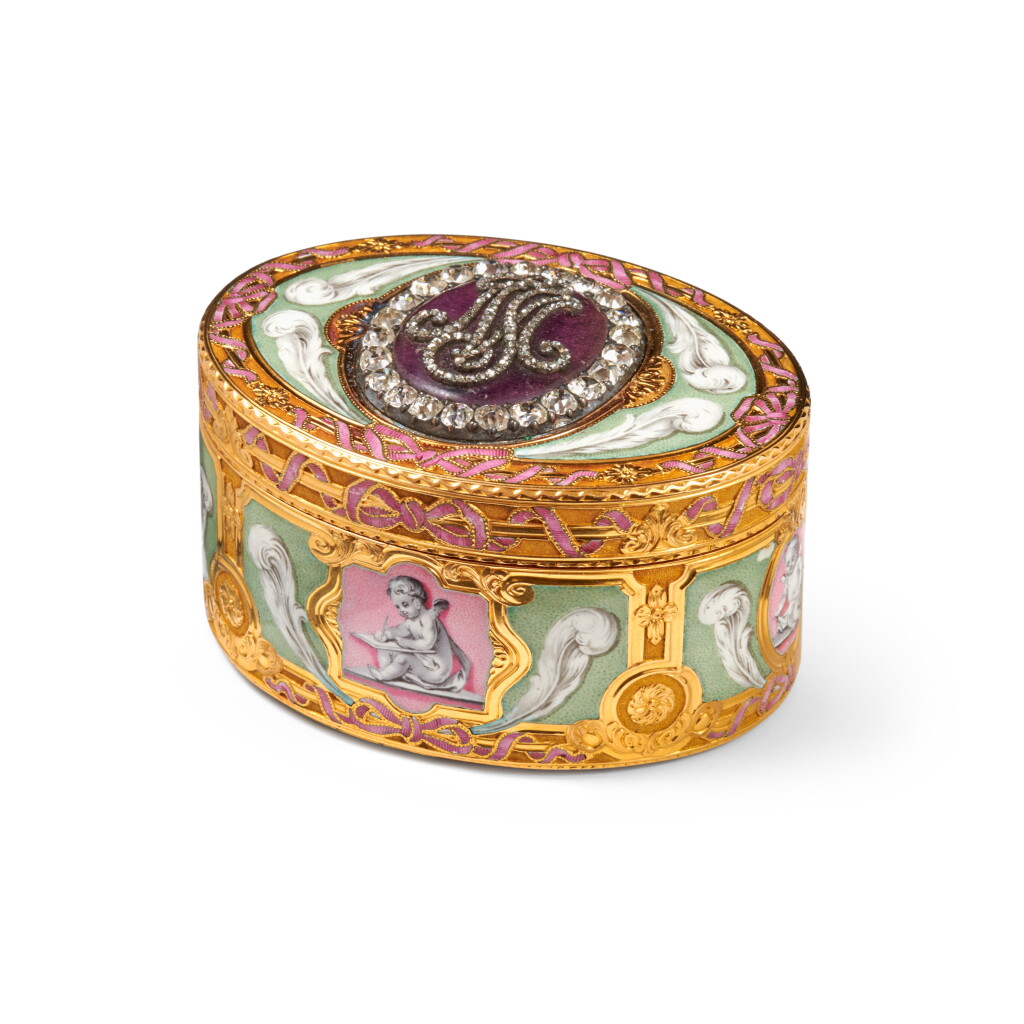
A jewelled gold and enamel boite-à-chiffre, Vienna, circa 1775
Lot Closed
May 16, 01:51 PM GMT
Estimate
26,000 - 35,000 CHF
We may charge or debit your saved payment method subject to the terms set out in our Conditions of Business for Buyers.
Read more.Lot Details
Description
oval, the lid centred with an oval foiled purple glass plaque applied with the rose-cut diamond-set cipher MT, within a diamond-set border and narrow gold frame, the ground finely enamelled en plein with white plumes on a stippled sage green enamel ground, framed by striped opaque pink cloisonné enamel ribbons twirling over a finely matted ground, the sides and base similarly decorated, the plumes framing medallions of en grisaille putti at various pastimes against a stippled pink enamel ground, double maker's mark IR in a shaped cartouche, struck twice, Vienna town mark,
6.3 cm., 2 ½ in. wide
It seems plausible that the rose-cut diamond-set initials MT on the present box are those of Maria Theresa of Austria, ruler of the Habsburg monarchy from 1740 until her death in 1780. A great patron and lover of the arts, in particular the decorative arts including lapidary works and bijouterie, the Empress supported many skilled craftsmen within her own empire and further afield. The present box is stylistically rather unusual in the combination of the finely painted enamel plumes and the pink ribbons with the more classical en grisaille putti on a stippled pink background that appears on Paris and (Huguenot) Berlin boxes slightly earlier.
Austrian enamel painters such as Philipp Ernst Schindler occasionally also worked in stippled enamel; see for example a signed portrait miniature in stippled enamel of Francis I, Holy Roman Emperor, on the interior of a box in the Iakobachvili collection (Haydn Williams, 18th-Century Snuff Boxes: The David and Mikhail Iakobachvili collection, vol. I, London, 2025, cat. no. 60, p. 88). The Viennese goldsmith responsible for the present box is yet to be identified, but the box is proof of the small number of inventive and high-quality boxes made in the Austrian capital in the 1770s and 1780s.