Property from the Ernest and Erika Michael Collection.
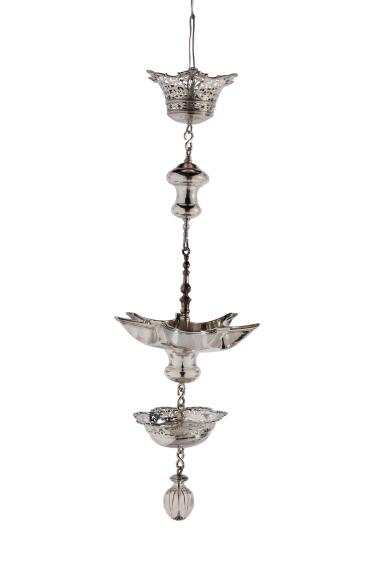
An Important Dutch Silver Hanging Sabbath Lamp, Harmanus Nieuwenhuys, Amsterdam, 1752
Auction Closed
December 17, 04:58 PM GMT
Estimate
150,000 - 200,000 USD
Lot Details
Description
the coronet-form top by William and James Priest, London, 1770.
The central section of seven-pointed star form, topped by a pear-shaped knop and pierced rococo coronet-form top, the drip-pan similarly pierced, marked with town (twice), maker and date letter inside lamp; maker and town on drip pan, maker's mark on screw-on shaft of lamp, lower ring of spacer, and ring of drop; full English marks inside crown
height 31 1/2 in.
80 cm
Samuel Montagu, 1st Baron Swaythling (1832-1911); to his daughter
The Hon. Lillian Helen Montagu, CBA (1873-1963)
Sotheby's Tel Aviv, April 17, 2001, lot 319.
London, Royal Albert Hall, Anglo-Jewish Historical Exhibition, 1887, no. 1615.
Inventory of Works of Art Settled as Heirlooms by Montagu, First Lord Swaythling, 1919, no. 255
Hanging silver Sabbath lamps were an important element of wealthy Dutch Jewish homes in the 18th century. Examples formed the centerpiece of Bernard Picart’s depictions of the Passover Seder (1725) and the Sukkot meal in a sukkah (1722), and one was depicted in detail in his plate of Jewish ritual items (1724).
Harmanus Nieuwenhuys (1736–1763) was an accomplished and prolific silversmith in rococo Amsterdam. He obviously had close ties to the local Jewish community, as in addition to two documented hanging Sabbath lamps, he also made two important Hanukkah lamps, one of 1747 (Venduehuis der Notarissen's-Gravenhage, Netherlands, November 17, 2016, lot 1657) and another of 1751, in the Dutch Royal collection since 1907, and now on loan at the Jewish Museum, Amsterdam (item no. MB02280). The other Sabbath lamp known by Nieuwenhuys was made the following year (1753) and also has a slightly later English-made crown by William Shaw and James Priest, London, in that case marked for 1778; see Sotheby’s Sotheby's Amsterdam, May 8, 2006, lot 64. The 1753 lamp was exhibited at the Jewish Historical Museum, Amsterdam, in 1978, and published in A Collector’s Guide to Judaica by Jay Weinstein (London, 1985). The silversmith’s son of the same name made a similar hanging Sabbath lamp in 1780, see Sotheby’s, New York, 13 December 2006, lot 87.
The offered lamp was formerly in the collection of Samuel Montagu, First Baron Swaythling (1832-1911), a prominent English Jewish banker and philanthropist. He was a founder of the merchant bankers Samuel Montagu & Co., and his early business in coins and bullion likely contributed to his appreciation of important Early English Silver, of which he formed a notable collection, and metalwork Judaica. He was one of the earliest collectors of Judaica, and showed many pieces at the great 1887 Anglo-Jewish Historical Exhibition at the Royal Albert Hall: a combination of antique items like this lamp, and modern pieces which he had received in his role as one of the most important advocates for Jews at the period. His London home in the 1880s was in Lancaster Gate, on the north side of Hyde Park, directly next door to fellow collector Reuben David Sassoon.
Montagu served as the Member of Parliament for Whitechapel from 1885-1900, a time when it was exploding with an immigrant Eastern European Jewish population not well received by the resident English, a situation worsened by the violent Jack the Ripper murders in Whitechapel in 1888. In 1887 the banker established the Federation of Synagogues, which united numerous small Orthodox synagogues from London’s East End, becoming a force to be reckoned with in English Jewry and politics. Montagu was made a baronet in 1894 and a baron in 1907.
At Lord Swaythling’s death, this lamp passed to his daughter Lily (1873-1963), considered the first woman to play a major role in Progressive Judaism. In 1902, at a house belonging to her sister, she coordinated the first meeting of the Jewish Religious Union for the Advancement of Liberal Judaism. The Union would go on to create the first Liberal Jewish synagogue in the UK, and be part of creating the World Union for Progressive Judaism; she attend their 1926 conference. In her 80s, Lily Montagu served as President of the World Union from 1955 to 1959, after the retirement of Leo Baeck. She was also a founding member of the Jewish League for Woman Suffrage.
You May Also Like