View full screen - View 1 of Lot 1. Le Crapaud de Maldoror.

Exquisite Corpus: Surrealist Treasures from a Private Collection

Valentine Hugo

Le Crapaud de Maldoror

Auction Closed

November 21, 12:43 AM GMT

Estimate

100,000 - 150,000 USD

Lot Details

Description

Valentine Hugo

(1887 - 1968)


Le Crapaud de Maldoror

signed with the artist’s monogram (lower left); signed Valentine Hugo and dated 1932 (lower right of the artist’s mat); signed again Valentine Hugo, dated Décembre 1932 and inscribed “Tu dois être puissant car tu as une figure plus qu’humaine, triste comme l’univers belle comme le suicide” Paris (on the verso of the artist’s mat)

colored pencil on black paper mounted in the artist's mat

image: 18 ½ by 12 in.   47 by 30.5 cm.

artist’s mat: 24 ⅛ by 17 ¾ in.   61.3 by 45 cm.

Executed in 1932.

Daniel Fillipacchi, Paris

Acquired from the above by 1978 by the present owner

Venice, XLII Esposizione Internazionale d’Arte La Biennale di Venezia, 1986, p. 86 (titled Viso rana and dated 1931)

New York, Solomon R. Guggenheim Museum, Surrealism: Two Private Eyes, 1999, vol. I, no. 103, p.164; p. 165, illustrated in color (dated 1936)

Surréalisme au service de la révolution, no. 5, 1933, illustrated (titled Lautréamont)

Europe: revue mensuelle, nos. 475-76, 1968, p. 48; p. 49, illustrated 

Jacques Baron, Anthologie plastique du surréalisme, Paris, 1980, p. 138, illustrated in color (dated 1936)

Anne de Margerie, Valentine Hugo, 1887-1968, Paris, 1983

Béatrice Seguin, ed., and Jean-Pierre Cauvin, Valentine Hugo, Arles, 2002, p. 141, illustrated (titled Lautréamont, Maldoror et le crapaud

Exh. Cat., Boulogne-sur-Mer, Bibliothèque des Annonciades, Valentine Hugo, Le Carnaval des Ombres, 2018, fig. 20, p. 24, illustrated in color; p. 132 (dated 1936)

Exquisitely detailed and expertly rendered, Le Crapaud de Maldoror presents one of the most exceptional works on paper by Valentine Hugo, an artist perhaps best known for her frequent contributions to collaborative Surrealist cadavre exquis drawings.


Educated at L’École des Beaux-Arts in Paris, Hugo contributed designs to the Ballets Russes and moved in artistic circles that included Jean Cocteau, Pablo Picasso, Paul Éluard, André Breton and Erik Satie among other luminaries of Surrealism. With her husband, painter and theatre designer Jean Hugo, she hosted Parisian salons frequented by leading artists and intellectuals. By the early 1930s, after her separation from Hugo and increasing involvement with the Surrealists, Valentine developed a distinctive visual language that merged literary inspiration with an intense, personal psychological lens. Her intricate and otherworldly imagery, exemplified by Le Crapaud de Maldoror reflects both her technical mastery and her engagement with the transformative power of imagination.


The present work draws on Les Chants de Maldoror, a late 1860s prose poem by the French writer Comte de Lautréamont (the nom de plume of Isidore Ducasse), whose text became a touchstone for the Surrealists decades after its initial, overlooked publication. With its transgressive, violent content and its misanthropic protagonist who renounces conventional morality, the work’s absurdist and iconoclastic ideas struck a chord with André Breton and his contemporaries, inspiring imagery that rejected social and moral conventions in favor of psychic and emotional liberation.


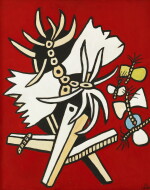
Le Crapaud de Maldoror illustrates an episode from Les Chants de Maldoror in which Maldoror encounters a toad (Bufo alvario), a species known for secreting hallucinogens. By licking the toad, Maldoror enters an altered state of consciousness, marked by hallucinations and shifts in perception and mood. In this drawing, Maldoror and the toad gaze at each other in a moment of intense tension, the focus squarely on their eyes. Maldoror, with his rich curly hair and radiant heterochromatic eyes, embodies a vision of sublime beauty. His furrowed brows and the fabric partially covering his face suggest an inner struggle, a battle to resist the toad’s hallucinogenic—and potentially lethal—secretion. The intricately rendered vegetation forms a charged psychic landscape, reflecting the protagonist’s inner turmoil. Much like Hugo’s Portrait d’Arthur Rimbaud, in which the poet’s visage and surrounding elements evoke the transformative power of literature and imagination, the toad functions as a cipher for psychic and emotional turbulence, demonstrating Hugo’s remarkable ability to translate literary sources into vivid Surrealist imagery.


The absurdist and iconoclastic ideas of Les Chants de Maldoror struck a chord with the Surrealists. Adopting its author as their prophet, in the First Surrealist Manifesto Breton proclaimed: “With Les Chants de Maldoror Surrealism was born.” Containing scenes of cruelty and nihilistic humour, at times cynical, grotesque and delirious, the poem rejects established notions of religion, state and morality as pillars of Western society. For the Surrealists, who looked for ways to undermine social conventions in their own search for freedom, Les Chants de Maldoror provided a rich source of imagery as an impetus for their imagination.


On the verso of the present work, Hugo affirms the source imagery for this work with her inscription: “Tu dois être puissant car tu as une figure plus qu’humaine, triste comme l’univers belle comme le suicide”—a phrase excerpted from "Chant premier" of Les Chants de Maldoror.


A fascination with Maldoror and Ducasse reverberates throughout much of Surrealist art. The dictum of “a chance encounter” inspired Man Ray to use a real sewing machine in his L’Enigme d’Isidore Ducasse of 1920, the work’s title referring both to the concealed identity of its subject, and to the mysterious circumstances of Ducasse’s death during the siege of Paris in 1870. In the 1930s, Dalí produced a series of prints to illustrate the book, using his “paranoiac-critical method;” in the 1940s, Magritte illustrated another edition with a variety of subjects from his own established iconography; several decades later, Hans Bellmer created a series of etchings, taking Les Chants de Maldoror as a starting point for an exploration of his erotic obsessions.


Created in 1932, amid personal and professional turbulence, Le Crapaud de Maldoror reflects Hugo’s inner state and her deep engagement with Surrealist literary sources. The summer of 1931 saw a brief romantic relationship with Breton, ending the following year in a failed suicide attempt. Paul Éluard intervened, saving her life. The two would remain close collaborators, with Hugo illustrating many of his texts. Her work from this period, including a 1932 portrait of Éluard, shares compositional and thematic affinities with Le Crapaud de Maldoror, particularly the dense, expressive vegetation and the interplay between human figures and symbolic surroundings.


The present work, therefore, stands as both a tribute to a pivotal literary text and a highly personal meditation on the interplay of psyche, literature, and Surrealist imagination.