Exquisite Corpus: Surrealist Treasures from a Private Collection
Dorothea Tanning
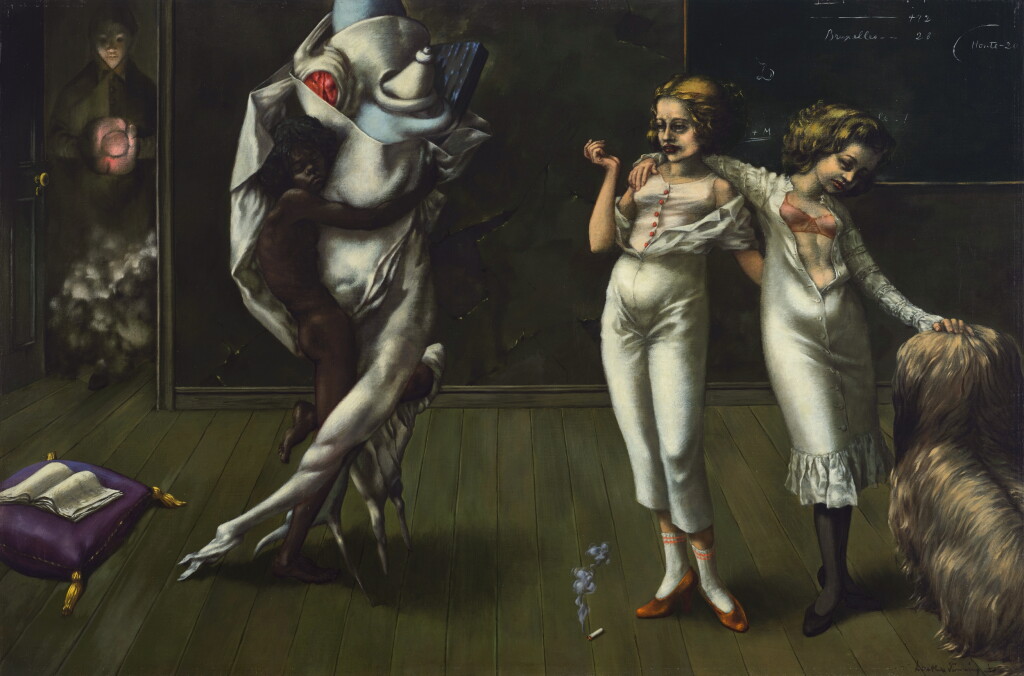
Interior with Sudden Joy
Auction Closed
November 21, 12:43 AM GMT
Estimate
2,000,000 - 3,000,000 USD
Lot Details
Description
Dorothea Tanning
(1910 - 2012)
Interior with Sudden Joy
signed Dorothea Tanning and dated ‘51 (lower right)
oil on canvas
23 ⅞ by 36 in. 60.8 by 91.5 cm.
Executed in 1951.
We are grateful to The Dorothea Tanning Foundation for their assistance in cataloguing this work.
William N. Copley, Paris and New York (acquired by 1958)
Ira Genstein and Tonian Volk Genstein, Pennsylvania (acquired by 1974)
Byron Gallery, New York
Acquired from the above by 1976 by the present owner
New York, Alexandre Iolas Gallery, Dorothea Tanning, 1953, no. 9
Paris, Galerie Daniel Cordier, Exposition Internationale du Surréalisme (EROS), 1959-60, n.n.
Santa Barbara, The Art Gallery, University of California, Surrealism: A State of Mind, 1924-1965, 1966, no. 32 (dated 1952)
Knokke-le-zoute, Casino Communal, XXe Festival Belge D'Été, Dorothea Tanning, 1967, no. 16
Paris, Centre National d'Art Contemporain, Dorothea Tanning, 1974, no. 16, p. 26, illustrated; n.p.
New York, M. Knoedler & Co., Surrealism in Art, 1975 (not included in the catalogue)
New York, Gray Art Gallery and Study Center, New York University, Tracking the Marvelous, 1981, no. 29, p. 35, illustrated
Malmö Konsthall, Dorothea Tanning, 1993, pp. 21-23 and 135; p. 46, illustrated in color
London, Camden Arts Centre, Dorothea Tanning: Works 1942-1992, 1993
New York, Solomon R. Guggenheim Museum, Surrealism: Two Private Eyes, 1999, vol. I, no. 243, p. 317; pp. 318-19, illustrated in color
Philadelphia Museum of Art, Dorothea Tanning: “Birthday and Beyond,” 2000-01
Patrick Waldberg, Max Ernst, 1958, Paris, p. 353, illustrated; p. 354
Patrick Waldberg, Le Surréalisme, Geneva, 1962, p. 114, illustrated in color
Dorothea Tanning, “Note Bibliographique,” Dorothea Tanning, Paris, 1966, p. 153
Alain Bosquet, La peinture de Dorothea Tanning, Paris, 1966, p. 62, illustrated
“Tanning,” Dictionnaire Universel de l’Art et des Artistes, vol. 3, Paris, 1967, p. 442 (dated 1952)
René Passeron, Encyclopédie du Surréalisme, Paris, 1975, p. 245
Gilles Plazy; Jean Saucet, ed., Dorothea Tanning, Paris, 1976, pp. 24-25, illustrated in color; p. 33
Patrick Waldberg, “Dorothea Tanning: La Mémoire Ensorcelée,” Les Demeures d’Hypnos, Paris, 1976, p. 320
Marcel Duhamel, “Quarante ans de corps à corps avec la peinture,” Dorothea Tanning: Numéro Spécial de XXe Siècle, Paris, 1977, p. 112
John Russell, “Le ‘Moi’ multiforme de Dorothea Tanning,” Dorothea Tanning: Numéro Spécial de XXe Siècle, Paris, 1977, p. 56
Exh. Cat., Los Angeles County Museum of Art; University Art Museum, The University of Texas at Austin; Carnegie Museum Institute of Art, Pittsburgh (and traveling), Women Artists: 1550–1950, 1976-77, p. 338
Marianne Oesterreicher-Mollwo, Surrealism and Dadaism: Provocative Destruction, the Path within and the Exacerbation of the Problem of a Reconciliation of Art and Life, Oxford, 1979, p. 93 (titled Interior Scene Accompanied by Sudden Joy and dated 1952)
Jacques Baron, Anthologie plastique du surréalisme, Paris, 1980, p. 254, illustrated in color
Wieland Schmied, “KUNSTmonographie Dorothea Tanning: Die Türen des Unbewussten,” KUNSTmagazin, no. 89, June 1980, p. 24; p. 27, illustrated
John Russell, “Art: Exploding Canvases of Elizabeth Murray… [and] Other exhibitions of interest: ‘Tracking the Marvelous’,” The New York Times, 8 May 1981, p. C20
Norman Weinstein, “Shadows of Eros: Notes on Dorothea Tanning’s Surrealism,” Spring: An Annual of Archetypal Psychology and Jungian Thought, 1981, pp. 141-43
Adam Biro and René Passeron, eds., Dictionnaire Général du Surréalisme et de ses Environs, Fribourg, 1982, p. 398
Dorothea Tanning, Birthday, Santa Monica, 1986, p. 84, pl. 16, illustrated
“Oral History Interview with Dorothea Tanning, conducted by Barbara Shikler, July 11–November 5, 1990,” Archives of American Art, Smithsonian Institution, 1990, p. 155
Bengt Eriksson, “Hundar, hundar överallt,” Sydsvenska Dagbladet, 28 April 1993
Hans Johansson, “Dorothea Tanning,” Beckerell, no. 2, April/May 1993, p. 41; p. 43, illustrated
Lyn MacRitchie, "Painting is life or death, every time," Financial Times, October 9-10, 1993, p. 23
Robert Radford, “Dorothea Tanning,” Art Monthly, no. 171, November 1993, p. 26
Jean-Christophe Bailly, “Image Redux: The Art of Dorothea Tanning,” Dorothea Tanning, New York, 1995, pp. 18 and 22-24; pl. 29, pp. 72-73, illustrated in color color; p. 96, illustrated
Brenda Shaughnessy, Interior with Sudden Joy, New York, 1999, illustrated in color on the cover (detail); p. 79
Annette Shandler Levitt, The Genres and Genders of Surrealism, New York, 1999, pp. 104-07
Dorothea Tanning, Between Lives: An Artist and Her World, New York and London, 2001, n.p., illustrated; pp. 140 and 152-53
Richard Howard, “Dorothea Tanning: Philadelphia Museum of Art” Artforum, vol. 39, no. 8, April 2001, p. 135
Joy Press, “Books: The Tanning Salon,” The Village Voice, vol. XLVI, no. 35, 4 September 2001, p. 65
Katharine Conley, “Les révolutions de Dorothea Tanning,” Pleine Marge: Cahiers de littérature, d’arts plastiques, & de critique, no. 36, December 2002, pp. 148; 159-65 and 169; p. 160, illustrated in color
Jürgen Pech, “Hinter den Türen des Werkes von Dorothea Tanning,” Mythen–Symbole–Metamorphosen in der Kunst seit 1800: Festschrift für Christa Lichtenstern zum 60. Geburtstag, Berlin, 2004, pp. 372-73
Exh. Cat., Paris, Galerie Malingue, “Grands” Surréalistes, 2008, p. 48
Victoria Carruthers, “Between Silence and Sound: John Cage, Karlheinz Stockhausen and the Sculptures of Dorothea Tanning,” Art, History and the Senses: 1830 to the Present, Surrey, 2010, p. 100
Victoria Carruthers, “Dorothea Tanning and Her Gothic Imagination,” Journal of Surrealism and the Americas, vol. 5, nos. 1-2, 2011, p. 141
Katharine Conley, Surrealist Ghostliness, Lincoln, 2013, pp. 139, illustrated, pp. 144 and 146
Gabriela Glăvan, “Corrupt Childhood. Dorothea Tanning’s Chasm: A Weekend,” British and American Studies, vol. XXII, 2016, pp. 58-59
“Reinventing The Marriage Between Heaven and Hell: Children’s Literature and the Avant-Garde,” A Serious Genre: The Apology of Children’s Literature, Newcastle upon Tyne, 2016, p. 199
“Verbal Dreamscapes. Dorothea Tanning’s Visual Literature,” Romanian Journal of English Studies, vol. 13, no. 1, December 2016, p. 111
Catriona McAra, A Surrealist Stratigraphy of Dorothea Tanning’s Chasm, Abingdon, 2017, pp. 25, 39-40 and 97; pl. 7, illustrated in color
Exh. Cat., Madrid, Museo Nacional Centro de Arte Reina Sofía and London, Tate Gallery, Dorothea Tanning, 2018-19, p. 62, illustrated in color; p. 198
Lauren Elkin, “The Shape-shifter,” Tate Etc., no. 44, Winter 2019, pp. 3 and 5
Catriona McAra, “Glowing Like Phosphorus: Dorothea Tanning and the Sedona Western,” Journal of Surrealism and the Americas, vol. 10, no. 1, 2019, fig. 6, p. 96, illustrated in color; p. 97
Exh. Cat., Brühl, Max Ernst Museum, Max Ernst–D-paintings–Zeitreise der Liebe, 2019, pp. 81-83 and 134
Rochelle Roberts, “Postcards in Isolation 28: Somaya Critchlow and Dorothea Tanning’s Interior with Sudden Joy, 1951,” illustrated in color, https://lucywritersplatform.com/2020/10/15/postcards-in-isolation-28-somaya-critchlow-and-dorothea-tannings-interior-with-sudden-joy-1951/ (accessed on 1 December 2025)
Victoria Carruthers, Dorothea Tanning: Transformations, London, 2020, fig. 70, p. 88; p. 91, illustrated in color; p. 92
Ara H. Merjian, “A Surrealist ‘Little Sister’? Dorothea Tanning’s (Femme) Fatala (1947), Metaphysical Painting, and the Roman Policier,” Word & Image: A Journal of Verbal/Visual Enquiry, vol. 37, no. 2, 2021, pp. 182-83
“Open Portfolio: Dorothea Tanning,” Sedona Monthly, May 2021, pp. 40 and 43
Amy Lyford, Exquisite Dreams: The Art and Life of Dorothea Tanning, London, 2023, pp. 97, 99, 102, 109 (in reproduction of Exh. Cat., Galerie Alexandre Iolas, Dorothea Tanning, 1953), pp. 110, 115-18, 121, 123, 125, 127, 130, 214 and 216; p. 213, illustrated (in storyboard for film Unheard-of News); p. 100, illustrated in color
Willard Spiegelman, “‘Exquisite Dreams’ Review: Dorothea Tanning’s Surreal Vision,” The Wall Street Journal, 16 March 2024, p. C10
You May Also Like