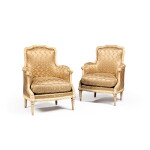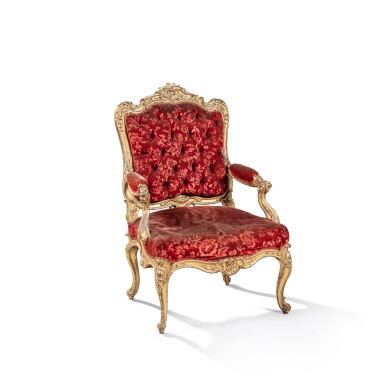
A Louis XV giltwood armchair, Paris, circa 1740, very probably made for the German market | Fauteuil en hêtre redoré d’époque Louis XV, Paris, vers 1740, très vraisemblablement réalisé pour le marché allemand
No reserve
Auction Closed
June 26, 03:37 PM GMT
Estimate
10,000 - 20,000 EUR
Lot Details
Description
A Louis XV beechwood armchair, Paris, circa 1740, very probably made for the German market
with a red embossed velvet upholstery, with a label inscribed "Schloss Baden Inventar seit Z22 10 n°331" : and with an ink label, Dieser Fauteuil aus dem Hause Messmer, welcher von Kaiser Wilhelm I. und Kaiserin Augusta benützt wurde, ist neu vergoldet worden und von Herrn Messmer Sr. Kgl. Hoheit dem Grossherzog Friedrich zu dessen 70. Geburtstage zum Geschenk gegeben. Vergoldet von Fried. Schmittlein, Vergolder Baden-Baden den 11. September 1896.
(re-gilt)
(2)
Height. 43 1/3 in, width. 28 in
----------------------------------------
Fauteuil en hêtre redoré d’époque Louis XV, Paris, vers 1740, très vraisemblablement réalisé pour le marché allemand
garniture de velours gaufré rouge, avec une étiquette "Schloss Baden Inventar seit Z22 10 n°331 ", avec une étiquette manuscrite inscrite à l’encre : Dieser Fauteuil aus dem Hause Messmer, welcher von Kaiser Wilhelm I. und Kaiserin Augusta benützt wurde, ist neu vergoldet worden und von Herrn Messmer Sr. Kgl. Hoheit dem Grossherzog Friedrich zu dessen 70. Geburtstage zum Geschenk gegeben. Vergoldet von Fried. Schmittlein, Vergolder Baden-Baden den 11. September 1896.
(2)
Haut. 110 cm, larg. 71 cm
Empereur Guillaume Ier (1797-1888), roi de Prusse
Vente Sotheby’s Baden-Baden, Markgrafen und Grossherzöge von Baden, 5 octobre 1995, lot 106.
This armchair, which until now has been presented as German, should in fact be reclassified as a French work made in a Parisian joinery workshop around 1740. There are a number of reasons for this new designation:
-The identification of a sofa en suite with this astonishing armchair, illustrated in B. Pallot's L'art du siège au XVIIIe siècle en France, 1996, p. 123 with a possible attribution to Jean-Baptiste Tilliard or Claude I Séné to which we could add the joiner Jean Gourdin. The sofa, which belonged to the Karl Lagerfeld collection, was sold by Christie's in Monaco on 28 April 1999, lot 16.It is illustrated in the drawing room of the château de Jeufosse in G. Mabille, Le style Louis XV, Paris, 1978.
-The typically Parisian construction of the sofa (the bevelling of the top of the central legs), like the armchair, suggests that these superb chairs were made in Paris. Their Rococo exuberance, and the 19th century provenance of several of these armchairs (see above), lead us to believe that they were very probably commissioned by one of the German courts for a very important person, around 1740: the Elector of Bavaria, the Elector of Saxony, the Dukes of Palatinate-Deux-Ponts, or King Frederick II the Great of Prussia.
As with some of the large, exuberant pieces of cabinetwork by Cressent, Latz and BVRB (still on display at the Residenz, Sans-Souci and Nymphenburg), commissioned in Paris for these German courts in the mid-eighteenth century, it is quite logical that equally exuberant chairs in a French rococo style influenced by the German rococo could have been made in Paris for a client on the other side of the Rhine.
-Finally, the later gilding (dating from 1896, see full text in German on the label) may have been applied to the original gilding, but no samples have been taken.
We also know of several chairs similar to ours (two in stripped wood belong to the Metropolitan Museum in New York, and are on deposit at Schloss Nymphenburg in Munich); a third is also in the collections of the Metropolitan Museum, with its original gilding, wrongly presented as being from southern Germany. Another was once in the Steinitz Gallery, Paris, and was sold in 2018 by Koller in Zurich.
Other armchairs, typically Parisian, with a wide upper crosspiece on the back and a shoulder punctuated by a double indentation whose generous proportions are repeated on the belt, include three from the former Thual collection sold by Sotheby's in Monaco on 8 February 1981, lot 216.
--------------------------
Ce fauteuil, présenté jusqu’à aujourd’hui comme allemand doit en fait être requalifié comme un travail français réalisé dans un atelier de menuiserie parisien vers 1740. Plusieurs éléments concourent à cette nouvelle désignation :
-L’identification d’un canapé en suite avec ce fauteuil étonnant, illustré dans l’ouvrage de B. Pallot, L’art du siège au XVIIIe siècle en France, 1996, p. 123 avec une possible attribution à Jean-Baptiste Tilliard ou Claude I Séné à laquelle nous pourrions ajouter le menuisier Jean Gourdin. Le canapé qui appartenait à la collection Karl Lagerfeld fut vendu par Christie’s à Monaco le 28 avril 1999, lot 16. Ce canapé est illustré dans le salon du château de Jeufosse (voir G. Mabille, Le style Louis XV, Paris, 1978).
-La construction typiquement parisienne du canapé (l’assemblage en biseau du haut des pieds centraux), comme le fauteuil, abonde pour une fabrication parisienne de ces superbes sièges. Leur exubérance rocaille, et la provenance XIXème siècle de plusieurs de ces fauteuils (voir supra), nous incite à penser qu’il s’agit très probablement d’une commande d’une des cours d’Allemagne pour un personnage très important, vers 1740. On peut penser à l’Électeur de Bavière, l’Électeur de Saxe, les ducs de Palatinat-Deux-Ponts, ou le roi de Prusse Frédéric II le Grand.
Comme certains grands meubles d’ébénisterie exubérants de Cressent, Latz, ou BVRB (encore visibles à la Residenz, à Sans-Souci, à Nymphenburg), commandés à Paris pour ces cours allemandes au milieu du XVIIIème siècle, il est fort logique que des sièges non moins exubérants et répondant à une esthétique rocaille française influencée par le rococo allemand aient pu être réalisés à Paris pour un commanditaire d’Outre-Rhin.
-Enfin la dorure postérieure (datant de 1896, voir texte complet en allemand sur l’étiquette) a peut-être été réalisée sur la dorure d’origine mais aucun prélèvement n’a été effectué.
Nous connaissons également plusieurs sièges en suite avec le nôtre (deux en bois décapé appartiennent au Metropolitan Museum à New York, ils sont en dépôt au château de Nymphenburg à Munich) ; un troisième également dans les collections du Metropolitan Museum, avec sa dorure d’origine, présenté à tort comme Allemagne du sud. Un autre exemplaire autrefois à la galerie Steinitz, Paris et passé en 2018 en vente chez Koller à Zurich.
D’autres fauteuils, typiquement parisiens, présentant une large traverse supérieure du dossier avec un épaulement rythmé par un double décrochement dont les généreuses proportions sont reprises sur la ceinture sont connus, on peut citer les trois de l’ancienne collection Thual vendus par Sotheby’s à Monaco le 8 février 1981, lot 216.
You May Also Like