Giovanni Antonio Guardi
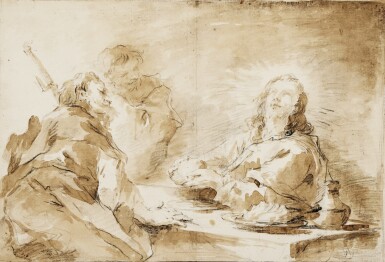
The Supper at Emmaus
Auction Closed
January 25, 04:44 PM GMT
Estimate
120,000 - 180,000 USD
Lot Details
Description
Giovanni Antonio Guardi
Vienna 1699 - 1760 Venice
The Supper at Emmaus
Point of the brush and brown wash over black chalk, within black chalk framing lines;
bears old attribution in brown ink to the old backing, lower right: GB Tiepolo
293 by 433 mm; 11½ by 17 in.
Private collection, England, by 1800 (with attribution to Tiepolo, then to Fragonard and finally to Francesco Guardi);
sale, Bern, Gutekunst and Klipstein, 1956 (as Francesco Guardi);
Walter Hugelshofer, Zurich
London, Royal Academy, The Glory of Venice, 1994, p. 295, fig. 193, p. 453, cat. 193
T. Pignatti, Disegni dei Guardi, Florence 1967, no. 3;
A. Morassi, Guardi: I Dipinti, Milan 1973, no. 9
R. Pallucchini, ‘Note alla mostra dei Guardi’, in Arte Veneta, Annata, XIX, 1965, p. 223;
A. Binion, Antonio and Francesco Guardi, Their Life and Milieu, New York and London 1976, cat. 56;
P. Casadio, Guardi, Metamorfosi dell’immagine, Castello di Gorizia 1987, pp. 160-161;
A. Morassi, Guardi, I disegni, Milan 1993, cat. 9, fig. 8, a detail reproduced in color on the dust jacket
Exquisitely rendered in energetic black chalk under drawing with abundant brown wash, this beautifully preserved sheet by Giovanni Antonio Guardi dates to circa 1740, when the artist was working primarily as a copyist under the patronage of Marshal Schulenberg (1661-1747). The subject depicted, that of The Supper at Emmaus was based, though in reverse, on Giovanni Battista Piazzetta's painting of the same subject, now in the Cleveland Museum of Art (fig.1).
Guardi was, however, no mere copyist as the present work clearly demonstrates. As noted by Mitchell Merling, rather than slavishly copying Piazzetta’s composition he has instead “exploded the compact pyramid and tangible physicality of Piazzetta’s image by dissolving outlines and granting independent life to the washes. The freedom with which light and shade pass over the surface anticipates similar effects in Francesco’s (Guardi) later views.”1
Merling also addresses the question of the present work appearing in reverse to Piazzetta’s painting, dismissing the suggestion that Antonio copied a 1742 reproductive engraving by Marco Pitteri (1702-1786) rather than the original painting. This argument is made on the basis that the Pitteri engraving only shows the head of St. James so, in Merling’s view, the intermediate source for Antonio’s drawing remains to be discovered.2
Though drawings of this scale, quality and condition by Antonio are extremely rare, a smaller sheet, also depicting The Supper at Emmaus, though composed in an entirely different manner, was previously in the collection of Dr. John O’Brien, prior to its dispersal in these rooms in 2021.3
1. See London, Royal Academy, The Glory of Venice, exhib. cat., 1994, p. 295
2. Ibid., p. 453, no. 193
3. Sale, New York, Sotheby’s, From Taddeo to Tiepolo: The Dr. John O’Brien Collection of Old Master Drawings, 27 January 2021, lot 237
You May Also Like