Elisabeth-Louise Vigée Le Brun
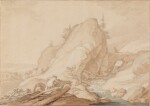
View of Lake Lucerne and Stansstad
Auction Closed
July 5, 10:16 AM GMT
Estimate
8,000 - 12,000 GBP
Lot Details
Description
Elisabeth-Louise Vigée Le Brun
Paris 1755 - 1842
View of Lake Lucerne and Stansstad
Pastel;
signed with initials and inscribed on the mount: Le Lac de Lucerne et Stans Stad LE VLB
192 by 284 mm
Among the greatest and most celebrated female artists living between the second half of the 18th century and the first half of the 19th century, Madame Vigée Le Brun was widely travelled. At the peak of her career, however, having established herself as a leading portrait artist of Ancien Régime society and at Court, and having become one of very few female artists admitted to the Académie royale de peinture et de sculpture, the start of the French Revolution caused her to flee France for Italy, together with her young daughter Julie. She was to be absent from France for twelve years, during which time she sought commissions throughout Europe, working in Italy, Austria, Russia and Germany, everywhere enjoying the patronage of distinguished members of the aristocracy. Madame Vigée Le Brun was finally able to return to France in January 1802. Subsequently she travelled to Great Britain, between 1803 and 1806, and twice to Switzerland, in 1807 and 1808.
In the third volume of her Souvenirs, Vigée Le Brun wrote that she had executed about two hundred landscapes during her trips to Great Britain and Switzerland, specifying that she made 'Près de cent paysage suisses au pastel, fait dans mes deux voyage' ('About one hundred Swiss landscapes in pastel, done during my two trips').1 Perhaps due to their surprising modernity, which may have led to later misattributions, relatively few of these Swiss views are known today. Just under ten sheets have been identified that represent the massif of the Mont-Blanc, while others show the Aiguille du Goûter, and several Swiss lakes, including Lucerne, Thun and Geneva.2
Nestled between the grand and imposing Swiss mountainous peaks, the present evocative landscape depicts Lake Lucerne and the town of Stansstad. Using quite a simple palette of soft blues and greens with touches of pink, Le Brun has created a timeless vista that speaks as much to the modern gaze as to her contemporary audience of more than two centuries ago.
1. Louise-Élisabeth Vigée Le Brun, Souvenirs de Madame Louise-Élisabeth Vigée Le Brun, Paris, H. Fournier 1835-37, vol. III, p. 354
2. Xavier Salmon, in Élisabeth Louise Vigée Le Brun, exhib. cat., Paris, Grand Palais et al., 2015-16, p.324
You May Also Like