The Property of the Rt Hon. The Earl of Jersey
Sir Peter Lely
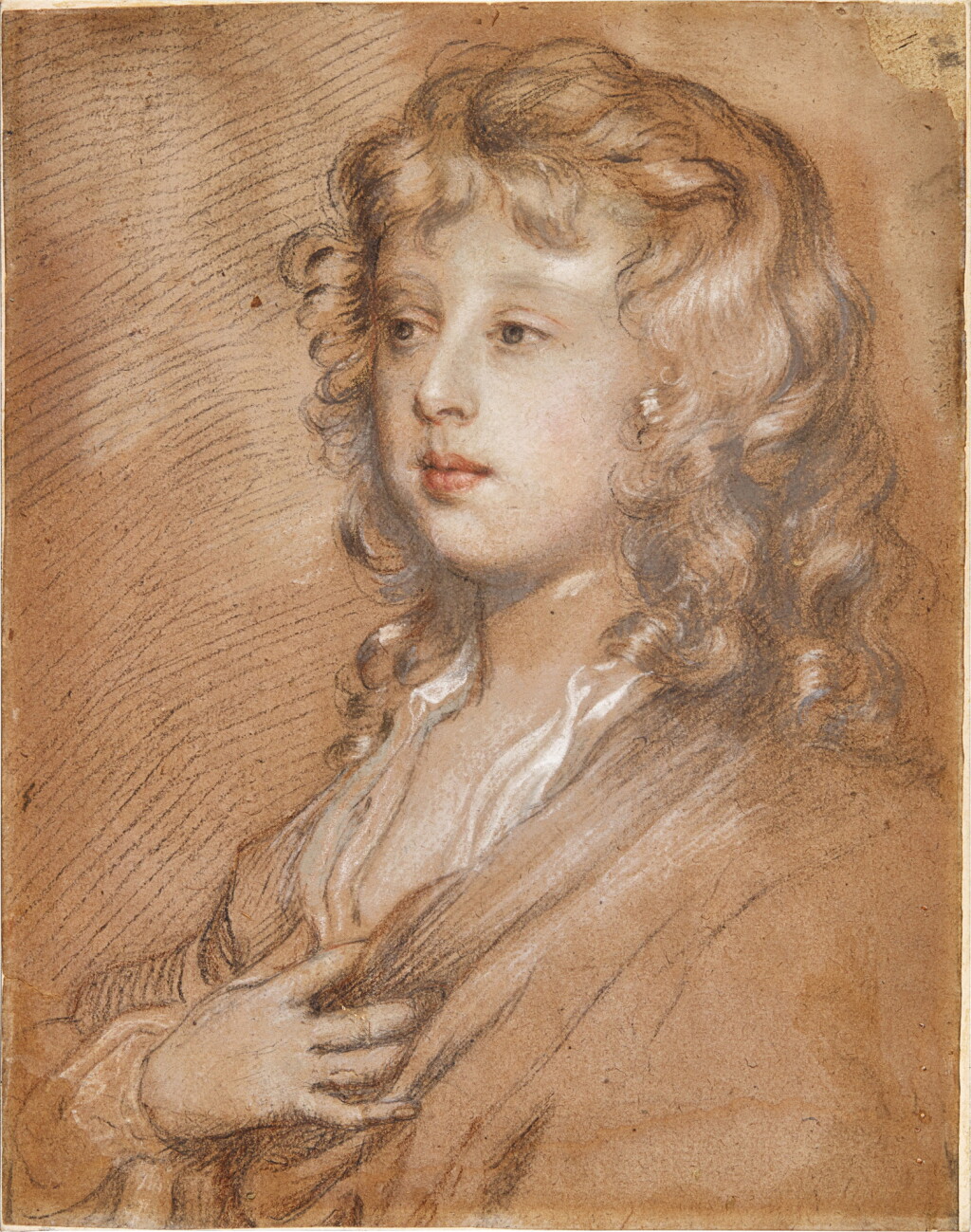
Portrait of a young boy
Auction Closed
July 5, 10:16 AM GMT
Estimate
50,000 - 80,000 GBP
Lot Details
Description
The Property of the Rt Hon. The Earl of Jersey
Sir Peter Lely
Soest 1618 - 1680 London
Portrait of a young boy
Black and red chalk heightened with white
265 by 208 mm
Sir Francis Child (1642-1714), 42 Lincoln's Inn Fields, by 1706,
by descent to his son, Sir Robert Child (1674-1721) of Osterley Park,
by descent to his brother, Sir Francis Child, the younger (1684-1740) of Osterley Park,
by descent to his brother, Samuel Child (1693-1752) of Osterley Park,
by descent to his son, Francis Child (1735-1763) of Osterley Park,
by descent to his brother, Robert Child (1739-1782) of Osterley Park and 38 Berkeley Square, London,
by descent to his wife, Sarah Child (d. 1793),
by descent to her grand-daughter, Lady Sarah Sophia Fane (1785-1867), who married George Child-Villiers, 5th Earl of Jersey and 8th Viscount Grandison (1773-1859) of Osterley Park, Middlesex and Middleton Park, Oxfordshire (recorded as hanging at Osterley Park, by 1915),
by family descent
O. Miller, Sir Peter Lely, exh. cat., London, National Portrait Gallery, 1978, p. 77, under no. 71
Sir Peter Lely: Three exceptional drawings from the collection of the Rt Hon. Earl of Jersey
Sotheby’s is delighted to present for sale, for the first time in at least 317 years, three exquisite and very rare portrait drawings by Sir Peter Lely. The last time any of these works were exhibited in public was within the National Portrait Gallery’s seminal exhibition of 1978: Sir Peter Lely.
Ever since his lifetime, Sir Peter Lely has always been considered one of the outstanding artists to have worked in seventeenth century England. After his arrival in London in the early 1640s, he rose rapidly to the top of his profession and by the middle of the 1650s, his contemporaries were describing him as ‘the best artist in England’.1 Soon after the Restoration, he was appointed Principal Painter to Charles II and his large-scale oil paintings seem to chronicle the sumptuous world of the King’s famously pleasure-seeking court. However, alongside producing these celebrated canvases, Lely was also a superb draughtsman and the three portrait drawings included in this sale are fascinating examples of this less widely known aspect of his oeuvre.
The drawings belong to a highly prized but small group of finished portrait drawings that Lely made as independent works of art and that Roger North, Lely’s friend and executor, described as ‘craions [sic] housed in ebony frames,’2 Dating to the mid-1640s lot 7 and the early 1650s lots 5 & 6, the portraits have been drawn with feathery strokes of black chalk, interspersed with subtle uses of reds and yellows, finished off with white highlighting. Lely – clearly enjoying the process of drawing – has contrasted the soft, almost tender mark-making used to depict the sitters’ skin and hair with crisp and powerful lines that are made with a sharpened point of chalk elsewhere in the compositions. His brilliance as a draughtsman is on full display and to spend time with these drawings is a moving experience.
Lely’s interest in creating finished portrait drawings of this type, which are exceptional for their sophistication and technical virtuosity, place him apart from many of his London-based contemporaries. Whereas the tradition of ‘presentation’ portrait drawings was not so uncommon in the Netherlands, it only really found a voice in England under Hans Holbein (circa 1497-1543), with his iconic drawings of members of Henry VIII’s court, and then again – almost a century later - with Sir Anthony Van Dyck (1599-1641).
The drawings’ provenance is equally remarkable. Their first-known owner was Sir Francis Child (1642-1714) who recorded them as hanging in his London home, 42 Lincoln’s Inn Fields, in an inventory dated 9 March 1706 and they have remained with his descendants until today.
Francis Child was one of most celebrated ‘city men’ of his time. Having amassed a large fortune through activities as a banker and goldsmith, he was knighted in 1689 and served as Lord Major of London in 1698. In 1671, he married Elizabeth Wheeler, the daughter of the well-established goldsmith, William Wheeler (d. 1661) and stepdaughter of Robert Blanchard (circa 1623-1681), another goldsmith and Child’s business partner. In 1681, Blanchard died and Child was left in sole charge of their business, also inheriting the bulk of his estate.
After Mrs Blanchard’s death in 1686, Francis Child and his wife moved to Holly Bush House, the Blanchards’ former home in Parsons Green, Fulham, but they also took on a house in Hemlock Court in the City itself. In 1702, he purchased 42 Lincoln’s Inn Fields, the second-largest house on that side of the square, which became his principal resistance. It was there that he displayed his superb art collection, which is recorded in his 1706 inventory entitled: A Catalogue of my pictures in my house in Lincoln’s Inn Field taken March 9 1706 and of my drawings in frames with glasses’. The document lists sixty-seven works of art, including the following: 1. The ceiling piece in my staircase, of Rubens. 2. The Duke of Buckingham on horseback, of Rubens 7. A landscape of Claude Lorraine. 11. St Peter converting in the prison, by Viviano and Carlo Marat. [Maratta] 17. Judith and Tamar, of Salvator Rosa 21. A large landscape, Of Gaspar Poussin 28. Our Savior with the woman of Canaan, of N. Poussin 38. Mrs Hughes, an ½ length by Sir Peter Lilly. The present drawings are recorded as: 49. A Woman’s head in croyons [sic], by Sir Peter Lilly 50. A young man’s head in croyons [sic], by Sir Peter Lilly and 51. A woman’s head in profile, by Sir Peter Lilly.
Child acquired the two masterpieces by Rubens during his travels through the Low Countries, Flanders and Germany in 1697 and, although it cannot be proven, he might well have bought the present three drawings by Sir Peter Lely at around the time of Lely’s executor’s sales in 1682 or 1688, auctions where he acted as guarantor for several of the named buyers.3
In 1713, the last year of his life, Sir Francis came into possession of Osterley Park in Middlesex. The estate became his family’s main seat and housed the celebrated picture collection, which was added to by successive generations. Sir Francis’s last male descendent was Robert Child (1739-1782) whose only issue was a daughter, Sarah Anne Child. She eloped with and then married John, 10th Earl of Westmorland (1759-1841). Her father was so furious that he disinherited her, leaving his entire estate to his granddaughter, Lady Sarah Sophia Fane (1785-1867). Lady Sarah married George Child-Villiers (he assumed the Child name in 1819), 5th Earl of Jersey and 8th Viscount Grandison (1773-1859) of Middleton Park, in whose family these drawings have descended.
1. R.B. Beckett, Lely, London 1951, p. 12;
2. Editorial: ‘Sir Peter Lely’s Collection’, Burlington Magazine, vol. 83, 1943, p. 188;
3. D. Dethloff, ‘The Dispersal of Sir Peter Lely’s Collection’, Journal of the History of Collections, vol. 8, no. 1, 1996, p. 19
You May Also Like