
Property from a Private Collection
Jean-Honoré Fragonard
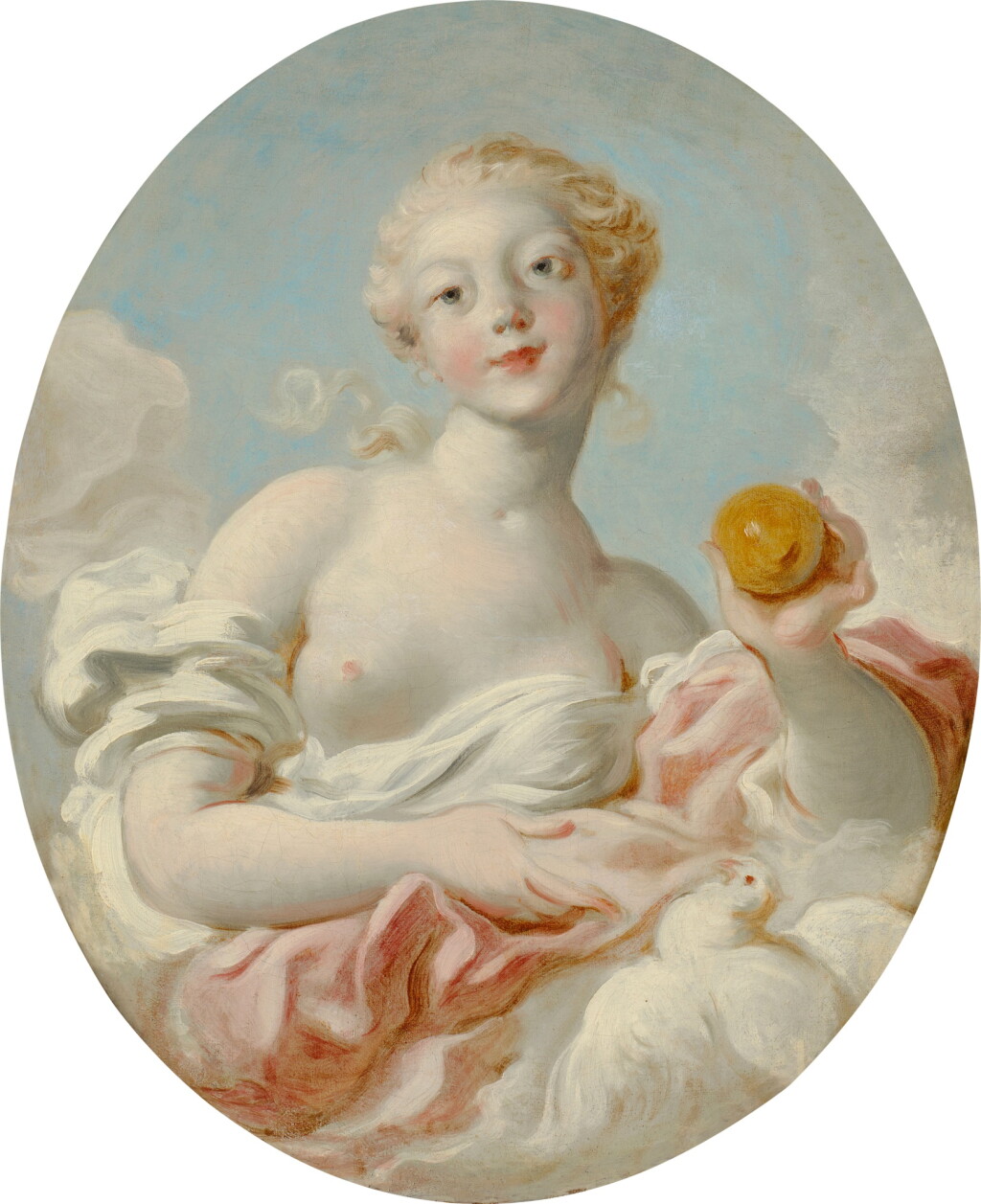
Portrait of a Lady, Said to be Marie-Catherine Colombe, as Venus
Auction Closed
June 2, 05:22 PM GMT
Estimate
300,000 - 500,000 USD
Lot Details
Description
Property from a Private Collection
Jean-Honoré Fragonard
Grasse 1732 - 1806 Paris
Portrait of a Lady, Said to be Marie-Catherine Colombe, as Venus
oil on canvas, an oval
canvas: 22 ⅜ by 18 ½ in.; 55.9 by 47.0 cm
framed: 31 ¼ by 28 in.; 79.4 by 71.1 cm
Anonymous sale, Paris, Hôtel Drouot Paris, 18 January 1877, lot 12;
Félix Doisteau (1846-1936), Paris;
With Wildenstein, New York;
From whom acquired by William Salomon (1852-1919), 1020 Fifth Avenue, New York, by 1914;
His estate sale, American Art Galleries, New York, 4-7 April 1923, lot 388 (erroneously described as "from the collection of the Château de Saint Brice");
Where acquired by Duveen Bros., New York, for $41,000 ;
William Randolph Hearst (1863-1951), Los Angeles;
By whom given to Marion Davies (1897-1961), Los Angeles;
By whom donated to the Los Angeles County Museum of Art (inv. no. 5510.56-9), 1956;
By whom deaccessioned and sold ("An Auction of Property Deaccessioned by the Los Angeles County Museum of Art to Benefit New Acquisitions"), Los Angeles, Sotheby's, 21-23 June 1982, lot 37;
Where acquired by a private collector;
By whom sold ("The Property of a Private Collection"), New York, Christie's, 12 January 1994, lot 113;
Anonymous sale, Paris, Tajan, 19 December 2007, lot 36;
His Highness Sheikh Hamad bin Abdullah Al Thani, Hôtel Lambert, Paris;
His sale ("Hôtel Lambert, Une Collection Princière, Volume I: Chefs-d’oeuvre"), Paris, Sotheby's, 11 October 2022, lot 36;
Where acquired by the present collector.
New York, E. Gimpel & Wildenstein, Exhibition of Paintings and Drawings by Fragonard, 1914, no. 9 (lent by William Salomon).
Exhibition of Paintings and Drawings by Fragonard, exhibition catalogue, New York 1914, pp. 27-28, cat. no. 9;
J. Stern, Mesdemoiselles Colombe de la Comédie-Italienne, Paris 1923, pp. 58 note 2, 284;
L. Réau, Fragonard, sa vie et son œuvre, Brussels 1956, p. 177, under "Les sœurs Colombe, 2";
R.F. Brown, "Fragonard's 'Mademoiselle Colombe as Venus'," in Los Angeles County Museum: Bulletin of the Art Division 9, no. 1 (1957), pp. 3-5, reproduced;
J. Cailleux, "Fragonard as Painter of the Colombe Sisters," in Burlington Magazine (advertisement supplement) 102, no. 690 (September 1960), pp. v, iii, reproduced fig. 7;
G. Wildenstein, The Paintings of Fragonard, London 1960, p. 290, cat. no. 416, reproduced fig. 175;
G. Mandel, L'opera completa di Fragonard, Milan 1972, p. 105, cat. no. 442, reproduced;
J.P. Cuzin, Jean-Honoré Fragonard: Vie et oeuvre, Catalogue complet des peintures, Fribourg 1987, p. 303, cat. no. 223, reproduced;
P. Rosenberg, Tout l'œuvre peint de Fragonard, Paris 1989, pp. 96-97, cat. no. 235, reproduced;
J.P. Cuzin, "Fragonard: quelques nouveautés et quelques questions," in Mélanges en hommage à Pierre Rosenberg, Paris 2001, p. 178.
Painted circa 1770, this enchanting allegorical portrait depicts a young woman in the guise of Venus, goddess of love and beauty. Traditionally identified as the actress and dancer Marie-Catherine Colombe, the sitter presents the golden apple awarded by Paris to the most beautiful of the goddesses, while a white dove at lower right serves as both a traditional attribute of Venus and a playful allusion to "colombe" (meaning "dove" in french). Executed in the fresh pastel palette characteristic of Fragonard’s work of the 1770s, the composition exemplifies the artist’s extraordinary technical confidence: animated impasto highlights enliven the creamy flesh tones and white draperies, while the luminous sky and fluid brushwork lend the painting an atmosphere of spontaneity and seduction.
Marie-Catherine Riggieri (1751-1830), known as Mademoiselle Colombe, was born in Venice in 1751 and brought to Paris as a child along with her younger sisters Marie-Thérèse and Marie-Madeleine. Later bestowed with the collective sobriquet “Colombe,” the sisters became celebrated actresses and demi-mondaines of the Comédie italienne, admired for their beauty, vivacity, and carefully cultivated charm. Marie-Catherine entered the corps de ballet of the Comédie Italienne in 1766 and quickly rose to prominence, attracting the admiration of Parisian society. Fragonard appears to have been especially captivated by the sisters, portraying them repeatedly throughout the 1770s in a celebrated series of allegorical portraits. According to Jacques Cailleux, the present painting was the first in a sequence of approximately fifteen such works, in which the sisters were shown with attributes including apples, flowers, doves, cupids, lyres, and cats.1
More than straightforward portraits, these paintings function as idealized evocations of feminine grace and sensuality, infused with what one scholar described as Fragonard’s “sense of pure pleasure.” Painted when both artist and sitter were at the threshold of their respective careers, the present work possesses a freshness and immediacy that distinguishes Fragonard’s finest portraits of the decade. The remarkably free handling of paint, particularly in the luminous flesh tones and swirling draperies, demonstrates the artist at the height of his powers.
The present painting also boasts a fascinating provenance. Once owned by the Parisian collector Félix Doisteau (1846-1936), it was later bought by William Salomon (1852-1919), the New York banker and philanthropist, before its subsequent acquisition by newspaper tycoon William Randolph Hearst (1863-1951). In a gesture that recalls Fragonard's evident admiration of Mademoiselle Colombe, Hearst gifted the painting to his longtime mistress, the actress and producer Marion Davies (1897-1961), a particularly fitting owner for a work linked to the theatrical world of the Comédie italienne. Davies ultimately donated the work to the Los Angeles County Museum of Art in 1956, from which it was deaccessioned in 1982.
1 See Jean-Pierre Cuzin, op. cit., cat. nos. 86, 218, 220-226, 228, 301, 302, and 359.