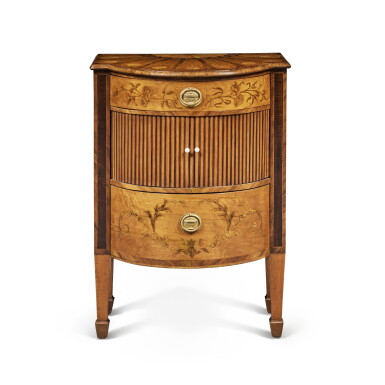
A George III Satinwood, Sycamore Rosewood Banded and Marquetry Bedside Cupboard, Circa 1775
No reserve
Auction Closed
January 31, 05:43 PM GMT
Estimate
8,000 - 12,000 USD
Lot Details
Description
A George III Satinwood, Sycamore Rosewood Banded and Marquetry Bedside Cupboard, Circa 1775
with label to underside X608
height 31 1/2 in.; width 22 1/2 in.; depth 17 1/2 in.
80 cm; 57 cm; 44.5 cm
William Hesketh Lever, 1st Viscount Leverhulme (1851-1925), Thornton Manor, Cheshire and the Hill, Hampstead, sold Knight, Frank & Rutley, London, 10-11 June 1926
Christie's London, 11 November 1999, lot 158
Lucy Wood, The Lady Lever Art Gallery Catalogue of Commodes, London 1994, pp. 328-29
The elegant design of this bedside cupboard or commode can be related to a design published by Thomas Sheraton in his Cabinet-Maker's and Upholsterer's Drawing Book, of 1793, pl. XLIII. Similarities to the work of John Linnell can also be drawn owing to a closely related piece attributed to this renowned maker in the Taffeta Bedroom of Osterley Park, Middlesex.
Formerly in the collection of 1st Viscount Leverhulme, this small commode would have formed part of the extensive collection of neo-classically inspired marquetry furniture that furnished Lord Lever's homes, much of which now resides in The Lady Lever Art Gallery and recorded by Lucy Wood in her extensive review of the collection, Catalogue of Commodes, London 1994. The English industrialist, peer and philanthropist William Hesketh Lever was born in Lancashire and with his younger brother James founded Lever Brothers Soap Manufacturers, which later became the multinational Unilever. He was an important collector of British Art and English furniture from the Adam period in particular, believing it to be of equal if not superior artistic merit to French work of the same era that was actively acquired by his contemporaries.
You May Also Like