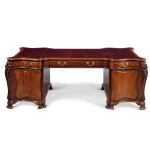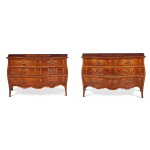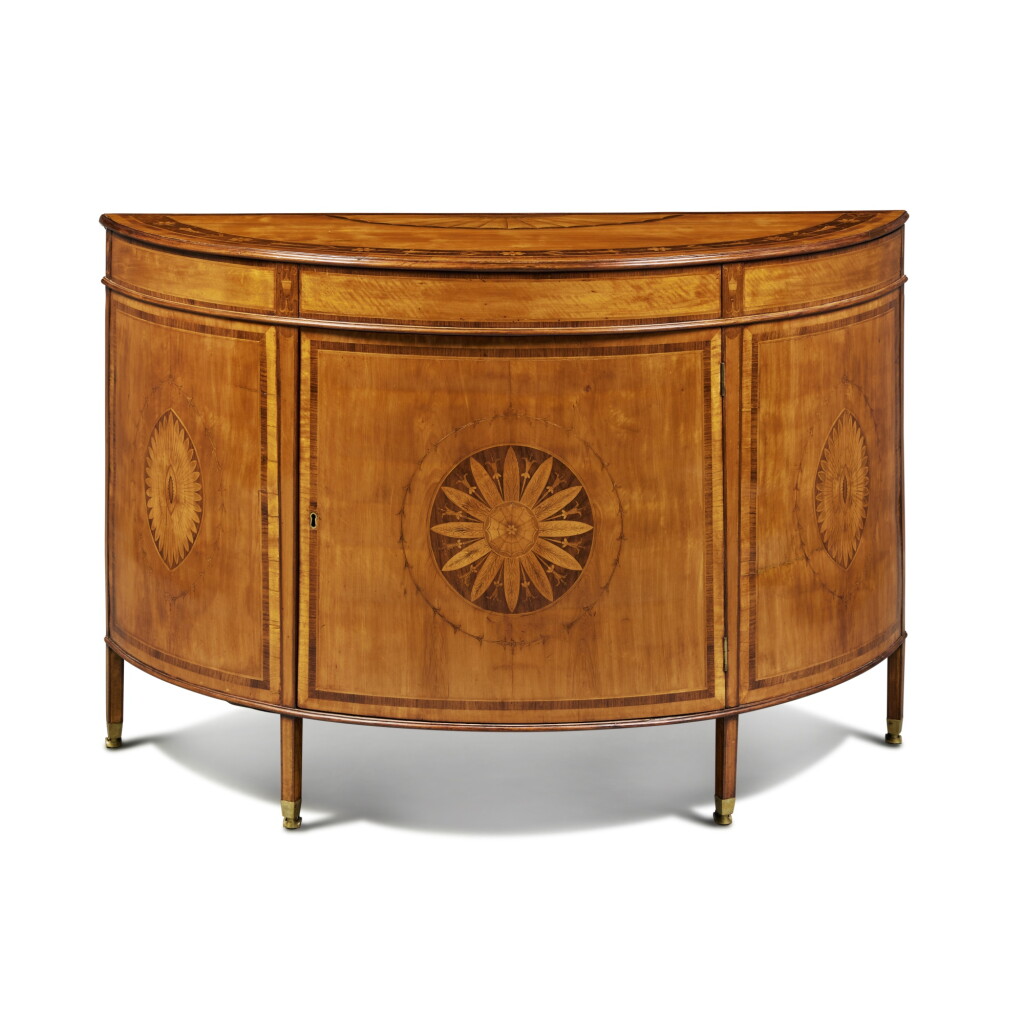
A George III Satinwood, Rosewood and Marquetry Commode, circa 1790, in the manner of Mayhew and Ince
No reserve
Auction Closed
January 31, 05:43 PM GMT
Estimate
10,000 - 15,000 USD
Lot Details
Description
A George III Satinwood, Rosewood and Marquetry Commode, circa 1790, in the manner of Mayhew and Ince
height 34 1/4 in.; width 54 in.; depth 21 1/4 in.
87 cm; 137 cm; 54 cm
The Estate of Diana Kendall, Christie's New York, 14-15 October 1994, lot 533
Christie's New York, 15 April 2005, lot 226
Property from a Californian Collection, Christie's New York, 23 November 2010, lot 338
The form of this commode is based on a design found in Robert and James Adam's Works in Architecture, 1777, pl. VIII from vol. II, for a commode for the Countess of Derby's Dressing Room; the form was later illustrated in A. Hepplewhite & Co's Cabinet-Maker and Upholsterer's Guide, 1788, pl. 78, where its use is described as 'adapted for a drawing-room: within are shelves which answer the use of a closet or cupboard. It may have one principal door in the front, or one at each end...and being used in principal rooms, require considerable elegance, the panels may be of satin wood, plain, or inlaid; the top and also the border round the front, should be inlaid.'
The use of fine satinwood, together with laurel leaf marquetry wreaths, husk pendants suspended from flowerheads and ebonized borders are decorative motifs found in the work of the London firm of John Mayhew and William Ince, whose partnership is described in Gilbert and Beard, The Dictionary of English Furniture Makers 1660-1840, 1986, pp. 589-598, as 'one of the most significant, probably the longest lived but, as far as identified furniture is concerned, the least well documented of any of the major London cabinetmakers of the 18th century'. The firm is recorded as working with the architect Robert Adam on several notable commissions, including Coventry House, Piccadilly and, Croome Court for the 6th Earl of Coventry, Shelburne House, Audley End, Derby House and Sherborne Castle. Adam's influence is seen in 'their ability to produce very early on furniture in the most startling advanced Neo-classical taste is beyond doubt...and certainly owed much to their early collaboration with the country's leading Neo-classical architects'. (Beard and Gilbert, op. cit.). A related George III inlaid satinwood commode in the manner of Mayhew and Ince, fitted with four drawers, the stiles similarly inlaid with laurel leaf pendants, with flanking cupboard doors and ribbon-tied foliate sprays and oval panels, was sold Christie's, London, May 28, 1964, lot 116.
George D. Widener, Jr. (1889-1971) was the grandson of P.A.B. Widener (1834-1915), the Philadelphia businessman ranked among the forty wealthiest Americans in history, whose peerless collection of Old Master Paintings, donated by his son Joseph in 1942, formed part of the nucleus of the National Gallery of Art in Washington, DC. George was the son of Eleanor Elkins, later Mrs Alexander Hamilton Rice, and George Widener, Sr. who perished on the Titanic.
You May Also Like