Property from an Important Connecticut Collection
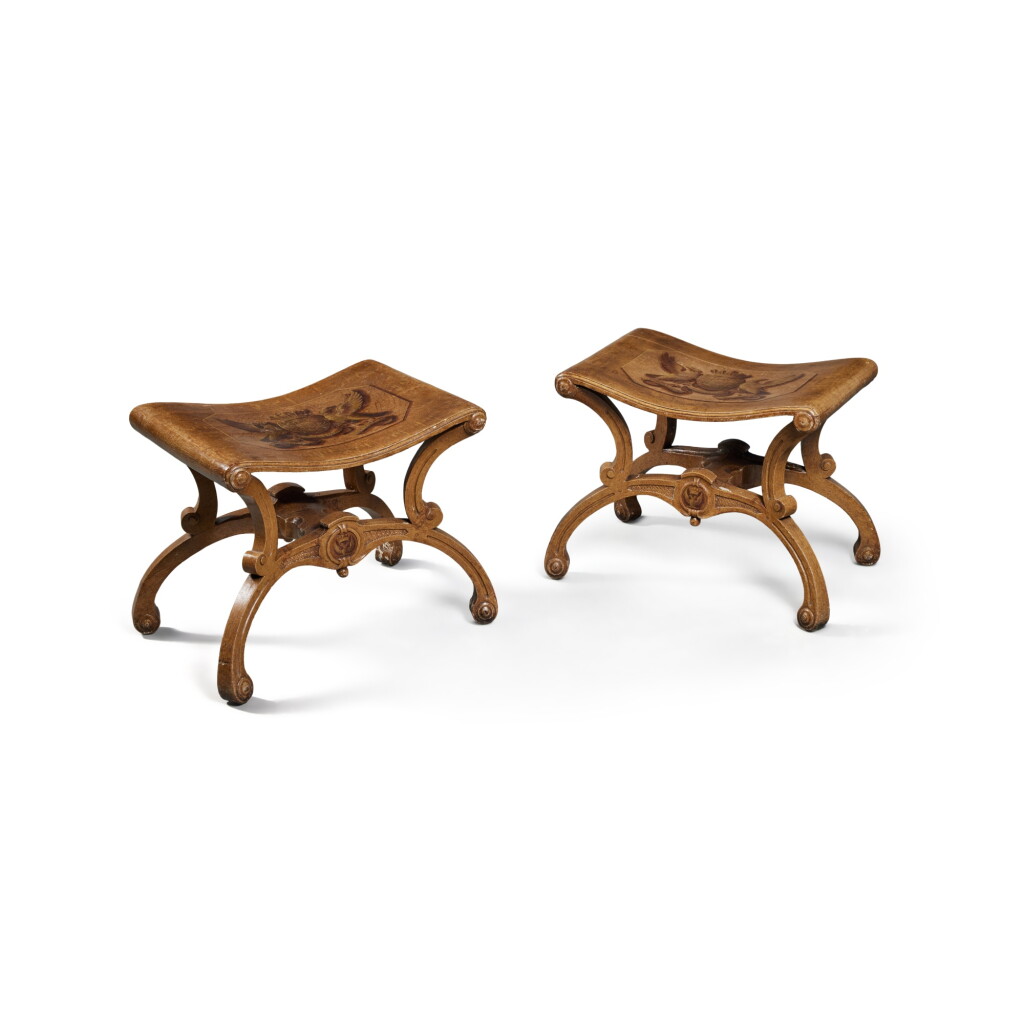
A Pair of George III Grained and Grisaille-Painted Curule-Form Stools, Circa 1765
Lot Closed
October 28, 02:04 PM GMT
Estimate
20,000 - 30,000 USD
We may charge or debit your saved payment method subject to the terms set out in our Conditions of Business for Buyers.
Read more.Lot Details
Description
Each scroll plank seat centered by a coat of arms and motto PATRIA CARA CARIOR LIBERTAS on inscrolled supports, the downscrolled legs centered by a cartouche bearing the crest of Bouverie family used by the earls of Radnor.
height 18 1/2 in. width 22 1/2 in; depth 17 in.
46.9 cm; 57.1 cm; 43.1 cm
Coleshill House, Berkshire, almost certainly commissioned by William Bouverie, (1724-1776), Viscount Folkestone and Baron Longford, of Longford Castle, Wiltshire, created Baron Pleydell-Bouverie of Coleshill in 1765, and Earl of Radnor 1767.
Thence by descent to the late Miss M. de Pleydell-Bouverie, sold Christie’s, London, 25 November 1965, lot 35
Mallett & Son (Antiques) Ltd., London, from whom purchased in 1988
The Bill Blass Collection, Sotheby's New York, 21 October 2003, lot 238
H. Avray Tipping, English Homes, Period IV, Vol. I, London, 1920, ‘Coleshill House’, pp. 1-22, fig. 10, Side of the Hall, and figs. 17 and 18, the Dining Room, the stools shown in situ.
P. Macquoid and R. Edwards, The Dictionary of English Furniture, revised edition, 1954, p. 182, fig. 67, one of the stools, described as ‘mahogany’.
O. Hill and J. Cornforth, English Country Houses - Caroline 1625-1685, 1966, pp. 90-96.
The present stools were almost certainly conceived as part of a larger suite of seat furniture, probably intended for either the entrance hall at Coleshill House, Berkshire, or the family's principal seat at Longford Castle, Wiltshire. Japanned in imitation of oak, the stools retain their original painted seats depicting the Bouverie coat-of-arms beneath an earl's coronet and are documented in situ at Coleshill in H. Avray Tipping's English Homes, published in 1920, where examples are shown in both the Hall and Dining Room.
Their design reflects fashionable English seat furniture of the 1760s and may be compared with a pattern published by Robert Manwaring in The Cabinet and Chair-Maker's Real Friend and Companion, plate 18, "Lady's Dressing Stools." A further comparison can be made with the group of approximately twenty-six mahogany stools supplied by Thomas Chippendale for the library at Christ Church, Oxford, in 1764. Although there is no documentary evidence linking Chippendale directly with the Earl of Radnor, his influence at Longford is suggested by the upper section of a bookcase there, which derives from plate CXIII of the Director.
Four related mahogany stools with Longford Castle provenance are recorded, each carved with the double eagle-headed crest of the Bouverie family. Closely corresponding to the present examples in profile, they feature curved legs enriched with ribbed carving and a crest-centered cartouche framed by foliate ornament (see Sotheby's New York, 23 January 1988, lots 70 and 71). The stools were accompanied by a typed label signed by David Bouverie and dated July 1967, recounting the family tradition that "...the stools were already at Longford Castle when Thomas Chippendale came to design Porter's Hall furniture. He admired them and copied them extensively and they were later sent to Coleshill." While no surviving documentary evidence confirms a commission from Chippendale to the 3rd Earl of Radnor, the Coleshill stools have long been associated with the cabinetmaker on stylistic grounds.
Coleshill House was built between 1649 and 1662 to designs by sir Roger Pratt for his cousin, Sir George Pratt. From 1728 until 1768, the house belonged to Sir Mark Pleydell, and upon his death was bequeath to his grandson William Bouverie, who subsequently assumed the name Pleydell-Bouverie. Coleshill thereafter formed part to the Pleydell-Bouverie family estates, and the stools were presumably introduced as part of its furnishings during this period. Coleshill was destroyed by a fire in 1953.
You May Also Like


