Hans Hartung
P1967-35
Lot Closed
March 30, 11:20 AM GMT
Estimate
20,000 - 30,000 EUR
Lot Details
Description
Hans Hartung
1904 - 1989
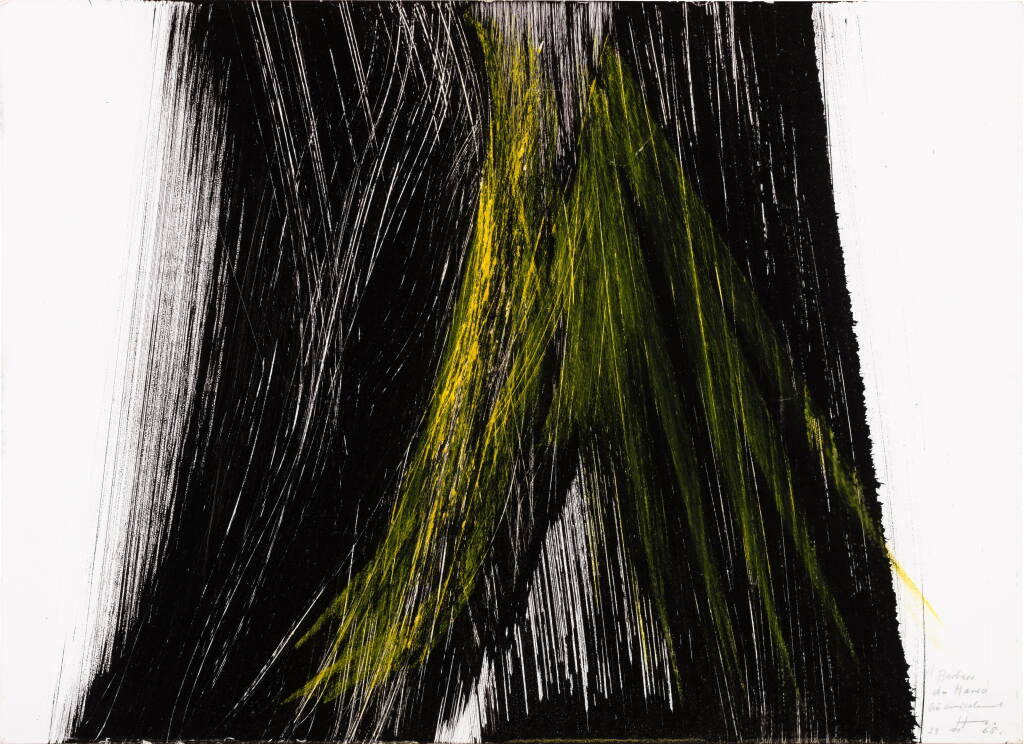
P1967-35
signed, dedicated and dated 23/11/68 ; titled and dated on the reverse
acrylic and pastel on baryta cardboard
36,4 x 49,9 cm ; 14 5/16 x 19 5/8 in.
Executed in 1967.
This work is registered in the archives of the Fondation Hartung Bergman under the number P1967-35, and will be included in the forthcoming catalogue raisonné of Hans Hartung currently being prepared by Fondation Hartung Bergman, Antibes.
________________________________________________________
Hans Hartung
1904 - 1989
P1967-35
signé, dédicacé avec date 23/11/68 ; titré et daté au dos
acrylique et pastel sur carton baryté
36,4 x 49,9 cm ; 14 5/16 x 19 5/8 in.
Exécuté en 1967.
Cette œuvre est répertoriée dans les archives de la Fondation Hartung Bergman sous le numéro P1967-35 et figurera au catalogue raisonné de l'œuvre de Hans Hartung entrepris par la Fondation Hartung Bergman, Antibes.
Private Collection, Switzerland (gifted by the artist)
Thence by descent to the current owner
___________________________________________________________________
Collection Particulière, Suisse (offert par l'artiste);
Puis par descendance au propriétaire actuel
P1967-121 and P1967-35, produced by Hans Hartung in 1967, mark a turning point in the artist’s career. In 1960, on the occasion of the Venice Biennale, Hartung was awarded the grand international prize for painting, which became a driving force behind his success and prompted him to develop a new practice. It was then that the artist invented the technique of “scraping”, which involves manually removing a freshly applied pictorial layer in order to create a dynamic composition. This approach, which relies greatly on gesture, places the artist at the heart of the Art Informel movement, which advocates for creative freedom.
With a gesture that is both controlled and unpredictable, Hartung is not afraid to scratch the surface of his work, giving way to extensive lines that invade the composition. These sharp motifs are the result of a violent and destructive gesture that expresses itself through the tearing of pictorial layers. The support becomes a receptacle of emotions, allowing the artist to communicate his feelings. The dancing lines scattered on both works, are encompassed by a burst of colors. P1967-121 displays a flamboyant yellow stain, which, superimposed on the black background, highlights the intensity of the lines. By combining gesture and color, the artist manages to reach another level of expressiveness, placing him at the forefront of lyrical abstraction. He declares, “the line itself – in itself, and not what it represents or shows- becomes an expression and a sign charged with emotion” (Interview between Hans Hartug and Tadao Takemoto, Augus 14, 1968, Chisaburoh F. Yamada (ed.), Dialogue in art: Japan and the west, London, 1976, p. 194-195).
The materials and supports used by the artist are also an integral part of his conceptual approach. Both works are made on baryta paper. The extreme brightness of this support, combined with oil pastel, renders the scraping marks more visible. In addition, the use of ink, a material that glides easily on paper, contributes to the artist’s automatic and spontaneous gesture.
These two works originate from the collection of the architect who conceived the building of the Hartung Bergman Foundation. In order to convey their artistic vision to future generations, Hans Hartung and his wife Anna Eva Bergman built a villa in Antibes, in which their works would later be preserved and exhibited. The bright lines and inclined walls are reminiscent of the purity of modernism and draw from the simplicity of vernacular architecture. This elementary style devoid of any ornament, is in line with the principles advocated by the artist through his works. To achieve a true expression of the gestural, Hartung detached himself from any superficial elements, giving way to refined and poignant works.
_________________________________________________________
P1967-121 et P1967-35 réalisées en 1967 par Hans Hartung, attestent d’un tournant dans la carrière de l’artiste. En 1960, lors de la Biennale de Venise, Hartung est consacré par le grand prix international de la peinture. Moteur de son succès, cette prestigieuse récompense le conduit à faire évoluer sa pratique. C’est alors qu’il développe la technique du ‘grattage’. Cette dernière repose sur le décapage manuel d’une couche picturale fraichement appliquée, en vue de créer une composition dynamique. Cette approche fondée sur le principe de la gestuelle inscrit l’artiste au cœur du mouvement Art Informel, qui prône par-dessus toute la liberté créative.
D’un geste à la fois contrôlé et imprévisible, Hartung n’hésite pas à égratigner la surface de son œuvre donnant lieu à de longs tracés qui envahissent la composition. Ces motifs tranchants sont le fruit d’un geste violent et destructeur qui s’exprime par la lacération des couches picturales. Le support se mue en un réceptacle d’émotions permettant à l’artiste de communiquer ce qui l’émeut et l’exalte. Les lignes dansantes parcourent les deux œuvres dans lesquelles font irruption des couleurs intenses. P1967-121 est traversée par un jaune flamboyant, qui, superposé au fond noir met en exergue l’intensité des traits. C’est ainsi qu’en alliant gestes et couleurs, l’artiste parvient à atteindre un autre niveau d’expressivité faisant de lui le chef de fil de l’abstraction lyrique. Celui-ci déclare : « le trait lui-même – en lui-même, et non ce qu’il représente ou ce qu’il montre- devient une expression et un signe plastique chargé d’émotion » (Entrevue entre Hans Hartung et Tadao Takemoto, 14 aouts 1968, Chisaburoh F. Yamada (ed.), Dialogue in art : Japan and the west, Londres, 1976, p. 194-195)
Les matériaux et supports mobilisés par l’artiste font également partie intégrante de sa démarche conceptuelle. Les œuvres sont toutes deux réalisées sur papier baryté. La blancheur et l’extrême brillance de ce support mêlées au pastel gras, font d’autant plus ressortir les marques de grattage. De plus l’usage de l’encre de chine, un matériau qui glisse facilement sur le papier, contribue au geste automatique et spontanée de l’artiste.
Ces deux œuvres sont également issues de la collection de l’architecte ayant conçu le bâtiment de la fondation Hartung Bergman. En vue de transmettre leur vision artistique aux futures générations, Hans Hartung et son épouse Anna Eva Bergman font construire une villa sur les hauteurs d’Antibes dans laquelle seront plus tard conservées et exposées leurs œuvres. Les lignes blanches et les murs inclinés sont inspirés de la pureté du modernisme ainsi que de la simplicité de l’architecture vernaculaire. Ce style élémentaire dénué de toute fantaisie, renvoie aux principes promulgués par l’artiste au travers ses œuvres. Pour parvenir à une véritable expression du geste, ce dernier se détache de tout éléments superficiels créant des œuvre à la fois épurées et poignantes.
You May Also Like