Alighiero Boetti
Aerei
Lot Closed
March 30, 11:09 AM GMT
Estimate
100,000 - 150,000 EUR
Lot Details
Description
Alighiero Boetti
1940-1994
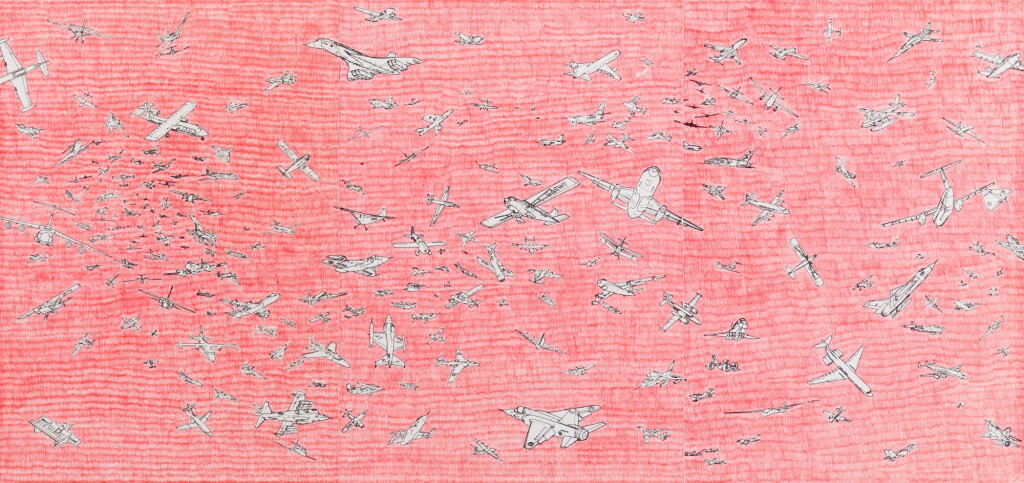
Aerei
signed and titled on the reverse
ball point pen on three sheets laid down on card
22,5 x 48 cm ; 8 7/8 x 18 7/8 in.
Executed in 1977.
This work is registered in the Archivio Alighiero Boetti, Rome under no. 3824. A certificate of authenticity issued by Archvio Alighiero Boetti could be delivered to the buyer.
_______________________________________________________
Alighiero Boetti
1940-1994
Aerei
signé et titré au dos
crayon à bille sur trois feuilles marouflées sur un cartonnage
22,5 x 48 cm ; 8 7/8 x 18 7/8 in.
Exécuté en 1977.
Cette oeuvre est enregistrée dans l'Archivio Alighiero Boetti, Rome, sous le no. 3824. Un certificat d'authenticité de l'Archivio Alighiero Boetti pourra être remis à l’acquéreur.
Centro di Cultura Ausoni, Rome
Arnaldo Romani Brizzi, Rome
Private Collection (acquired from the above)
Christie’s, Paris, Art Contemporain, 3 December 2014, lot 126
Private Collection, France (acquired from the above)
___________________________________________________________
Centro di Cultura Ausoni, Rome
Arnaldo Romani Brizzi, Rome
Collection Particulière (acquis auprès du précédent)
Christie’s, Paris, Art Contemporain, 3 décembre 2014, lot 126
Collection Particulière, France (acquis auprès du précédent)
Jean-Christophe Ammann, Alighiero Boetti. Catalogo generale, Tomo II, Milan 2012, p. 260, no. 883
___________________________________________________________________________________________
Jean-Christophe Ammann, Alighiero Boetti. Catalogo generale, Tomo II, Milan 2012, p. 260, no. 883
"... I would like to have an assistant draw a thousand planes on a sheet with a background bluer than the sky of the nativity scene. They would be precisely executed, drawn from all perspectives and angles, evoking desire. It must be an explosion!" (In quell’artista c’è uno sciamano, Alighiero Boetti interviewed by Maurizio Fagiolo dell’Arco, 1977).
The Aerei series was born in 1977 when Boetti met the architect Guido Fuga, a skilled cartoonist and illustrator, on a trip to Venice. The first Aerei triptych debuted alongside other works on paper in an exhibition at the Galleria Il Collezionista in Rome during November of the same year. The works were executed with blue, black, green and red backgrounds. Over the years, the artist experimented with different mediums from washes of watercolour, swirls of ink and strokes of ballpoint pen.
The airplanes are temporary and transient objects that threaten to causally disappear off the sides of the canvas at any moment. We imagine the innate potential of these airplanes beyond the frame, to lose themselves in infinite possible journeys. The artist thus explores the provisional and transitory nature of life, not least his own. This transcending of divisions in geography, ideology and culture is all the more pertinent 40 years on.
The Aerei series, in its repetitiveness, embodies all the beauty of the compositional variety and the limitless serial possibilities that were crucial to Boetti's artistic research. In line with rest of Boetti’s oeuvre of the artist, the Aerei have a permutative structure, disoriented and chaotic, yet at the same time classifying and reasoned.
The artist explores the concept of ‘order’ versus ‘disorder’, a theme developed by the artist in many works of the same period which bear that very title. There is an irony in the perfection and order of the plot of the sky which contrasts with the disorder of the arrangement of the planes. This number of planes would never be permitted to remain in the same stretch of airspace. While the stark white of the airplanes in relief lends sense of emptiness and suspension of time and space.
Boetti’s art is predominantly conceptual, but at the same time aesthetically pleasing even in its only visual component. His images are ‘elementary’ in appearance and ‘complex’ in meaning, but never ‘simple’ or ‘complicated’ (a subtle lexical difference which Carlos Martí Arís explores in his text Silenzi Eloquenti).
Within the work, we can identify an encyclopedic variety of civil and military planes, both modern and vintage, with differing sizes and markings. An observation of the work at a distance nullifies the distinctions between the planes. Nevertheless, each individual model was executed by assistants, young artists and amateurs, tracing from newspapers and magazines to render even the smallest details with distinct accuracy. The act of delegating the work's execution and reproducing drawings of previously published illustrations of planes creates a dislocation between the artist and the direct authorship of the work. This concept of shared creativity would return in many of Boetti’s works of the following period.
In their dense patterning, Boetti’s biro works recall the warp and weave of the Afghan tapestries. Boetti led a nomadic lifestyle, and this flexible concept of travel is perfectly reflected in the perpetual state of mobility of his aircrafts. He himself expressed his desire to travel in the following words: "Perhaps it comes from the schizophrenic idea that nobody can stay in the same place forever." (in P. Morsani, When 2 is 1: the Art of Alighiero and Boetti, Houston 2002, p. 93)
________________________________________________________
" ... Je voudrais qu'un assistant dessine mille avions sur une feuille dont le fond serait plus bleu que le ciel de la crèche. Ils seraient exécutés avec précision, dessinés sous toutes les perspectives et tous les angles, évoquant le désir. Ce doit être une explosion !" (In quell'artista c'è uno sciamano, Alighiero Boetti interviewé par Maurizio Fagiolo dell'Arco, 1977).
La série des Aerei est executée en 1977, lorsque Boetti rencontre, lors d'un voyage à Venise, l'architecte Guido Fuga, dessinateur et illustrateur chevronné. Le premier triptyque Aerei est présenté avec d'autres œuvres sur papier lors d'une exposition à la Galleria Il Collezionista de Rome en novembre de la même année. Les œuvres sont exécutées sur des fonds bleus, noirs, verts et rouges. Au fil des années, l'artiste expérimente avec divers médiums, dont des lavis d'aquarelle aux tourbillons d'encre en passant par les traits de stylo à bille.
Les avions sont des objets temporaires et transitoires qui menacent à tout moment de disparaître des extrémités de la toile. Il est possible d’imaginer le potentiel inné de ces avions qui s’affranchiront éventuellement de leur cadre, pour se perdre dans des voyages infinis. L'artiste se penche alors sur le caractère provisoire et transitoire de la vie, et notamment de la sienne. Ce dépassement des limites géographiques, idéologiques et culturelles est d'autant plus pertinent 40 ans plus tard.
L'artiste explore le concept d'"ordre" par rapport à celui de "désordre", un thème développé par l'artiste dans de nombreuses œuvres de la même période qui portent le même titre. Le contraste entre la perfection et la netteté du ciel, et le désordre produit par la disposition des avions, est vecteur d’une certaine ironie. Les avions, de par leur quantité imposante, semblent saturer l’espace qu’ils occupent. Leur blancheur austère donne lieu à une sensation de vide et de suspension du temps et de l’espace.
L'art de Boetti est essentiellement conceptuel, tout en procurant un certain plaisir esthétique par le biais de ses composantes visuelles. Ses images "élémentaires" en apparence mais "complexes" dans leur signification, ne peuvent être qualifiées de "simples" ou "compliquées" (une différence lexicale subtile que Carlos Martí Arís explore dans son texte Silenzi Eloquenti). Dans ces œuvres, nous pouvons déceler une variété encyclopédique d'avions civils et militaires, modernes et anciens, de tailles et de marquages divers.
You May Also Like