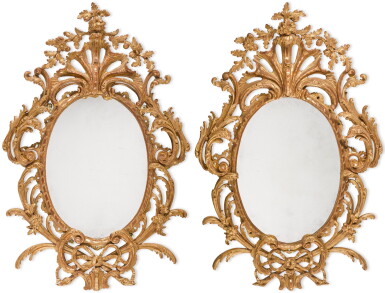
A pair of George III carved giltwood oval mirrors, circa 1765
Auction Closed
December 6, 03:29 PM GMT
Estimate
25,000 - 40,000 GBP
Lot Details
Description
A pair of George III carved giltwood oval mirrors, circa 1765
with boldly-scrolled pierced foliate crestings and oval plates within further deeply-scrolled and pierced rocaille foliate surrounds, with ribbon-centred C-scroll aprons, re-gilt
128cm. high, 83cm. wide; 4ft. 2 3/8in., 2ft. 8 5/8in.
These mirrors are illustrated and discussed by Graham Child in his seminal study World Mirrors with reference to of their ‘crossed-bough’ decoration, which was popular on the aprons of oval-shaped early George III mirrors like the present lot but was also frequently featured in the cresting of more rectilinear George II mirrors in the Kentian style. Palm fronds have a multitude of symbolic associations, but in Christian culture are usually linked to Jesus' entry into Jerusalem on 'Palm Sunday' as narrated in the Gospels, named afthe branches waved by the crowd who welcomed him. Palm fronds feature so frequently in John Linnell’s work that the cover of the monograph on Linnell by Helena Hayward and Pat Kirkham is decorated solely with two palm fronds, but notable examples are also associated with other great cabinet-makers like Thomas Chippendale: a Chippendale mirror with crossed palms to the base that extend around the whole frame sold at Christie’s London, 9 July 1992, lot 50.
However, this is just one of several carved motifs that are interwoven on the present mirror, which is impressive in the relatively large radius of its deeply-carved frame. The usual band connecting the palm fronds is enlarged into a more elaborate ribbon with a bow, a common motif in Louis XVI and English Neoclassical furniture: the combination of ribbon and palm fronds can be observed on a drawing for a sconce by John Linnell in the V&A, acc. no. E.161-1929, and in numerous examples such as the apron of the mirror at Hinton Ampner, Hampshire, NT 1529698. The surrounding frame displays the softly curvaceous side of Rococo design, eschewing the icicles and architectural fragments that often make an appearance in favour of foliate tendrils and trailing tendrils of flowers.
You May Also Like