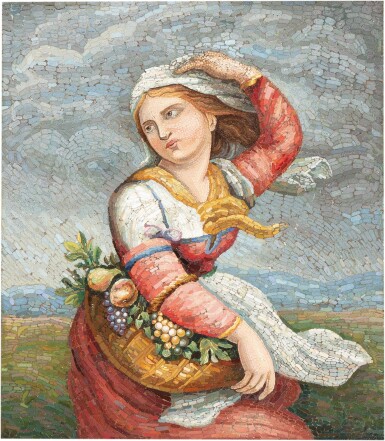
A micromosaic plaque, Roman work by Federico Campanili, Vatican Workshop, late 19th century | Plaque en micromosaïque, travail Romain par Federico Campanili, atelier du Vatican, fin du XIXe siècle
Lot Closed
July 7, 02:43 PM GMT
Estimate
4,000 - 6,000 EUR
Lot Details
Description
A micromosaic plaque, Roman work by Federico Campanili, Vatican Workshop, late 19th century
in a giltwood and carved frame
Height 8⅓in, width 7 in,
__________________________________________________________________________
Plaque en micromosaïque, travail Romain par Federico Campanili, atelier du Vatican, fin du XIXe siècle
dans un cadre en bois doré
Haut. 21 cm, larg. 18 cm
In the early years of the the 19th century in Rome there are recorded twenty private workshops around the Spanish steps. During the occupation, Napoleon promoted the art of mosaics by converting the Vatican Workshop into the Studio Imperiale del Mosaico.
Federico Campanili:
Federico Campanili was active in the second half of the 19th century. He is recorded as being active from 1861 to 1880 in the Vatican Workshop in Rome. Furthermore, he is recorded as mosacista in stile minuto. Circa 1861-1862, he made the mosaic la ghirlanda di fiori nel dejeuner con la Veduta del Tempio di Vesta, from the design by Antonio Roccheggiani . In 1863 –1864 he made a picture representing un vaso di fiori after a painting by Andrea Cherubini. In 1880, he was nominated mosaicista soprannumero.
L'Atelier du Vatican :
Au début du XIXe siècle, on recense à Rome une vingtaine d'ateliers privés autour de la place d'Espagne. Pendant l'occupation, Napoléon encourage l'art de la mosaïque en transformant l'atelier du Vatican en Studio Imperiale del Mosaico.
Federico Campanili :
Federico Campanili est actif dans la seconde moitié du XIXe siècle, enregistré de 1861 à 1880 au sein de l'atelier du Vatican à Rome. De plus, il est identifié comme mosaïste au stile minuto. Vers 1861-1862, il réalise la mosaïque La ghirlanda di fiori nel dejeuner con la Veduta del Tempio di Vesta, d'après le projet d'Antonio Roccheggiani. En 1863-1864, il réalise un tableau représentant un vaso di fiori d'après une peinture d'Andrea Cherubini. En 1880, il est nommé mosaicista soprannumero.
You May Also Like